
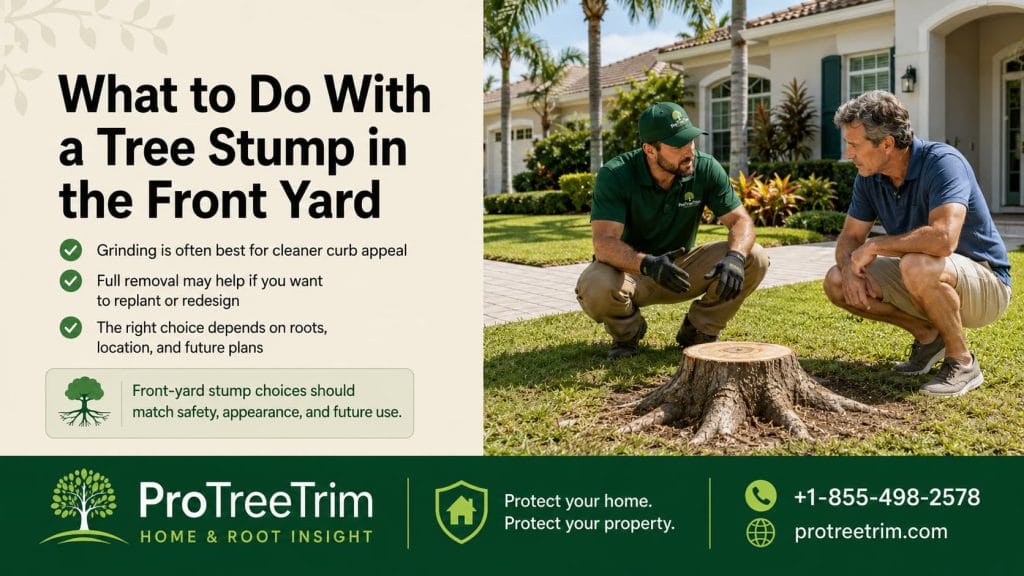
A tree stump in the front yard is more than a leftover piece of wood. It can affect curb appeal, mowing, lawn repair, home sale photos, sidewalk safety, driveway access, and future landscaping. It may also send up sprouts, attract insects or fungi, or create a soft low spot as underground roots decay.
The best option depends on what you want the front yard to become: clean lawn, mulch bed, new tree, driveway repair area, walkway access, or a low-maintenance landscape feature.
First, Decide Whether the Stump Is a Problem
Not every stump needs urgent removal. A stump in a back natural area may be harmless. A stump in the front yard is different because it is visible, used, and often close to driveways, sidewalks, mailboxes, entry walks, or landscaping.
Ask:
- Is the stump visible from the street?
- Does it make the yard look unfinished?
- Is it hard to mow around?
- Is it a trip hazard?
- Is it sending up sprouts?
- Is it near the driveway or sidewalk?
- Will you sell the home soon?
- Do you want to plant or sod the area?
- Is the stump attracting insects or mushrooms?
If the answer to several of these is yes, the stump is not just cosmetic. It is a yard-use decision.
Option 1: Grind the Stump
Stump grinding is often the most practical choice for a front-yard stump. It removes the visible stump below grade without digging out the entire root system. The area can then be cleaned, leveled, mulched, seeded, or prepared for sod.
Stump grinding is usually useful when:
- the stump hurts curb appeal
- mowing around it is annoying
- the stump is a trip hazard
- you want a smoother lawn
- the stump is close to a walkway
- sprouts keep returning
- the yard needs a finished look
- the tree was recently removed
- you plan to sell or photograph the home
Grinding usually creates less disruption than full stump removal.
Option 2: Remove the Whole Stump
Full stump removal means digging out the stump and more of the root mass. This is more disruptive than grinding, but it may be useful when the area needs deeper work.
Full removal may make sense when:
| Future plan | Why full removal may help |
|---|---|
| New driveway or walkway | Roots and stump may interfere with base prep |
| Fence post installation | Root mass may block post holes |
| Major grading | Stump may prevent clean soil work |
| Construction | Excavation needs a clear area |
| Utility or irrigation work | Root mass may block trenching |
| Replanting in the exact spot | Old stump material may interfere |
| Severe sprouting | More complete removal may reduce regrowth |
For everyday curb appeal, grinding is often enough. For construction or deep excavation, full removal may be worth discussing.
Option 3: Turn It Into a Landscape Feature
Some homeowners choose to keep a stump and use it as a rustic feature, planter base, birdbath stand, or garden accent. This may work in a backyard or natural landscape, but it is harder to make look intentional in a front yard.
Keeping the stump may be acceptable when:
- it is not a trip hazard
- it is not near a walkway
- it does not block mowing
- it is structurally sound
- it fits the landscape style
- it is not attracting pests
- it does not send up sprouts
- HOA or neighborhood expectations allow it
In many front yards, a stump feature looks less polished than a clean lawn or mulched bed.
Option 4: Leave It to Decay Naturally
Leaving a stump to rot naturally is the slowest option. It may be fine in a low-use area, but it is often not ideal in a front yard. Decay can take time, and the stump may look worse before it disappears.
Natural decay may involve:
- softening wood
- mushrooms or fungal growth
- insects using the stump
- sprouts from stump or roots
- uneven ground as roots break down
- difficulty mowing
- a visible unfinished look
If curb appeal matters, natural decay is usually not the best front-yard plan.
Front-Yard Stumps Affect Curb Appeal
A front-yard stump often makes a property look unfinished, even if the rest of the landscaping is clean. It can draw attention in listing photos, drive-by views, and neighborhood presentation.
This matters before:
- selling the home
- exterior photography
- driveway or walkway repair
- lawn renovation
- new mulch installation
- insurance or property documentation
- HOA review
- seasonal cleanup
A ground-down stump and leveled area usually looks more intentional than a cut stump left in place.
Stumps Make Mowing Harder
A stump in the lawn creates a mowing obstacle. It can also damage mower blades, force awkward trimming, and leave tall grass around the base.
Common mowing problems include:
- mower deck hitting the stump
- string-trimmer damage around roots
- grass growing unevenly around the stump
- exposed roots blocking a clean pass
- sprouts returning after mowing
- debris collecting around the base
If the stump is in a main lawn area, grinding it often makes maintenance easier.
Stumps Can Become Trip Hazards
A front-yard stump near a walkway, driveway, sidewalk, mailbox, or front entry can become a trip hazard. This is especially true when the stump is low enough to miss visually but high enough to catch a foot.
Pay attention when the stump is near:
- front walkways
- public sidewalks
- driveway edges
- garage approaches
- mailbox paths
- garden paths
- rental property access
- outdoor lighting areas
A stump in a high-use path should usually be removed or ground down.
Stump Sprouts Can Keep Coming Back
Some stumps and roots can send up new shoots after the tree is cut down. These sprouts may appear around the stump, along old roots, or in the lawn nearby.
Sprouts are more likely when:
- the stump remains alive
- roots still have stored energy
- the tree species suckers easily
- the stump was cut but not ground
- root sprouts were already present
- mowing keeps cutting shoots without addressing the source
Stump grinding can reduce the main sprouting point, but some root sprouts may still need follow-up.
Mushrooms Around a Stump Are Common
Mushrooms may appear as wood and roots decay. This does not always mean there is an emergency. Decaying wood naturally supports fungal activity. But in a front yard, mushrooms can look messy and may concern homeowners.
Mushrooms are more important when:
- they appear around a nearby living tree
- the stump is close to another tree’s roots
- the ground stays wet
- children or pets use the area
- the stump is soft and collapsing
- the area is near a walkway or driveway
If the stump is leftover from a removed tree, mushrooms are often part of decay. If mushrooms are at the base of a living tree, that deserves more attention.
Insects May Use Old Stumps
Old stumps can attract insects that use decaying wood. Not every insect around a stump is a problem, but a stump near the house, porch, or walkway may create concern.
A front-yard stump deserves attention if:
- it is close to the house
- it is soft or hollow
- ants or termites are active in the wood
- wood is crumbling
- the stump is near a porch or entry
- mulch and moisture collect around it
- the area stays damp
Removing or grinding the stump can reduce the decaying wood source.
Grinding Leaves Roots Underground
Stump grinding removes the visible stump below grade, but roots remain underground. Those roots usually decay over time. This is normal and does not mean the grinding was incomplete.
After grinding, homeowners may notice:
- soil settling
- soft spots
- mushrooms
- old roots during digging
- occasional sprouts from some species
- uneven grass growth
- depression where the stump was
The area may need additional soil and leveling later as underground wood breaks down.
Should You Remove the Wood Chips?
Stump grinding produces wood chips mixed with soil. In a front yard, cleanup matters because the finished look is important.
Remove excess grindings if you plan to:
- plant grass
- install sod
- create a level lawn
- replant nearby
- repair a walkway
- create a clean mulch bed
- avoid future settling
Some chips can be useful in a landscape bed, but too many mixed into the soil can make lawn restoration uneven.
Can You Plant Grass Over a Ground Stump?
Yes, but the area needs preparation. Grass does not always grow well directly over a pile of fresh grindings. The spot may settle as wood breaks down.
A better lawn repair process:
- Grind the stump to the needed depth.
- Remove excess wood chips.
- Add clean soil.
- Level the area.
- Allow for settling if needed.
- Seed or sod when conditions are right.
- Monitor for low spots later.
The smoother you want the front lawn, the more cleanup matters.
Can You Plant a New Tree Where the Stump Was?
Sometimes, but planting directly in the old stump spot is often not ideal. Old roots, wood chips, settling soil, and the reason the previous tree was removed may all affect the new tree.
Before planting in the same area, ask:
- Why was the old tree removed?
- Was it too close to the driveway or sidewalk?
- Was it diseased or storm-damaged?
- Are old roots still blocking the planting hole?
- Is the soil full of fresh wood chips?
- Will the new tree have enough mature space?
- Is the location too close to the house?
- Would planting a few feet away be better?
Replanting nearby is often better than forcing a new tree into the exact stump hole.
Front-Yard Stumps Near Driveways
A stump near a driveway can interfere with parking, mowing, visibility, or driveway repairs. If roots from the old tree lifted the driveway, stump grinding may be only part of the solution.
Check:
- did roots damage the driveway?
- are pavers or concrete lifted?
- is the stump close to the driveway edge?
- will grinding create a void near the hardscape?
- will roots remain under the driveway?
- is future driveway repair planned?
- is replanting too close to the driveway risky?
If hardscape damage already exists, the stump decision should be coordinated with repair planning.
Front-Yard Stumps Near Sidewalks
A stump near a sidewalk can be a safety and appearance issue. If the stump or roots are close to a public sidewalk, local rules may affect repair options.
Before work, consider:
- sidewalk ownership or responsibility
- trip hazards
- exposed roots
- access for grinding equipment
- whether roots lifted sidewalk panels
- whether the tree was city-managed or private
- whether permits are required for related repair
Do not assume the sidewalk can be altered without checking local requirements.
Front-Yard Stumps Near Utility Lines
Before grinding or removing a stump, think about underground lines. Front yards may contain irrigation, lighting wires, gas lines, water lines, cable, fiber, drainage, or utility routes.
Check for:
- irrigation heads
- sprinkler lines
- landscape lighting
- utility boxes
- gas or water service paths
- drainage pipes
- septic components
- low-voltage wires
Stump work should not become a utility repair problem.
If You Are Selling the Home
A front-yard stump can hurt first impressions. Even if it is not dangerous, buyers may see it as unfinished maintenance.
Before listing, consider:
- grinding visible stumps
- leveling the lawn
- removing old sprouts
- cleaning mulch beds
- trimming dead branches nearby
- repairing stump-area low spots
- taking before-and-after photos
- keeping tree service documentation
A clean front yard helps the home look maintained.
When Keeping the Stump May Be Fine
Keeping a stump may be fine when:
- it is not visible from the street
- it is not in a walkway or lawn path
- it is not hard to mow around
- it does not sprout
- it is part of a planned natural bed
- it is far from the house
- it is not attracting pests
- the homeowner likes the look
But in a front yard, “fine” often depends on whether it looks intentional.
What Homeowners Should Photograph
Before choosing, take photos of:
- the stump from the street
- stump close up
- stump height
- roots around the stump
- nearby driveway or sidewalk
- sprouts around the stump
- lawn condition
- access gates or obstacles
- nearby irrigation heads
- desired finished area
Photos help clarify whether grinding, full removal, or landscape redesign is the best fit.
What to Ask Before Stump Grinding
Ask:
- How deep will the stump be ground?
- Are surface roots included?
- Will the chips be left or removed?
- Can grass be planted afterward?
- Will the area need soil?
- Could it settle later?
- Is access clear for equipment?
- Are irrigation or utilities nearby?
- Is full removal better for my future plan?
The answer depends on the finished yard goal.
Final Homeowner Takeaway
A front-yard tree stump affects more than appearance. It can make mowing harder, create trip hazards, send up sprouts, attract decay activity, complicate driveway or sidewalk repairs, and make the yard look unfinished.
For most front yards, stump grinding is often the practical solution. Full removal may be better if construction, regrading, utilities, or exact-location replanting is planned. Leaving the stump may work only if it is safe, intentional, and not hurting curb appeal.
If you are unsure whether to grind, remove, landscape around, or leave a front-yard stump, ProTreeTrim can help connect homeowners with local tree service support. Call +1-855-498-2578 or visit protreetrim.com.
FAQs
Should I remove a tree stump from my front yard?
Often yes, especially if it affects curb appeal, mowing, walking safety, sprouts, or future landscaping.
Is stump grinding enough for a front-yard stump?
Usually, yes. Grinding removes the visible stump below grade and is often enough for lawn or mulch restoration.
Can I plant grass where a stump was ground?
Yes, but excess chips should usually be removed and clean soil added before seeding or sod.
Will a stump keep sprouting after the tree is cut down?
It can, depending on the species and whether the stump or roots remain alive. Grinding can reduce the main sprouting source.
ProTreeTrim™ can help you take the next step.
If you are dealing with a damaged tree, fallen branch, stump, root issue, palm concern, or storm cleanup question in Florida, call ProTreeTrim for tree service support.