
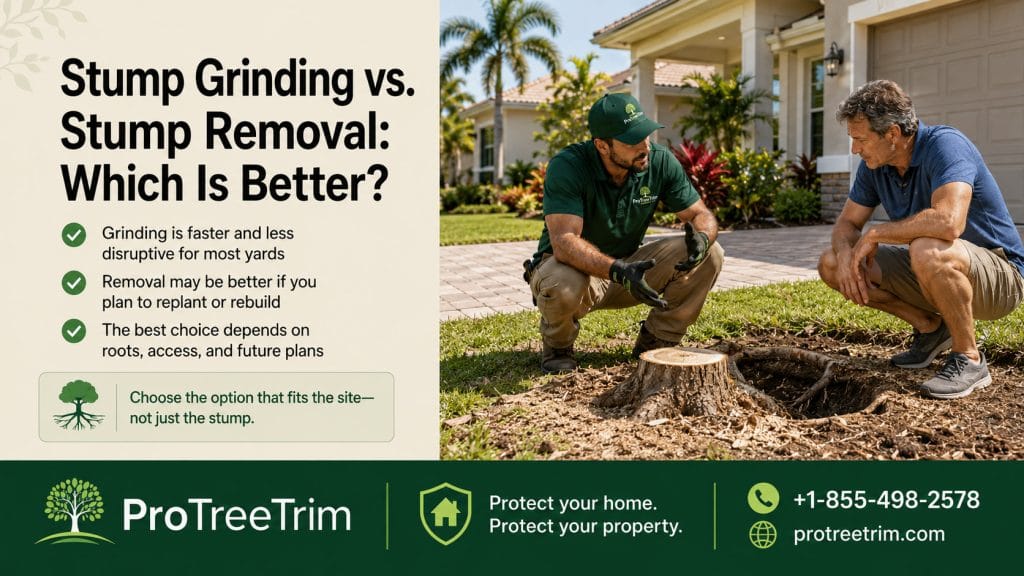
After a tree is cut down, the stump becomes the next decision. Should you grind it down, remove the whole stump, leave it alone, or wait until the roots decay naturally?
For most residential yards, stump grinding is often the more practical option because it removes the visible stump below grade without digging out the entire root system. Full stump removal may make sense when the area needs construction, major regrading, utility work, or complete root removal for a specific reason.
The right choice depends on what you want to do with the space afterward.
Stump Grinding and Stump Removal Are Not the Same
Stump grinding uses a machine to grind the visible stump into wood chips below the soil surface. The underground roots usually remain and decay over time.
Full stump removal means digging out the stump and major root ball. This is usually more disruptive because it requires more excavation and leaves a larger hole.
| Option | What it does |
|---|---|
| Stump grinding | Grinds the stump below ground level |
| Stump removal | Removes stump and more of the root mass |
| Leaving stump | Allows stump to decay naturally over time |
| Chemical decay products | May speed decay in some cases but is not instant |
| Manual digging | Possible for small stumps, difficult for large ones |
Grinding solves the visible stump problem. Removal goes deeper but creates more disturbance.
When Stump Grinding Is Usually Enough
Stump grinding is often enough when the goal is to restore the lawn, reduce a trip hazard, improve curb appeal, remove mowing obstacles, or prepare for mulch, sod, or basic landscaping.
Grinding may be a good fit when:
- the stump is in the lawn
- mowing around it is difficult
- the stump is a trip hazard
- the tree was recently removed
- the yard needs a cleaner look
- you want to plant grass nearby
- the stump is near a driveway or walkway
- the visible stump is the main problem
- you do not need to excavate the full root system
For many homeowners, stump grinding gives the best balance of cleanup, cost, and practicality.
When Full Stump Removal May Make Sense
Full stump removal may be worth considering when the stump area must be completely cleared for a specific project. This can include construction, hardscape installation, major regrading, foundation-side work, or utility access.
Full removal may make more sense when:
- a structure will be built where the stump is
- a new driveway or patio will cover the area
- utility trenching is planned
- the stump is in the way of fence posts
- major regrading is needed
- the root ball blocks excavation
- the tree species is aggressively sprouting
- the site needs deeper soil replacement
- the stump is very small and easy to remove fully
Full removal is more invasive, so it should have a clear reason.
Grinding Leaves Roots Underground
This is one of the biggest homeowner surprises. Stump grinding removes the stump below grade, but it does not remove every root underground. Large roots may remain under the lawn, driveway edge, patio area, sidewalk, or planting bed.
Those roots usually decay over time, but the timeline varies.
Remaining roots may cause:
- soil settling later
- mushrooms as wood decays
- soft spots in the lawn
- minor depressions
- old roots under sod
- obstacles during future digging
- occasional sprouts from some species
This does not mean grinding failed. It means grinding is designed to remove the stump, not erase the entire root system instantly.
Stump Removal Creates a Bigger Hole
Full stump removal removes more material, but it also leaves a larger hole and disturbs more soil. Depending on the stump size, the yard may need backfill, grading, compaction, sod, seed, or additional repair.
Full removal may affect:
| Area affected | Why it matters |
|---|---|
| Lawn grade | A large hole must be filled correctly |
| Nearby roots | Other tree roots may be disturbed |
| Irrigation lines | Digging may damage hidden lines |
| Hardscape edges | Driveways or pavers may be affected |
| Soil stability | Backfill may settle later |
| Replanting area | Soil may need improvement |
| Access | Equipment may need room to work |
Removal gives a cleaner underground result, but it is not always the cleaner yard project.
Stump Grinding Is Less Disruptive in Most Yards
Grinding is usually more targeted than full removal. The machine works on the stump area rather than pulling out the entire root system. That can make it easier for residential yards with fences, narrow gates, driveways, irrigation, or landscaping nearby.
Grinding may be preferable when:
- access is limited
- the stump is near a fence
- the stump is near a driveway
- the yard has irrigation
- the lawn needs quick restoration
- the stump is close to other plants
- full excavation would damage the yard
- you do not need deep root removal
The less soil you disturb, the easier the cleanup usually is.
How Deep Should a Stump Be Ground?
Stump grinding depth depends on the future use of the area. A shallow grind may be enough for mulch. A deeper grind may be better for lawn restoration or replanting nearby.
Depth matters when you plan to:
- lay sod
- plant grass seed
- install mulch
- place a small garden bed
- repair a walkway
- reset pavers
- replant a tree nearby
- level the yard
If you know what the area will become after grinding, say that before the work begins.
Can You Plant a New Tree Where the Old Stump Was?
You can sometimes plant near the old stump area, but planting directly in the same spot can be difficult after grinding. Wood chips, old roots, soil settling, and decaying material may affect the planting hole.
Before replanting, consider:
- whether chips need to be removed
- whether soil needs replacement
- whether old roots block the hole
- whether the new tree needs more space
- whether the old tree failed from site problems
- whether the same location is too close to hardscape
- whether drainage is suitable
- whether the new tree’s mature size fits
Often, planting a little away from the old stump is better than forcing a new tree into the exact same spot.
Should You Remove Stump Grindings?
After grinding, the area will contain wood chips mixed with soil. Some chips can be used as mulch, but too much chip material in the planting area may cause settling or make lawn restoration uneven.
Removing excess grindings may be smart when:
- you want to install sod
- you want a flat lawn
- you plan to replant nearby
- the chip pile is large
- the area is near a driveway or walkway
- you want clean topsoil added
- you need the grade restored
Leaving some material may be fine for a mulched bed, but a lawn area usually needs more careful cleanup.
Stump Grinding and Lawn Repair
If the goal is grass, the stump area needs more than grinding. The chips may need to be reduced or removed, the hole may need soil, and the area may need leveling.
A good lawn restoration plan may include:
- Grind the stump to the needed depth.
- Remove excess wood chips.
- Add clean soil where needed.
- Allow for some settling.
- Level the area.
- Seed or sod when conditions are right.
- Monitor for low spots later.
The old stump area may settle as roots decay, so a second leveling may be needed later.
Stump Grinding Near Driveways and Sidewalks
Stumps near driveways, sidewalks, patios, or pavers need careful handling. Roots may extend under hardscape, and grinding near edges can expose old roots or affect surrounding soil.
Before grinding near hardscape, check:
- how close the stump is to concrete or pavers
- whether roots are lifting the surface
- whether the hardscape is already cracked
- whether the stump blocks repair work
- whether grinding will create a void near the edge
- whether future settling may affect the surface
If the roots have already lifted hardscape, stump grinding may be only part of the repair plan.
Stump Grinding Near Fences
Stumps close to fences can be awkward because equipment access may be limited. The grinder may need enough room to reach the stump safely. Fence posts, gates, and property lines can all affect the job.
Fence-side stump questions include:
- Can equipment reach the stump?
- Is the stump touching the fence?
- Are roots growing around fence posts?
- Will fence panels need to be removed?
- Is the stump on or near a property line?
- Are there underground utilities near the fence?
A simple stump can become more complicated when access is tight.
Stump Grinding Near Irrigation and Utilities
Stump work involves grinding, digging, or cleanup around the soil. Underground irrigation, lighting wires, drainage pipes, cable lines, and utilities may be nearby.
Before stump work, identify:
- irrigation lines
- sprinkler heads
- landscape lighting wires
- drainage pipes
- utility routes
- septic components
- gas or water lines
- low-voltage cables
Do not assume the area is clear just because the stump is visible.
What About Chemical Stump Removal?
Chemical stump decay products are sometimes used to speed decomposition. They are usually not instant solutions. They may be more relevant when a stump is being left to decay rather than physically removed quickly.
Chemical approaches may be less suitable when:
- the stump is a trip hazard
- you need the lawn restored soon
- the stump is near pets or children
- the area is close to desirable plants
- the stump blocks a driveway, sidewalk, or patio repair
- you need predictable timing
For most homeowners who want the stump gone soon, grinding is usually more practical.
Leaving a Stump Alone
Leaving a stump is possible, especially in low-use areas. But in front yards, lawns, driveways, and high-traffic areas, it often creates problems.
A leftover stump may:
- create a trip hazard
- make mowing harder
- attract insects or fungi
- send up sprouts
- look unfinished
- interfere with planting
- block sod or lawn repair
- decay unevenly over time
Leaving it alone may be acceptable in a natural area. It is often less ideal in a maintained yard.
Stump Sprouts After Tree Removal
Some stumps and roots can send up new shoots after the tree is cut down. This is more likely in species that sucker aggressively or when the stump remains alive.
Stump grinding can reduce this by removing the main stump tissue, but some root sprouts may still appear depending on the tree.
Sprouting is more likely when:
- the stump is left above ground
- roots have stored energy
- the species suckers easily
- grinding was shallow
- shoots already appeared before removal
- root tissue remains active
If sprouts are a major concern, mention that before choosing the stump treatment.
Does Stump Grinding Stop Roots From Growing?
Usually, once the tree is removed and the stump is ground, the remaining roots lose their main energy source and decay over time. But some species may still produce sprouts from remaining roots or stump tissue.
Grinding helps reduce regrowth risk from the stump, but it does not instantly remove every root.
After grinding, expect:
- roots to remain underground
- gradual decay
- possible soil settling
- occasional mushrooms
- possible sprouts from some species
- future root discovery during digging
This is normal for many stump jobs.
Stump Grinding Before Replanting
If you plan to replant, tell the crew before grinding. The depth, chip removal, and soil replacement may need to be different.
For replanting, consider:
- grinding deeper if appropriate
- removing excess chips
- replacing soil
- shifting the new planting location
- choosing a smaller or better-suited tree
- avoiding old root masses
- checking drainage
- giving the new tree enough mature space
The old tree’s location may not be the best location for the new one.
Stump Grinding Before Selling a Home
A visible stump in a front yard can make a property look unfinished. It may also raise questions for buyers: Was the tree removed after storm damage? Are roots still lifting the driveway? Is the yard repaired?
Before listing a home, stump grinding may improve:
- curb appeal
- lawn appearance
- mowing convenience
- buyer confidence
- walkway safety
- driveway presentation
- overall yard maintenance impression
Take before-and-after photos and keep any tree work documentation.
When Stump Removal Is Worth the Extra Disruption
Full removal may be the better choice when the stump is not just a lawn problem but a construction or excavation problem.
Consider full removal when:
| Future use | Why full removal may help |
|---|---|
| Building a structure | Root ball may block excavation |
| Installing a driveway | Old roots may interfere with base prep |
| Pouring a patio | Stump area may settle later |
| Fence post installation | Roots may block post holes |
| Major grading | Stump and roots may affect soil work |
| Utility trenching | Root mass may be in the way |
| Small stump | Full removal may be practical |
| Severe sprouting species | More complete removal may reduce regrowth |
The more permanent the next project, the more important the underground stump condition becomes.
When Grinding Is the Better Choice
Grinding is usually better when the main goal is practical yard cleanup.
Grinding often fits when:
- the stump is a mowing obstacle
- the stump is a trip hazard
- the tree was removed from a lawn
- the yard needs a cleaner appearance
- the area will become mulch or grass
- access is limited
- full excavation would damage the yard
- the roots do not need to be fully removed
For most everyday residential stump problems, grinding is the common practical solution.
What Homeowners Should Photograph
Before stump work, take photos of:
- the stump from several angles
- nearby driveway, sidewalk, or patio
- visible roots
- nearby irrigation heads
- fence or gate access
- overhead and surrounding obstacles
- lawn damage around stump
- branches or tree debris if recent removal
- where you want the area restored
Photos help clarify the job and document the property condition.
What to Ask Before Hiring Stump Work
Ask:
- How deep will the stump be ground?
- Are surface roots included?
- Will grindings be left or removed?
- Can equipment access the stump?
- Is the stump near irrigation or utilities?
- Is replanting planned?
- Will the area need soil afterward?
- Could the area settle later?
- Is full removal better for the next project?
The best stump choice depends on what happens after the stump is gone.
Final Homeowner Takeaway
Stump grinding is usually the better choice for everyday lawn restoration, mowing convenience, curb appeal, and trip-hazard reduction. It removes the visible stump below grade with less disruption than full removal.
Full stump removal may be better when the area needs construction, deep excavation, major regrading, driveway or patio installation, utility work, or complete root-ball removal for a specific reason.
If you are unsure whether stump grinding or full stump removal is better for your yard, ProTreeTrim can help connect homeowners with local tree service support. Call +1-855-498-2578 or visit protreetrim.com.
FAQs
Is stump grinding better than stump removal?
For many residential yards, stump grinding is more practical and less disruptive. Full removal may be better for construction or deep excavation needs.
Does stump grinding remove all roots?
No. Stump grinding removes the visible stump below grade, but many roots remain underground and decay over time.
Can I plant grass after stump grinding?
Yes, but excess wood chips may need to be removed and clean soil added before seeding or sod.
When is full stump removal necessary?
It may be necessary when the area will be built on, paved, deeply excavated, or used for a project where the root ball would interfere.
ProTreeTrim™ can help you take the next step.
If you are dealing with a damaged tree, fallen branch, stump, root issue, palm concern, or storm cleanup question in Florida, call ProTreeTrim for tree service support.