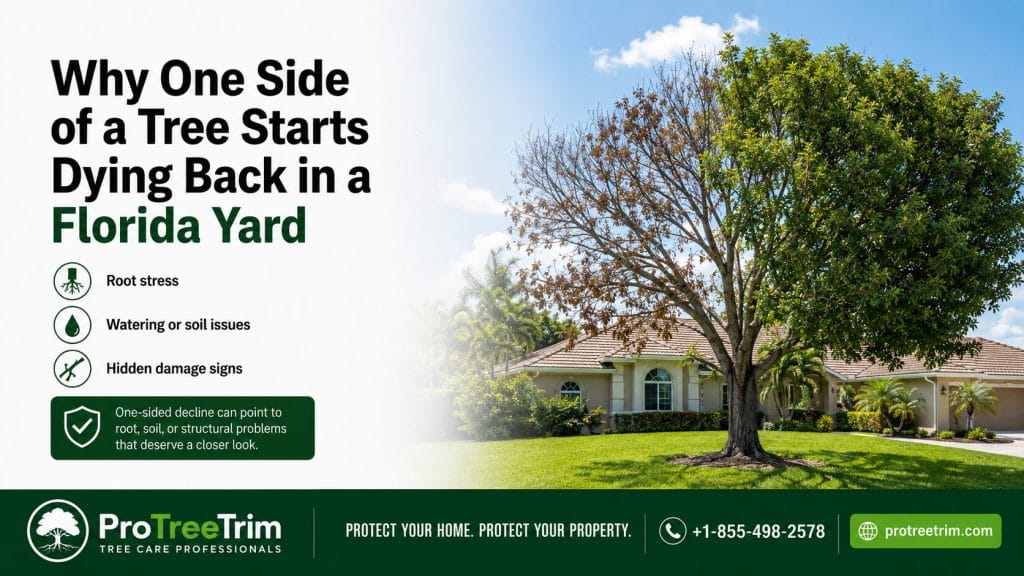
When one side of a tree starts dying back, the problem may be above ground, below ground, or both. In Florida yards, uneven canopy loss can follow root damage, drainage changes, drought stress, construction, pruning wounds, storms, or disease. The important step is not guessing the cause too quickly. Look at what changed around that side of the tree.
Start Below the Dying Side
A tree with one thin or dead side often makes homeowners look up first. That makes sense; the dead branches are what you can see. But many one-sided canopy problems begin at the roots.
UF/IFAS explains that root damage on one side of a tree can cause branch dieback on that same side in some trees, including oaks and mahogany. In other species, the branch death may appear elsewhere in the crown, which is one reason visual diagnosis can be tricky from the ground.
That matters in ordinary yard situations. A paver walkway may have been repaired on one side of the tree. A trench may have been dug for irrigation. A fence post, pool project, driveway edge, or landscape bed may have disturbed roots without looking dramatic at the time.
| What changed near the weak side? | Why it matters |
|---|---|
| Recent digging, trenching, or fence work | Roots may have been cut or compacted |
| Pavers, driveway, or walkway repaired | Soil and roots may have been disturbed |
| Water pools after rain | Roots may be stressed by poor drainage |
| Irrigation hits one side heavily | Soil may stay too wet or uneven |
| Mulch piled around the trunk | Moisture and decay can be hidden |
| Soil washed away from roots | Support and root protection may be reduced |
Do Not Blame Disease Too Fast
Disease can cause dieback, but it is not the only explanation. ISA’s TreesAreGood guidance describes decline symptoms such as smaller or fewer leaves, dieback in the crown, and early color change; it also notes that stressed trees can become more vulnerable to insects and diseases.
In plain homeowner terms: stress may come first, and disease or pests may show up later. A tree that was weakened by root injury, drought, flood stress, hurricane damage, or herbicide exposure may not show the full effect right away. UF/IFAS Extension has noted that root injury from construction, floods, drought, hurricanes, or herbicide injury can appear long after the original damage.
So instead of starting with “What disease is this?” start with a timeline:
- Did the dieback begin after a storm?
- Was there recent digging, paving, grading, or irrigation repair?
- Is the dying side facing reflected heat from a driveway or wall?
- Did one large limb break or get pruned heavily?
- Is the soil on that side staying wetter or drier than the rest of the yard?
When One-Sided Dieback Becomes a Safety Concern
A thin canopy alone does not mean the tree is about to fail. But one-sided dieback deserves more attention when it appears with structural warning signs: trunk cracks, mushrooms near the base, lifted soil, exposed roots, a new lean, large dead limbs, or branches hanging over a roof, driveway, pool cage, fence, or walkway.
Do not cut off the dead side just to make the tree look cleaner. Removing weight from one area can change the tree’s balance, and large dead limbs can break unpredictably. Take photos first: the full tree, the dying side, trunk base, roots, soil, nearby hardscape, and anything the tree could hit.
If you are unsure whether one-sided dieback, root stress, storm damage, or large dead limbs need professional attention, ProTreeTrim can help connect homeowners with local tree service support. Call +1-855-498-2578 or visit protreetrim.com.
FAQs
Does one-sided dieback mean the tree is dying?
Not always. It may point to root damage, water stress, construction injury, pruning problems, disease, or a mix of issues.
Should I remove the dead branches myself?
Small dead twigs may be manageable from the ground, but large dead limbs, overhead branches, or roof-adjacent limbs should be handled carefully.
Can root damage show up months later?
Yes. Root stress or injury may not appear in the canopy right away, especially after construction, drainage changes, drought, flooding, or storm damage.
ProTreeTrim™ can help you take the next step.
If you are dealing with a damaged tree, fallen branch, stump, root issue, palm concern, or storm cleanup question in Florida, call ProTreeTrim for tree service support.