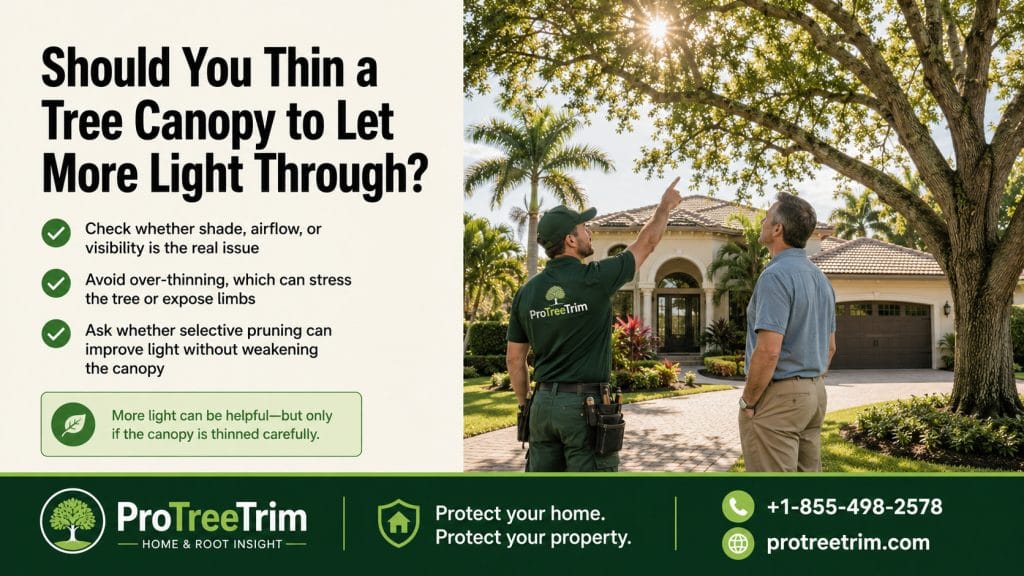
Thinning a tree canopy can make sense when branches are crowded, rubbing, dead, storm-damaged, or blocking needed clearance. But thinning should not mean stripping out the inside of the tree until it looks hollow. A healthy canopy protects the tree, feeds the roots, shades the bark, and helps the tree handle heat, wind, and stress.
Start With Why You Want More Light
Homeowners usually ask for canopy thinning because the yard feels too dark, grass will not grow, the house looks hidden, or the tree looks heavy. Those are real concerns. The mistake is assuming that removing a lot of interior branches will solve all of them.
More light is not always a tree problem. Grass may struggle under a tree because of shade, root competition, irrigation patterns, compacted soil, or the wrong turf for the site. A patio may feel dark because branches hang too low, not because the whole canopy needs thinning. A roof may collect debris because one limb hangs over a gutter, not because the tree needs to be opened up from the inside.
| Homeowner concern | Better first question |
|---|---|
| “The yard is too dark” | Is the issue shade, low branches, or tree placement? |
| “Grass will not grow” | Is turf realistic under this tree? |
| “The tree looks too full” | Are branches crowded, dead, or structurally weak? |
| “I want wind to pass through” | Will thinning help, or would it weaken branch structure? |
| “Branches touch the roof” | Is selective clearance enough? |
| “The tree drops too many leaves” | Will thinning reduce debris meaningfully, or only stress the tree? |
Good Thinning Is Selective
Proper thinning is not random cutting. It removes specific branches for specific reasons.
A careful pruning plan may remove deadwood, crossing branches, rubbing limbs, weak interior growth, or branches that interfere with rooflines, driveways, walkways, pool cages, or fences. The goal is to improve structure and clearance while keeping enough healthy canopy for the tree to function.
Bad thinning often looks dramatic right away. The inside of the canopy is stripped out, small branches are removed all along the main limbs, and the tree ends up with foliage only at the outer ends. This is sometimes called “lion-tailing.” It can make branches heavier at the tips, expose bark to sun, and encourage weak regrowth.
A tree should not look like a skeleton after thinning. It should still look like the same tree, just cleaner, safer, and better structured.
More Thinning Does Not Always Mean Safer in Storms
A common belief is that a tree should be thinned heavily so wind can pass through it. That sounds logical, but over-thinning can backfire. Branches need interior foliage and smaller side branches to distribute movement and support the tree’s natural structure.
If too much is removed, long limbs may become more exposed to wind and more heavily loaded at the ends. The tree may also respond by producing fast, weak sprouts that need more pruning later.
For storm preparation, the better question is not “How much can we remove?” It is:
- Are there dead limbs?
- Are branches cracked or hanging?
- Are limbs rubbing against each other?
- Is one large limb overextended above the roof or driveway?
- Are branches touching the house, gutters, or pool cage?
- Is the tree leaning, hollow, or showing root movement?
- Has the tree been topped or over-pruned before?
Storm prep pruning should reduce clear problems, not strip the tree bare.
Grass Under the Tree May Still Struggle
Many homeowners request canopy thinning because grass under the tree keeps thinning out. Sometimes a little more light helps. Often, it does not solve the whole problem.
Tree roots and turf roots compete in the same upper soil layer. The tree may be taking water and nutrients before the grass can use them. The soil may be compacted from foot traffic, shade may still be too deep, or irrigation may not reach the area evenly. Cutting more branches may stress the tree while only giving the grass a temporary improvement.
In many yards, a wider mulch ring, shade-tolerant groundcover, or a redesigned bed is better than repeatedly thinning the tree to force grass to grow where it does not want to grow.
When Canopy Thinning Makes Sense
Canopy thinning may be reasonable when it has a clear purpose and the tree is healthy enough to handle the work.
Good reasons include:
- removing dead, cracked, or rubbing branches
- improving structure in a young or developing tree
- reducing crowding without stripping the canopy
- clearing rooflines, gutters, or walkways selectively
- improving visibility around the front of a home
- reducing weight on a specific overextended branch
- correcting poor past pruning where possible
The best thinning is usually modest. It respects the tree’s shape and avoids large, unnecessary live cuts.
When You Should Be Cautious
Be careful with thinning if the tree is already stressed. A tree with yellowing leaves, small leaves, early leaf drop, dead branch tips, trunk cracks, mushrooms near the base, root damage, or recent construction stress may not respond well to live-canopy removal.
Also be cautious with mature trees. Large trees do not need aggressive thinning just because they are big. Heavy pruning on an older tree can create wounds, change balance, and trigger decline if the tree is already struggling.
Do not thin heavily right after drought, flooding, storm damage, trenching, driveway work, or major root disturbance unless there is a safety reason.
What to Ask Before Approving the Work
Before a crew starts, ask what branches are being removed and why. A good answer should be specific.
Ask:
- Are you removing deadwood, live branches, or both?
- How much live canopy will be removed?
- Are any large branches being cut?
- Will interior branches be preserved where possible?
- Are you correcting rubbing or crossing limbs?
- Is this tree healthy enough for thinning?
- Will the finished tree still have natural shape?
- Are roof, driveway, pool cage, or utility conflicts being addressed?
Be careful if the answer is simply, “We will open it up.” That can mean anything from careful selective pruning to damaging over-thinning.
The Better Goal: A Balanced Tree
The best canopy work does not leave the tree looking dramatically different. It leaves the property safer, cleaner, and more usable while keeping the tree’s health intact.
A good result may give a little more light, better airflow, improved clearance, and fewer obvious defects. It should not leave long bare limbs, giant open holes, or a canopy that looks stripped from the inside.
If you are unsure whether your tree needs thinning, deadwood removal, roofline clearance, or a different yard plan, ProTreeTrim can help connect homeowners with local tree service support. Call +1-855-498-2578 or visit protreetrim.com.
FAQs
Is thinning a tree canopy good for the tree?
It can be, if done selectively for structure, deadwood, rubbing branches, or clearance. Heavy thinning without a clear purpose can stress the tree.
Will thinning help my grass grow under the tree?
Maybe a little, but shade is not the only issue. Root competition, soil compaction, water, and turf type also matter.
Does thinning make a tree safer in storms?
Not automatically. Removing dead, cracked, or poorly attached branches can help, but over-thinning may weaken structure or create long, exposed limbs.
How do I know if a tree was over-thinned?
Warning signs include bare interior limbs, foliage only at branch tips, large unnecessary cuts, sun-exposed bark, and a canopy that looks hollow or unbalanced.
ProTreeTrim™ can help you take the next step.
If you are dealing with a damaged tree, fallen branch, stump, root issue, palm concern, or storm cleanup question in Florida, call ProTreeTrim for tree service support.