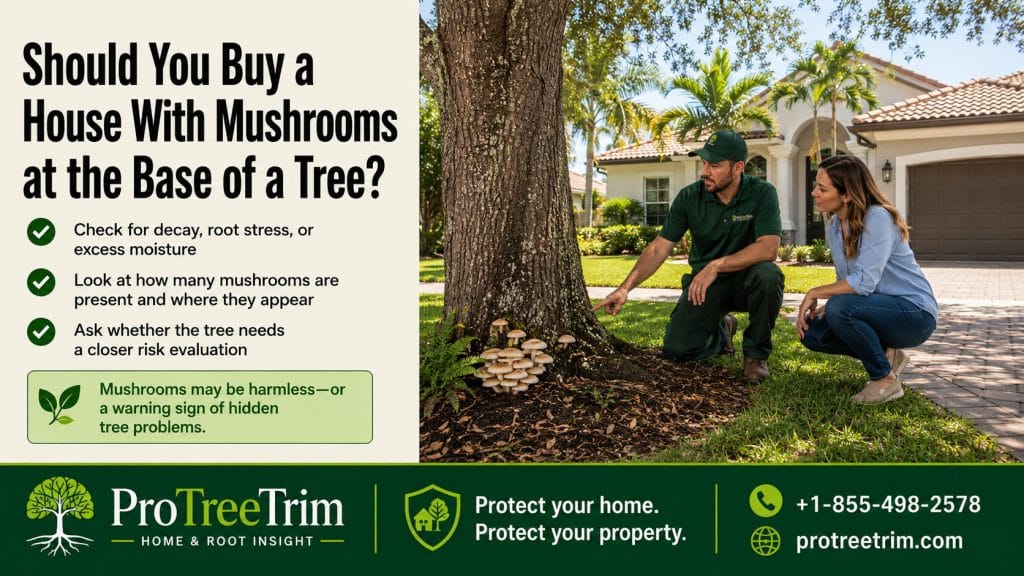
Mushrooms at the base of a tree do not automatically mean you should walk away from a house. But they are worth taking seriously, especially if the tree is large, close to the home, leaning, dropping limbs, or growing near a driveway, pool cage, fence, patio, or walkway. Mushrooms can sometimes point to decaying roots or wood, and that can become a post-closing cost.
First, Look at Where the Mushrooms Are Growing
Not every mushroom near a tree means the same thing. Mushrooms may grow from old mulch, buried roots, decaying stump material, or organic debris in the soil. The concern rises when they appear directly from the trunk base, root flare, large roots, or a hollow-looking area.
As a buyer, do not try to diagnose the fungus. Focus on the visible pattern and the tree’s location.
| What you see | Why it matters as a buyer |
|---|---|
| Mushrooms in old mulch away from trunk | May be decomposing organic material |
| Mushrooms attached to trunk base | Decay concern deserves closer review |
| Mushrooms along large roots | Root or old wood decay may be involved |
| Mushrooms plus hollow trunk | Tree condition should be checked carefully |
| Mushrooms plus dead limbs | Decline and structural concerns may overlap |
| Mushrooms near a tree leaning toward the house | Higher buyer concern |
| Mushrooms near an old stump | Could be leftover decay from past removal |
The same mushrooms that are only a landscape curiosity in a far back corner may be a bigger concern beside a garage, pool cage, or main walkway.
Check the Whole Tree, Not Only the Fungus
Mushrooms are one clue. They do not tell the whole story.
Step back and look at the full tree. Is the canopy thin? Are large branches dead? Is the trunk cracked or hollow? Is bark peeling near the base? Does the tree lean toward the home, driveway, fence, or neighbor’s yard? Are roots lifting soil or pavers?
A tree with mushrooms but a full canopy and no visible structural concerns may simply need further observation. A tree with mushrooms, dead limbs, soft wood, and a target nearby deserves more caution before closing.
Pay special attention to trees near:
- rooflines
- bedrooms
- driveways
- pool cages
- patios
- fences
- sidewalks
- utility areas
- neighbor-facing boundaries
The question is not only “Are the mushrooms bad?” The buyer question is: what would this tree hit if decay or root failure is involved?
Ask the Seller About Tree and Stump History
Mushrooms may be connected to a current tree, but they may also be connected to something that happened before you saw the property. A tree may have been removed nearby. Roots may be decaying underground. A stump may have been ground and covered with mulch. Storm damage may have led to past pruning.
Ask practical questions:
- Has this tree been evaluated before?
- Were any nearby trees removed?
- Was stump grinding done in this area?
- Have large limbs fallen from this tree?
- Has the tree leaned more after storms?
- Was fresh mulch added recently?
- Are there invoices or before-and-after photos from tree work?
- Did the seller notice the mushrooms before listing?
A seller may not know the answer. That is not automatically a problem, but it tells you whether you may need a closer look before closing.
Do Not Let Fresh Mulch Hide the Base
Fresh mulch before a sale is common. It can make the yard look cleaner in photos. But mulch can also hide the root flare, old stump chips, soft soil, mushrooms, or decay signs near the trunk.
During the inspection period, look at whether mulch is piled against the tree. If the trunk looks like a pole disappearing straight into mulch, the root flare may be buried. That makes it harder to see what is happening at the base.
You do not need to dig aggressively. Just notice whether the base is visible and whether mushrooms are growing from mulch, soil, roots, or the trunk itself.
How Mushrooms Can Affect Your Buying Decision
Mushrooms alone may not change your decision to buy the house. They may simply become a maintenance note. But mushrooms paired with tree defects can affect your budget and negotiation.
| Situation | Buyer next step |
|---|---|
| Mushrooms in mulch, no tree symptoms | Monitor and ask about recent landscaping |
| Mushrooms near old stump | Ask whether stump grinding was done |
| Mushrooms at trunk base | Consider tree-specific review |
| Mushrooms plus dead limbs | Treat as a higher-priority concern |
| Mushrooms plus lean toward house | Slow down before closing |
| Mushrooms near roots lifting pavers | Consider tree and hardscape together |
| Mushrooms near power lines | Utility safety may affect any future work |
The issue may lead to pruning, monitoring, removal, stump grinding, debris hauling, paver repair, or simply better documentation. The important thing is not to inherit a large tree problem without understanding it.
What to Photograph During the Inspection Period
Take wide photos first. Show the full tree and its relationship to the home, driveway, fence, pool cage, or walkway. Then take closer photos of the mushrooms, trunk base, roots, mulch, dead limbs, cracks, or hollow areas.
Useful photos include:
- full tree from several angles
- mushrooms and exact location
- trunk base and root flare
- canopy and dead limbs
- nearby roofline, driveway, or pool cage
- exposed roots or lifted pavers
- old stump areas or fresh mulch
- lean direction, if any
These photos help you ask better questions and compare the tree later if you decide to buy.
When It May Be Manageable
The issue may be manageable if the mushrooms appear in mulch or old organic material, the tree looks stable, there are no large dead limbs, and the tree is away from structures or high-use areas.
In that case, you may simply budget for monitoring, mulch correction, or routine tree care after closing.
When to Slow Down
Slow down if mushrooms are growing directly at the trunk base, the tree is large, there are dead limbs, the trunk sounds hollow, bark is peeling, the tree leans toward the house, or roots appear lifted or damaged.
Also slow down if the tree is in a tight spot where removal would be expensive: near a pool cage, between houses, against a fence, over a driveway, or close to utility lines.
If you are unsure whether mushrooms at the base of a tree, root decay, stump issues, or dead limbs should be handled before or after buying a home, ProTreeTrim can help connect homeowners with local tree service support. Call +1-855-498-2578 or visit protreetrim.com.
FAQs
Do mushrooms at the base of a tree mean the tree is dying?
Not always. Mushrooms may be growing from mulch, old roots, stump material, or decaying wood. Their location and the tree’s overall condition matter.
Should I buy a house if a large tree has mushrooms near the trunk?
Maybe, but do not ignore it. If mushrooms are at the trunk base and the tree is near the house, driveway, pool cage, or fence, ask for more information before closing.
Can mushrooms mean root decay?
They can sometimes point to decay in wood or roots, but buyers should not diagnose from mushrooms alone. Look for lean, dead limbs, hollow areas, soft wood, or root movement.
What should I ask the seller?
Ask whether the tree has been evaluated, whether any trees were removed nearby, whether stump grinding was done, and whether large limbs have fallen before.
ProTreeTrim™ can help you take the next step.
If you are dealing with a damaged tree, fallen branch, stump, root issue, palm concern, or storm cleanup question in Florida, call ProTreeTrim for tree service support.