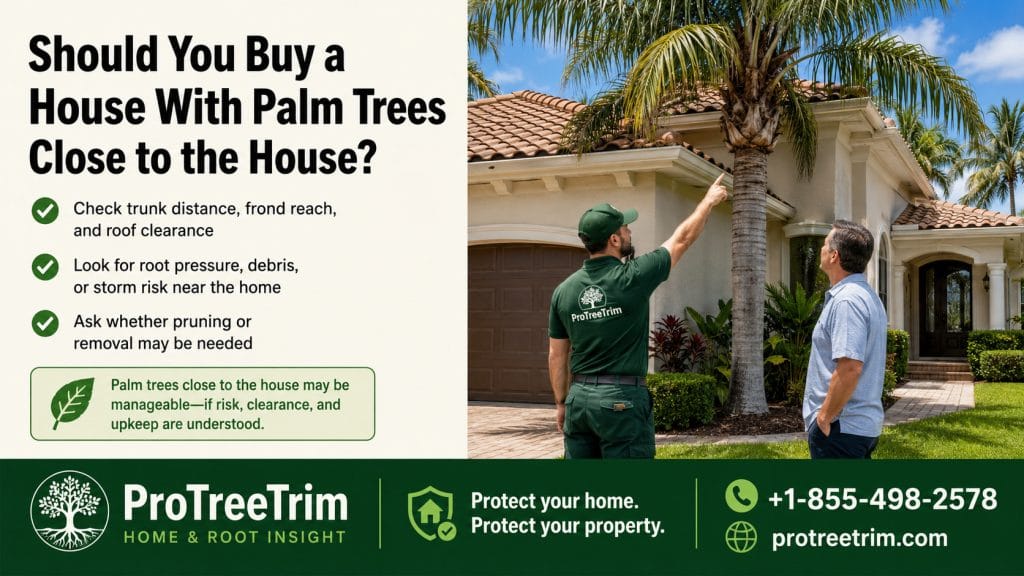
Palm trees close to a house are not automatically a problem. In many Florida-style yards, palms are part of the look buyers expect: tropical, clean, and established. The concern begins when a palm leans toward the roof, drops heavy fronds near the entry, touches a pool cage, crowds the driveway, or sits in a place where future trimming or removal would be difficult.
Start With What the Palm Could Hit
A palm near open lawn is one thing. A palm close to a bedroom window, roof edge, garage, pool enclosure, driveway, walkway, or power line is different.
Palms may not spread like broad shade trees, but they can still create real property concerns. A tall palm with a heavy crown can drop fronds, seed pods, or old boots. A leaning palm can become a buyer anxiety point. A palm beside a pool cage may look beautiful until fronds rest on the screen panels.
| What you see | Why it matters as a buyer |
|---|---|
| Palm leaning toward the house | Needs context: old lean or recent movement? |
| Fronds touching the roof | Roofline and debris concerns |
| Palm beside pool cage | Screen damage and cleanup issues |
| Seed pods over driveway or walkway | Falling debris and maintenance concern |
| Trunk close to foundation bed | Access, drainage, and future removal planning |
| Palm near power/service line | Utility safety comes before tree work |
| Fresh heavy pruning | Ask what was done and why |
A palm can be attractive and still need maintenance. The question is whether that maintenance is routine or likely to become expensive soon after closing.
Look at the Crown and the Base
Buyers often look at the palm’s height first. The better check starts with the crown and the base.
At the crown, look for dead fronds, hanging fronds, seed clusters, broken fronds, or a sparse, unhealthy-looking top. Some old fronds are normal. A crown that looks collapsed, uneven, or heavily stripped may deserve closer attention.
At the base, look for soil movement, soft ground, standing water, trunk wounds, mulch piled too high, or a lean that seems to start near the ground. A palm can look green at the top while the site around it tells a different story.
Ask yourself:
- Is the palm leaning toward something valuable?
- Does the lean look natural and long-standing, or recent?
- Are fronds or seed pods dropping where people walk or park?
- Is the palm close to a pool cage, roofline, or utility area?
- Can a crew access it later without damaging pavers, fences, or screens?
- Has the seller trimmed it recently?
Do Not Confuse “Clean” With Over-Pruned
A palm that has been cleaned up before listing may look neat. That can be good maintenance. But a palm that has been stripped too aggressively can look unnatural, with too many green fronds removed and only a small tuft left at the top.
As a buyer, ask why the palm was recently trimmed. Was it routine frond and seed pod cleanup? Was it done because fronds were touching the roof or pool cage? Was there storm damage? Did the seller remove dead or hazardous material, or was the palm cut hard just to make the yard look sharper for photos?
A useful seller record would include an invoice, date of trimming, and scope of work. “Palm trimming” can mean very different things.
Think About Future Access Before You Buy
Palm work can be simple in an open front yard and much harder in a tight space. A palm between a house and fence, beside a pool cage, near pavers, over a roofline, or close to utility lines may require careful planning.
Future costs may include:
| Possible future work | Why it matters |
|---|---|
| Routine palm trimming | Fronds and seed pods may need periodic cleanup |
| Pool cage clearance | Work must avoid screen and frame damage |
| Roofline clearance | Fronds should not rest on shingles or gutters |
| Removal | Tall palms in tight areas can be more complex |
| Stump grinding | Access, irrigation, and pavers may complicate work |
| Debris hauling | Palm debris can be bulky and messy |
| Paver or bed repair | Work near hardscape may leave cleanup needs |
Do not assume a palm will be cheap to remove just because it has a narrow trunk. Height, access, nearby structures, and disposal all matter.
When a Palm Is a Strong Feature
A palm may be a positive part of the property if it is stable, well placed, not touching structures, not blocking access, and not dropping heavy debris over daily-use areas. A well-maintained palm can frame a front entry, add curb appeal, and make a pool area feel more finished.
In that case, the palm is not a reason to hesitate. It is simply something to maintain.
When to Slow Down Before Closing
Take the palm more seriously if it is newly leaning, touching the roof, pressing into a pool cage, dropping heavy fronds near the entry, standing in soft wet soil, or growing close to utility lines.
Also slow down if the palm was recently trimmed very heavily and the seller cannot explain why. Fresh work may be responsible maintenance, but it may also be a clue that the palm was creating a problem before listing.
If you are unsure whether a palm tree near a house, roofline, pool cage, driveway, or utility area should be handled before or after buying a home, ProTreeTrim can help connect homeowners with local tree service support. Call +1-855-498-2578 or visit protreetrim.com.
FAQs
Is a palm tree close to the house a dealbreaker?
Not usually. The concern depends on lean, roof contact, crown condition, falling debris, pool cage clearance, utility lines, and future access.
Should I ask the seller to trim palms before closing?
If fronds, seed pods, or dead material are over the roof, driveway, walkway, or pool cage, it is reasonable to ask for trimming, records, or a clear plan.
Can palm roots damage a foundation?
Palm roots are usually different from large woody shade-tree roots, but placement still matters. Check drainage, hardscape, access, and whether the palm is too close for future maintenance.
What should I photograph during inspection?
Photograph the full palm, crown, trunk base, lean direction, nearby roofline, pool cage, driveway, walkway, utility lines, and any fresh pruning cuts.
ProTreeTrim™ can help you take the next step.
If you are dealing with a damaged tree, fallen branch, stump, root issue, palm concern, or storm cleanup question in Florida, call ProTreeTrim for tree service support.