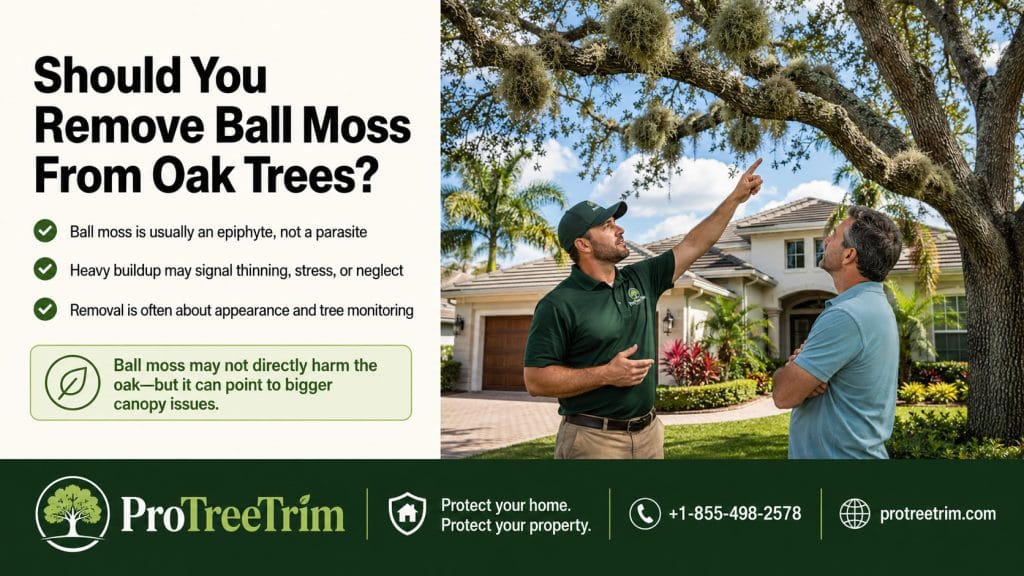
Ball moss on an oak tree can worry homeowners because it often looks like clumps of gray-green growth attached to branches. It may make the tree look old, neglected, or unhealthy. But ball moss is not always the main problem. In many cases, it grows on weak, shaded, or interior branches that were already declining. The real question is whether the oak is healthy overall or whether ball moss is hiding deadwood, thinning, or storm-risk concerns.
What Ball Moss Looks Like
Ball moss usually appears as small rounded clumps attached to branches or twigs. It can be gray, greenish, or brownish depending on moisture, age, and light conditions.
Homeowners sometimes confuse it with Spanish moss, fungus, mistletoe, or insect nests. Ball moss is different from all of those.
| What you see | What it may mean |
|---|---|
| Small round clumps on interior limbs | Often ball moss |
| Growth mostly on shaded branches | May reflect low light and weak interior growth |
| Clumps on dead twigs | Deadwood may be the real concern |
| Heavy growth throughout canopy | Tree condition should be checked more carefully |
| Ball moss plus thinning canopy | Stress or decline may be involved |
| Ball moss over roof or driveway | Hidden dead limbs matter more |
| Ball moss on one weak branch | Targeted pruning may be enough |
Ball moss by itself does not automatically mean the oak is dying.
Ball Moss Is Often a Clue, Not the Cause
A common mistake is assuming ball moss is killing the oak. In many cases, ball moss is more like a clue. It may appear more heavily on branches that receive less sunlight, have reduced vigor, or are already declining.
That does not mean it should always be ignored. A branch covered in ball moss may also be dead, weak, or shaded out. The branch condition matters more than the moss.
Step back and ask:
- Is the whole oak canopy full?
- Are new leaves growing normally?
- Are there dead branches mixed with ball moss?
- Is one side of the tree thinning?
- Are clumps concentrated on interior weak limbs?
- Are branches over a roof, driveway, pool cage, or walkway?
- Are there trunk cracks, mushrooms, or root concerns?
The ball moss may be what you notice first, but the oak’s structure tells the more important story.
When Ball Moss Is Mostly Cosmetic
Ball moss may be mostly cosmetic when the oak is otherwise vigorous, the canopy is full, and only a few interior branches have clumps.
In that case, removing every clump may not be worth the cost, effort, or risk. Tall oak work can be expensive and should not be done casually just to make the tree look cleaner.
It may be reasonable to leave ball moss alone when:
- the oak looks healthy overall
- the growth is light or moderate
- branches are not dead or cracking
- the tree is away from structures
- the clumps are mostly on small interior twigs
- cleanup is not a problem
- there are no major storm-risk concerns
A mature oak does not need to look perfectly clean to be healthy.
When Removal or Pruning Makes Sense
Ball moss removal may make sense when the growth is heavy, highly visible, hiding deadwood, or concentrated on limbs above important property areas.
Removal may be worth considering when ball moss is found on branches over:
| Area | Why it matters |
|---|---|
| Roof | Deadwood or debris may affect shingles and gutters |
| Driveway | Falling twigs or limbs may affect vehicles and people |
| Pool cage | Hidden dead branches can damage screens |
| Patio | Cleanup and overhead branch condition matter |
| Walkway | Falling material may affect daily access |
| Fence line | Neighbor-facing cleanup or limb concerns may appear |
| Front entry | Curb appeal and safety perception matter |
In many cases, the better scope is not “remove all ball moss.” It is “inspect and remove dead, weak, or declining branches where ball moss is heavy.”
Do Not Strip the Oak Just to Remove Moss
Oak trees should not be heavily cut just because ball moss is visible. Removing too many live branches can stress the tree and create unnecessary wounds.
A good approach is selective:
- remove deadwood
- remove broken or weak branches
- reduce branches touching rooflines
- clear limbs over high-use areas when needed
- preserve healthy canopy
- avoid topping
- avoid stripping interior branches too aggressively
A poor approach is to cut large healthy limbs only because they have ball moss on them.
Ball Moss Can Hide Dead Branches
The biggest practical concern is visibility. A branch covered with clumps can make it harder for homeowners to see whether the branch is alive, cracked, or dead.
This matters before storm season. A small dead twig may be only a cleanup issue. A larger dead limb above a driveway, roof, pool cage, patio, or walkway is different.
Look for signs that the branch itself is failing:
- no leaves beyond the moss
- brittle twigs
- bark peeling
- cracks along the limb
- hanging broken pieces
- fungal-looking growth on wood
- repeated twig drop below the branch
- dead branch tips across the canopy
If deadwood is present, pruning may be justified even if ball moss is not the true cause.
Do Not Use Harsh DIY Treatments
Homeowners sometimes look for a spray or quick chemical fix. Be careful. Random chemicals, pressure washing, scraping, or aggressive pulling can damage bark, surrounding plants, lawn, and the oak itself.
Also avoid climbing the tree or using ladders to remove clumps. Oak branches can be large, high, and unpredictable. If the work is above ground level, over property, or near wires, it is not a casual DIY task.
A safe homeowner response is usually:
- take photos
- check overall canopy health
- clean fallen debris from high-use areas
- remove only small reachable material if safe
- avoid cutting live limbs without a reason
- call for help if deadwood or structure concerns appear
When Ball Moss Suggests a Bigger Oak Problem
Ball moss deserves more attention when it appears with signs of decline.
Look closer if the oak has:
| Warning sign | Why it matters |
|---|---|
| Large dead limbs | Branch-fall risk may be present |
| Canopy thinning | Tree stress may be broader |
| One-sided decline | Root, trunk, or site stress may be involved |
| Mushrooms near base | Decay or moisture concern |
| Trunk cracks | Structural questions may exist |
| Root lifting or soil movement | Stability may be involved |
| New lean after storms | Needs attention beyond moss |
| Branches touching roof | Property conflict is already active |
In those cases, removing ball moss alone will not solve the real problem.
Ball Moss Before Selling a Home
For sellers, ball moss can affect perception. Some buyers may assume the oak is unhealthy, even if the tree is structurally fine. A front-yard oak covered in ball moss, dead twigs, and roofline debris may raise questions during showings or inspections.
Before listing, focus on the visible and practical issues:
- remove deadwood over driveways and walkways
- clean fallen moss, twigs, and leaves from the lawn
- clear roofline contact if branches touch the home
- clean gutters if oak debris has built up
- take before-and-after photos of tree work
- keep invoices for pruning or deadwood removal
A cleaner oak presentation can help, but avoid rushed over-pruning just for photos.
Ball Moss Near Pool Cages and Patios
Pool and patio areas are more sensitive because people spend time under the canopy. Ball moss may drop small debris, and dead twigs hidden by the clumps may fall into the pool area.
If the oak hangs over a pool cage, also check for:
- branches touching screen panels
- dead limbs above the enclosure
- acorns collecting on top of the cage
- leaves trapped in frame corners
- roofline or gutter debris nearby
- limited access for future pruning
A poolside oak may be worth keeping, but it needs practical maintenance.
What to Photograph Before Asking for Help
Take useful photos before trimming decisions are made.
Photograph:
- full oak from several angles
- close-up ball moss clumps
- branches with no leaves beyond the clumps
- any dead limbs or broken twigs
- trunk base and root flare
- roofline, driveway, pool cage, or walkway below
- mushrooms, cracks, or wounds if visible
- fallen debris under the canopy
These photos help separate a cosmetic moss issue from a deadwood or structural issue.
Final Homeowner Takeaway
Ball moss on oak trees is not automatically a reason to panic. It is often more of a symptom or cosmetic concern than the main cause of tree decline.
The right response depends on the oak’s overall condition and where the affected branches are located. If the tree is healthy and ball moss is light, monitoring may be enough. If ball moss is hiding deadwood over a roof, driveway, pool cage, patio, or walkway, selective pruning may make sense.
If you are unsure whether ball moss is harmless, hiding dead limbs, or part of a larger oak-tree problem, ProTreeTrim can help connect homeowners with local tree service support. Call +1-855-498-2578 or visit protreetrim.com.
FAQs
Is ball moss killing my oak tree?
Usually no. Ball moss is often more of a clue or cosmetic issue than the direct cause of oak decline.
Should ball moss be removed from oak trees?
Only when it is heavy, unsightly, hiding deadwood, or located on branches over roofs, driveways, pool cages, patios, or walkways.
Is ball moss the same as Spanish moss?
No. They are different growths. Spanish moss hangs in strands, while ball moss usually forms rounded clumps on branches or twigs.
Should I prune branches with ball moss?
Not automatically. Prune when branches are dead, weak, cracked, touching structures, or creating property risk—not just because moss is present.
ProTreeTrim™ can help you take the next step.
If you are dealing with a damaged tree, fallen branch, stump, root issue, palm concern, or storm cleanup question in Florida, call ProTreeTrim for tree service support.