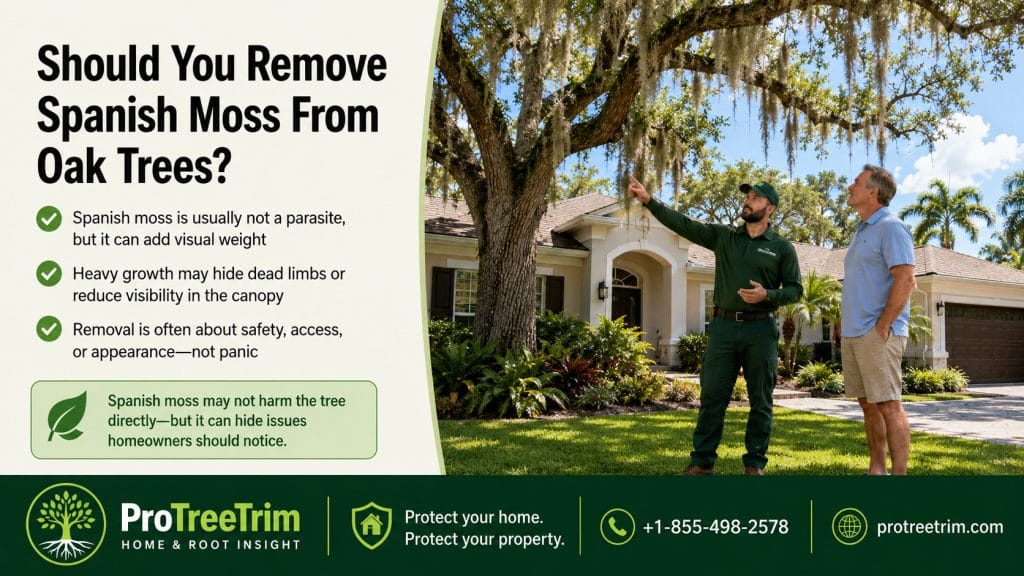
Spanish moss hanging from an oak tree can look beautiful, messy, or worrying depending on the yard. Many homeowners see heavy moss and assume the oak is being harmed. In most cases, Spanish moss is not the main threat to the tree. But heavy moss can hide dead limbs, make the canopy look darker, add visual weight, and make it harder to notice real oak problems before storms.
Spanish Moss Is Usually Not Killing the Oak
Spanish moss is an epiphyte, meaning it grows on the tree for support rather than feeding directly from the tree like a parasite. It uses the branches as a place to hang, not as a food source.
That said, a tree covered in moss may still have problems. The mistake is blaming the moss for every issue.
| What you see | What it may actually mean |
|---|---|
| Moss hanging from healthy limbs | Often normal in humid areas |
| Heavy moss on dead branches | Deadwood may be the real issue |
| Moss mostly on one side of canopy | Light, moisture, or airflow may influence growth |
| Moss hiding branch structure | Inspection becomes harder |
| Moss plus thinning canopy | Oak health should be checked separately |
| Moss over roof or driveway | Dead limbs may be harder to see |
| Moss falling after wind | Cleanup issue, not always tree decline |
Spanish moss may make a tree look older or heavier, but it does not automatically mean the oak is dying.
The Real Concern Is What the Moss Hides
Heavy Spanish moss can make it harder to see what matters most: dead limbs, cracks, rubbing branches, broken branch tips, cavities, or storm damage inside the canopy.
This matters more when the oak stands near:
- a roof
- driveway
- pool cage
- walkway
- patio
- fence
- parked vehicles
- neighbor’s yard
- utility area
If a large dead limb is hidden under moss and hanging over a driveway, the moss is not the danger. The dead limb is.
Should Homeowners Remove It for Tree Health?
Usually, Spanish moss removal is not needed for tree health alone. Removing moss from a healthy oak is often more about appearance, visibility, or cleanup than saving the tree.
Removal may make sense when:
- moss is so heavy that branch defects are hard to see
- dead limbs need to be identified before storm season
- moss is falling constantly over a patio or pool deck
- the tree is being evaluated before selling a home
- moss makes the front yard look neglected
- branches already need pruning and moss removal can be included carefully
But removing moss aggressively from high limbs may not be worth the cost or risk if the oak is otherwise healthy and away from structures.
Do Not Tear or Damage Branches to Remove Moss
Spanish moss can be pulled from low, reachable branches in some cases, but rough removal can break small twigs, strip bark, or disturb weak branches. On tall oaks, removal can also become unsafe because it may require ladders, climbing, pole tools, or work over structures.
Avoid:
- climbing the tree to pull moss
- using ladders under heavy limbs
- yanking moss from brittle branches
- cutting healthy limbs just because they hold moss
- using harsh chemicals around the tree
- removing moss near utility lines yourself
If removal requires height, equipment, or work over property, it is better handled professionally or skipped unless there is a clear reason.
Moss May Be More Visible on Stressed Trees
Sometimes Spanish moss appears heavier on a tree that is already declining. That does not mean the moss caused the decline. A thinning canopy may let more light and air reach branches, making moss easier to notice. Dead branches may also hold moss more visibly because there are fewer leaves around them.
Look past the moss and check for real oak warning signs:
- dead branches at the top
- large limbs without leaves
- cracks in the trunk
- mushrooms near the base
- hollow areas
- bark loss
- sawdust-like material
- roots lifting or soil movement
- new lean after rain or storms
- repeated large limb drop
If these signs are present, removing moss will not solve the real problem.
Spanish Moss Before Hurricane Season
Before storm season, the practical question is not whether the oak has moss. The better question is whether the oak has hidden defects.
Heavy moss can make canopy inspection harder. If the oak is close to the house, driveway, pool cage, or fence, it may be worth having the canopy reviewed for deadwood, broken limbs, and roofline conflicts.
A storm-prep visit should focus on the oak’s structure:
| Storm-prep concern | Why it matters more than moss |
|---|---|
| Dead limbs | Can fall during wind |
| Cracked branches | May split under load |
| Branches touching roof | Can damage shingles or gutters |
| Limb over driveway | Vehicles and people are exposed |
| Hollow areas | Structural strength may be reduced |
| Root movement | Stability may be affected |
| Old storm damage | Weak points may remain hidden |
Moss removal alone is not storm preparation. Tree condition matters more.
Spanish Moss Over Pools and Patios
Around pool areas, patios, and outdoor seating, Spanish moss can become a cleanup nuisance. It may drop strands into the pool, collect in screen enclosures, fall onto pavers, or stick to outdoor furniture after wind and rain.
In these areas, partial removal may be reasonable for comfort and appearance. But the scope should be careful. The goal is not to strip the entire oak. It is to reduce nuisance debris in high-use areas and check the branches above them.
If moss is falling onto a pool cage, also check whether branches are touching the screen, whether deadwood is hidden above the enclosure, and whether acorns or leaves are collecting in frame corners.
Spanish Moss Before Selling a Home
For sellers, Spanish moss can affect buyer perception. Some buyers see it as charming. Others see it as messy or assume the tree is unhealthy.
Before listing photos, focus on the practical presentation:
- remove fallen moss from lawn, patio, driveway, and pool deck
- clear moss piles from roof edges or gutters if accessible safely
- check for dead limbs hidden behind moss
- clean walkways and entry areas
- document any tree pruning or deadwood removal
- avoid aggressive cutting that makes the oak look damaged
A mature oak with light Spanish moss can look beautiful. A moss-covered oak with dead limbs over the driveway may raise buyer concerns.
When Removal Makes Sense
Spanish moss removal may make sense when the tree is highly visible, the moss is excessive, deadwood is hidden, or debris is falling into high-use areas.
It is more reasonable when:
- the oak is near the house
- branches hang over a pool cage
- moss falls onto a patio or driveway
- buyers will see the tree during a sale
- dead limbs are difficult to inspect
- cleanup is becoming constant
- a pruning crew is already working on the tree
Removal is less urgent when the oak is healthy, in open lawn, and the moss is mostly cosmetic.
When to Leave It Alone
Leaving Spanish moss alone is often fine when it is not hiding defects, not causing cleanup issues, and not affecting high-use areas. In many yards, moss is part of the natural look of mature oaks.
Do not remove it just because it looks different from a “clean” tree. A mossy oak can still be healthy, strong, and valuable.
Final Homeowner Takeaway
Spanish moss usually does not kill oak trees. The bigger issue is whether it hides dead limbs, decline, storm damage, or roofline conflicts.
If the oak looks healthy and the moss is not causing cleanup problems, removal may not be necessary. If moss is heavy over a roof, driveway, pool cage, patio, or walkway, use it as a reason to look more carefully at the tree—not as the only problem.
If you are unsure whether Spanish moss is harmless, hiding dead limbs, or part of a larger oak-tree concern, ProTreeTrim can help connect homeowners with local tree service support. Call +1-855-498-2578 or visit protreetrim.com.
FAQs
Does Spanish moss kill oak trees?
Usually no. Spanish moss grows on the tree for support and is not typically the main cause of oak decline.
Should Spanish moss be removed from an oak?
Only when it causes cleanup issues, affects appearance, hides dead limbs, or interferes with inspection near roofs, driveways, patios, or pool cages.
Can heavy Spanish moss hide tree problems?
Yes. Heavy moss can make it harder to see dead branches, cracks, storm damage, or weak limbs inside the canopy.
Is it safe to remove Spanish moss yourself?
Only from small, reachable areas if it can be done safely from the ground. High limbs, roofline areas, and branches near utilities should not be handled casually.
ProTreeTrim™ can help you take the next step.
If you are dealing with a damaged tree, fallen branch, stump, root issue, palm concern, or storm cleanup question in Florida, call ProTreeTrim for tree service support.