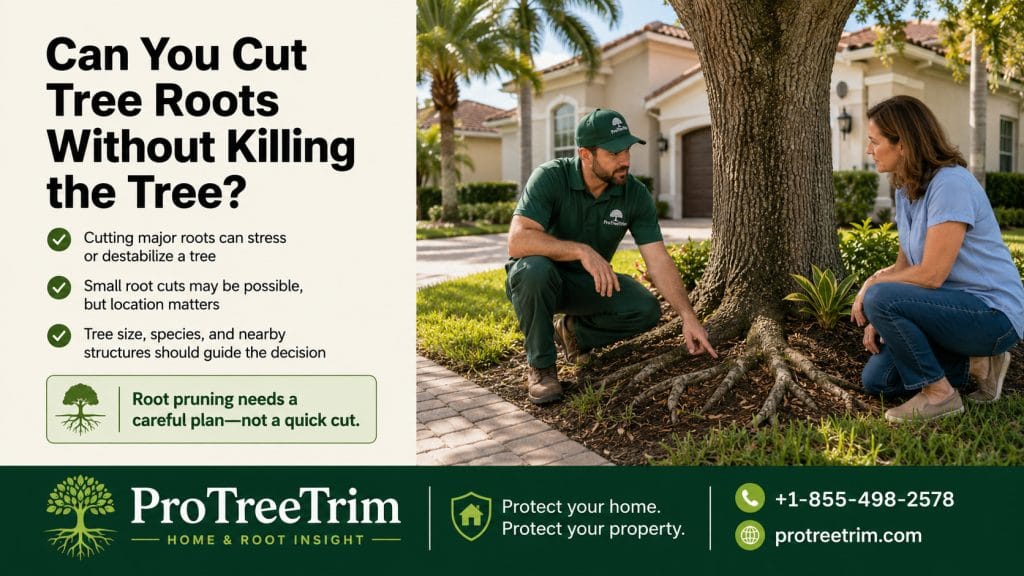
Sometimes you can cut a small tree root without killing the tree. But cutting large roots, roots close to the trunk, or several roots at once can seriously harm the tree. It can also affect stability, especially during wind, heavy rain, or saturated soil.
Homeowners usually ask this question because roots are lifting a sidewalk, cracking a driveway, disturbing pavers, growing near a patio, or showing above the lawn. The root may be inconvenient, but it may also be helping the tree stay alive and anchored.
The safest answer is: do not cut tree roots until you understand which root it is, how close it is to the trunk, and what the tree could hit if it becomes unstable.
Not All Tree Roots Are Equal
Some roots are small absorbing roots. Some are larger structural roots. Some are close to the trunk and help anchor the tree. Others are farther away and may be less critical.
The risk depends on the root’s size, location, and role.
| Root situation | Risk level |
|---|---|
| Small fine root far from trunk | Usually lower risk |
| One small surface root in lawn | May be manageable |
| Large root close to trunk | Higher risk |
| Several roots being cut | Much higher stress |
| Root on side of tree supporting lean | Stability concern |
| Root near driveway or house | Consequences may be higher |
| Root from declining tree | Tree may not tolerate more damage |
| Root under major hardscape | Repair and stability decisions overlap |
A root that looks like a nuisance may be part of the tree’s support system.
Distance From the Trunk Matters
The closer a root is to the trunk, the more cautious you should be. Roots near the trunk are more likely to be important for stability and tree function. Cutting them can create stress that may not show immediately.
Before cutting any root, ask:
- How far is the root from the trunk?
- How large is the root?
- Is the root connected to a visible surface flare?
- Is the tree leaning?
- Is the canopy healthy?
- Are there dead limbs?
- Is the tree near a house, driveway, patio, or sidewalk?
- Would more than one root need to be cut?
If the root is large and close to the trunk, slow down.
Cutting Roots Can Affect Stability
Tree roots do more than absorb water. They help anchor the tree. When important roots are cut, the tree may become less stable, especially if soil is wet or wind is strong.
This matters most when the tree is near:
- homes
- driveways
- sidewalks
- patios
- pool cages
- fences
- parked vehicles
- outdoor seating areas
- neighbor property
- utility areas
A tree that becomes unstable in open woods is one issue. A tree that becomes unstable beside a house or driveway is another.
Cutting Roots Can Cause Delayed Decline
A tree may not look bad immediately after roots are cut. Decline can show up weeks, months, or even later as the canopy struggles to get enough water and nutrients.
Possible delayed symptoms include:
- leaf browning
- early leaf drop
- branch dieback
- thinning canopy
- smaller leaves
- dead top
- increased deadwood
- reduced growth
- stress shoots
- greater vulnerability to pests or disease
This delay is why root cutting can seem safe at first, then become a problem later.
Root Cutting Near Sidewalks
Roots lifting a sidewalk may create a trip hazard, but cutting the roots can damage the tree. In many cases, the sidewalk and the tree should be evaluated together.
Before cutting roots near a sidewalk, check:
- Is the sidewalk public or private?
- Are local rules or permits involved?
- Is the root large?
- Is the root close to the trunk?
- Can the sidewalk be ground, adjusted, or rerouted?
- Is the tree healthy enough to preserve?
- Would cutting the root make the tree unstable?
Sometimes the surface can be repaired without cutting major roots. Sometimes tree removal is more realistic than root cutting.
Root Cutting Near Driveways
Driveway roots are frustrating because they can crack concrete, lift asphalt, or shift pavers. But driveways are often close to large trees, and the roots involved may be substantial.
Root cutting near driveways is more concerning when:
- several roots are involved
- roots are close to the trunk
- the tree leans toward the driveway or house
- the driveway repair requires excavation
- heavy equipment will compact the root zone
- the tree already has dead limbs or thinning canopy
A driveway repair should not create a tree hazard over the same driveway.
Root Cutting Near Patios and Pavers
Pavers can sometimes be reset around roots, which may reduce the need for cutting. But root damage can still happen during excavation, base preparation, or compaction.
Before cutting patio roots, ask:
- Can the pavers be adjusted around the root?
- Can the tree bed be expanded?
- Is the patio too close to the tree?
- Would cutting the root affect stability?
- Is the tree shading or dropping branches over the same patio?
- Has this paver area lifted before?
If the tree and patio keep fighting each other, the long-term answer may be redesign or removal, not repeated root cutting.
Root Cutting Near a House
Homeowners often worry about roots near foundations. The situation is usually more complicated than “root touches house, cut root.” Drainage, soil movement, hardscape, planting distance, and tree size all matter.
Do not cut major roots near a house without evaluating the whole situation.
Check:
- distance from trunk to wall
- drainage near foundation
- roots under walkway or patio
- branches touching roof or gutters
- tree lean
- canopy health
- soil movement
- existing cracks or water issues
Cutting roots near the house may reduce one concern while increasing another if the tree becomes unstable.
Root Cutting Near Septic or Utilities
Roots near septic systems, pipes, irrigation lines, or utilities require extra caution. Digging blindly can damage infrastructure, and cutting roots may not solve the underlying moisture or placement issue.
Before any digging or cutting:
- know where utilities are located
- avoid guessing septic layout
- check irrigation lines
- consider drainage patterns
- understand whether roots are entering a damaged line
- avoid cutting large roots close to the trunk
- preserve access for repairs
If roots and utilities are in conflict, the decision may require both tree and utility expertise.
Small Roots Are Usually Less Risky Than Large Roots
Small roots farther from the trunk are generally less risky to cut than large roots close to the trunk. But even small roots matter if many are removed, especially during drought, heat, transplant stress, or construction.
Root cutting risk increases when:
| Factor | Why it matters |
|---|---|
| Root is large | More important to support and function |
| Root is close to trunk | Stability risk increases |
| Multiple roots are cut | Cumulative stress increases |
| Tree is mature | Established roots are harder to replace |
| Tree is already stressed | Less recovery capacity |
| Soil is wet or loose | Stability matters more |
| Canopy is thin | Root stress may already exist |
| Tree is near targets | Consequences are higher |
The number and size of roots matter together.
Do Not Cut Roots Just to Make Mowing Easier
Exposed roots in a lawn are annoying. They can make mowing difficult, create uneven ground, and damage mower blades. But cutting them for mowing convenience is usually the wrong first move.
Better options include:
- expanding the mulch bed
- stopping mowing over roots
- using a shallow mulch layer
- redirecting foot traffic
- avoiding soil buildup over roots
- reducing string-trimmer damage
- accepting that grass may not grow well under the tree
A mower problem should not become a tree-stability problem.
Do Not Bury Roots After Cutting or Repair
Some homeowners try to cover roots with soil, gravel, rocks, or paver base material after cutting or repair. Deep cover can reduce oxygen and stress the root zone.
Avoid:
- piling soil over roots
- burying the root flare
- adding thick gravel over major roots
- packing sand against the trunk
- installing fabric over roots
- building raised beds against the tree
- hiding root wounds under mulch piles
Roots need oxygen. The trunk base should stay visible.
Root Barriers Are Not a Simple Fix
Root barriers can sometimes be useful in planned landscapes, but they are not a magic solution for an existing mature tree. Installing a barrier often requires trenching, and trenching can cut roots.
A root barrier may be less useful when:
- the tree is already mature
- roots are already under the hardscape
- the tree is very close to the structure
- trenching would cut major roots
- the root conflict is severe
- the tree is already declining
Root barriers work best when planned early, not used as a desperate fix after major damage appears.
Root Cutting Can Invite Decay or Pests
A cut root is a wound. Large root wounds can decay, especially if soil conditions are wet or oxygen is limited. Root decay can affect tree health and stability over time.
Watch for warning signs after root damage:
- mushrooms near the base
- canopy thinning
- branch dieback
- soft or decaying root areas
- new lean
- soil lifting
- bark cracks
- increased deadwood
The root cut may be hidden underground, but the tree may show symptoms above ground later.
When Root Cutting May Be More Acceptable
Root cutting may be lower risk when the root is small, farther from the trunk, and the tree is otherwise healthy. Even then, the cut should be clean and limited.
Root cutting may be more reasonable when:
- the root is small
- the root is far from the trunk
- only one minor root is involved
- the tree is young and vigorous
- the canopy is healthy
- the tree is not leaning
- the tree is not near major targets
- the cut is part of a careful repair plan
This does not mean it is automatically safe. It means the risk may be lower.
When Root Cutting Is a Bad Idea
Root cutting is a bad idea when it removes large structural roots, cuts close to the trunk, or affects several roots at once.
Avoid root cutting when:
- the root is large and close to the trunk
- the tree is leaning
- the tree is mature and large
- several roots must be cut
- the tree has canopy decline
- the trunk has cracks or decay
- soil is saturated or unstable
- the tree is near a house, driveway, walkway, or patio
- the root is part of the visible root flare
In these cases, the tree may need evaluation before any hardscape repair continues.
When Tree Removal May Be Safer Than Root Cutting
Sometimes the conflict is too severe. If repairing the driveway, sidewalk, patio, or utility line requires cutting major roots, the better long-term decision may be tree removal.
Removal may need discussion when:
- major roots must be cut for repair
- the tree is too close to hardscape
- the tree is already declining
- the tree leans toward a structure
- roots have lifted multiple surfaces
- repairs have failed before
- the tree has trunk decay or cracks
- the tree is too large for the site
- root cutting would leave the tree unstable
Removing a tree is a big decision. But leaving a compromised tree after major root cutting can be worse.
What Homeowners Should Photograph Before Root Cutting
Before any root work, take photos.
Photograph:
- full tree from several angles
- the root being considered for cutting
- distance from root to trunk
- trunk base and root flare
- canopy condition
- any lean
- dead limbs
- nearby driveway, sidewalk, patio, or house
- drainage or erosion
- hardscape damage
Photos help compare the tree before and after work and help explain the situation to professionals.
What to Do First
A practical first response:
- Do not cut the root immediately.
- Identify how large and how close it is to the trunk.
- Check whether the tree is leaning or declining.
- Look at what the tree could hit if it failed.
- Consider whether hardscape can be adjusted instead.
- Avoid burying roots under deep soil or gravel.
- Do not install barriers without understanding root damage.
- Get help before cutting large roots or multiple roots.
Root decisions should be slow and careful.
Final Homeowner Takeaway
You can sometimes cut small tree roots without killing the tree, but cutting large roots or roots close to the trunk can seriously harm tree health and stability. The danger is not always immediate. Root damage can show up later as canopy decline, dead branches, decay, or instability.
Before cutting roots, look at root size, trunk distance, tree health, lean, nearby structures, and whether the hardscape can be repaired around the roots. If major roots must be cut, tree removal may be safer than leaving a weakened tree in place.
If you are unsure whether a tree root can be cut safely—or whether repair, root protection, or removal is the better option—ProTreeTrim can help connect homeowners with local tree service support. Call +1-855-498-2578 or visit protreetrim.com.
FAQs
Can cutting tree roots kill a tree?
Yes, especially if large roots, roots close to the trunk, or several roots are cut. The tree may decline immediately or over time.
How close to the trunk can roots be cut?
Roots close to the trunk are usually more important and riskier to cut. They should not be cut casually.
Is it safe to cut roots that are lifting concrete?
Not always. Roots lifting concrete may be large and important. The concrete repair should be planned around tree health and stability.
What should I do instead of cutting exposed roots?
Consider a shallow mulch bed, hardscape adjustment, drainage correction, or professional evaluation before cutting roots.
ProTreeTrim™ can help you take the next step.
If you are dealing with a damaged tree, fallen branch, stump, root issue, palm concern, or storm cleanup question in Florida, call ProTreeTrim for tree service support.