
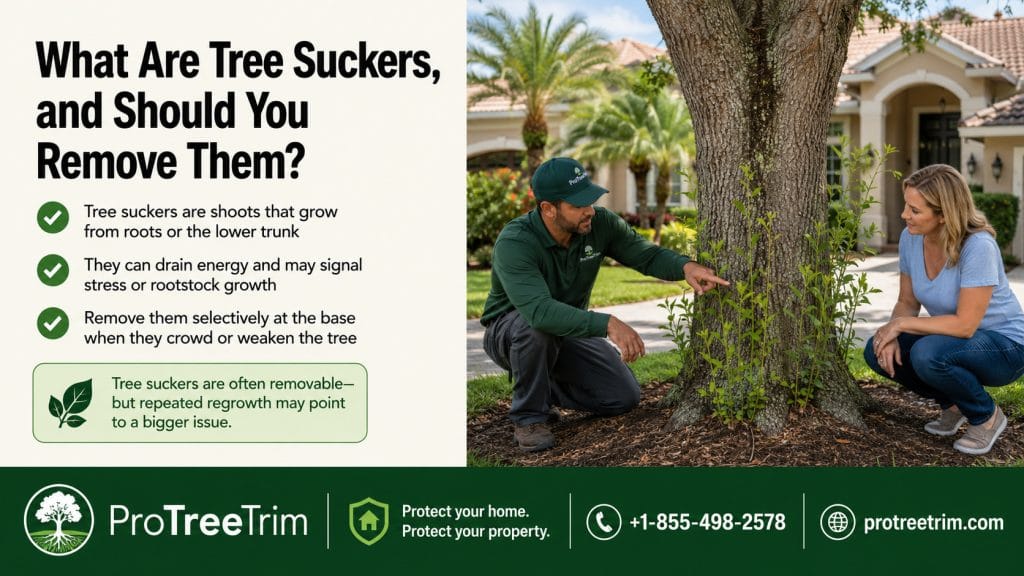
Tree suckers are fast-growing shoots that often appear from the base of a tree, along surface roots, or low on the trunk. They can make a tree look messy, but they are also a clue. Sometimes suckers are normal for the species. Other times, they show that the tree is stressed, damaged, grafted, over-pruned, or struggling below ground.
Suckers Are Not Always the Real Problem
A sucker is usually a vigorous shoot growing from the root system, root flare, lower trunk, or graft area. It may look like a small new tree coming up beside the main trunk.
Homeowners often want to cut them immediately because they make the yard look untidy. That may be fine, but first ask why they are there.
| Where suckers appear | What it may suggest |
|---|---|
| Around the trunk base | Stress, root flare issues, or species habit |
| From surface roots | Root disturbance or natural suckering behavior |
| Below a graft union | Rootstock growth may be taking over |
| After heavy pruning | Tree may be replacing lost canopy |
| After construction or trenching | Root stress may be involved |
| Around an old stump | Remaining roots may still be alive |
| Near a declining tree | Tree may be responding to stress or damage |
The sucker growth itself may not be dangerous. The condition that triggered it may matter more.
Cut Them Cleanly, but Do Not Tear the Bark
If suckers are small, they are usually easier to remove cleanly. The goal is to cut them close to their origin without ripping bark, gouging roots, or cutting into the main trunk.
Do not pull large suckers off by hand if they resist. Tearing them can create wounds that are worse than a clean cut. Do not dig aggressively around major roots just to remove every shoot. If suckers are coming from surface roots across the lawn, mowing them repeatedly may keep them short, but it does not solve the reason they keep returning.
For small suckers:
- Use clean, sharp hand pruners.
- Cut close to the point of origin.
- Avoid tearing bark.
- Avoid cutting into the root flare.
- Do not leave long stubs.
- Watch whether they return quickly.
If they return in large numbers, treat that as information, not just a nuisance.
Suckers Below a Graft Can Be a Bigger Deal
Some landscape trees are grafted. That means the top of the tree and the root system may come from different plant material. If shoots grow from below the graft union, they may not match the tree you want.
These shoots can grow fast and compete with the main tree. On some ornamentals and fruiting trees, rootstock suckers may look different from the desired canopy. If left alone, they can draw energy and change the tree’s shape.
If you see strong shoots below a visible graft swelling, remove them while they are small. If the main canopy is also declining, the sucker growth may be a sign that the top of the tree is struggling while the rootstock is still vigorous.
Why Suckers Often Show Up After Stress
Trees sometimes produce suckers after stress because they are trying to replace lost leaf area or respond to injury. That stress may be obvious, like heavy pruning or storm damage. It may also be hidden, like root damage from a driveway repair, compacted soil, overwatering, drought, or buried root flare.
Look for the bigger pattern:
- Did suckers appear after pruning?
- Did construction happen near the roots?
- Is mulch piled against the trunk?
- Are leaves smaller than usual?
- Are branch tips dying back?
- Is the tree dropping leaves early?
- Are roots exposed or damaged?
- Is the trunk cracked, hollow, or oozing?
A healthy tree with a few occasional suckers may not be a concern. A stressed tree pushing dozens of suckers while the canopy thins deserves closer attention.
Suckers Around an Old Stump
Suckers can also grow from roots left behind after a tree was cut down. That is common with some species. The stump may be gone or cut low, but living roots may still send up shoots around the yard.
This can become frustrating when suckers keep popping up through lawn, mulch, pavers, or fence-line beds. Cutting the shoots may manage appearance, but the root system may continue trying to regrow for a while.
If the stump is still present, stump grinding may reduce the problem, though it does not always remove every root. If roots are near irrigation, pavers, septic areas, pool decks, or utilities, cleanup needs to be planned carefully.
When You Should Not Ignore Suckers
Suckers deserve more attention when they appear with signs of decline or structural trouble.
Pay closer attention if you see:
- thinning canopy
- dead branch tips
- large dead limbs
- trunk cracks
- mushrooms near the base
- bark loss or soft wood
- sudden heavy sucker growth
- root damage or soil movement
- a new lean after rain or wind
If the tree is near a roof, driveway, pool cage, fence, walkway, parked vehicle area, or utility line, those warning signs matter more. Suckers alone are usually not the risk. Suckers plus decline may be part of a larger tree-health story.
Should You Keep Any Suckers?
Usually, suckers from the base of an established landscape tree are removed because they crowd the trunk, make maintenance harder, and compete with the main canopy.
There are exceptions. If a multi-stem tree or shrub-like species naturally grows that way, the shoots may be part of its form. If an old tree has failed and the homeowner intentionally wants regrowth from the base, that becomes a different landscape decision. But for most yard trees, random sucker growth is not something to encourage.
What Homeowners Should Do First
Start with simple cleanup and observation.
Remove small suckers cleanly if they are easy to reach. Pull mulch away from the trunk if it is hiding the root flare. Keep mowers and string trimmers from wounding the base. Check irrigation so the trunk is not being soaked every day. Take photos if sucker growth suddenly increases.
If suckers keep returning heavily, do not just keep cutting without asking why. The tree may be telling you something about stress, root damage, poor pruning history, or decline.
If you are unsure whether tree suckers are normal growth, stress response, rootstock growth, or a sign of a larger tree issue, ProTreeTrim can help connect homeowners with local tree service support. Call +1-855-498-2578 or visit protreetrim.com.
FAQs
Are tree suckers bad?
Not always. A few suckers may be normal for some trees, but heavy sucker growth can point to stress, root damage, graft issues, or poor pruning history.
Should I cut suckers off a tree?
Usually yes, especially when they grow from the trunk base, roots, or below a graft. Remove them cleanly while they are small.
Why do suckers keep growing back?
They may return because the tree is stressed, the species naturally suckers, the roots are still alive after removal, or shoots are growing from rootstock.
Can suckers mean the tree is dying?
They can be one clue, but not proof by themselves. Worry more if suckers appear with canopy thinning, dead limbs, trunk cracks, mushrooms, root damage, or leaning.
ProTreeTrim™ can help you take the next step.
If you are dealing with a damaged tree, fallen branch, stump, root issue, palm concern, or storm cleanup question in Florida, call ProTreeTrim for tree service support.