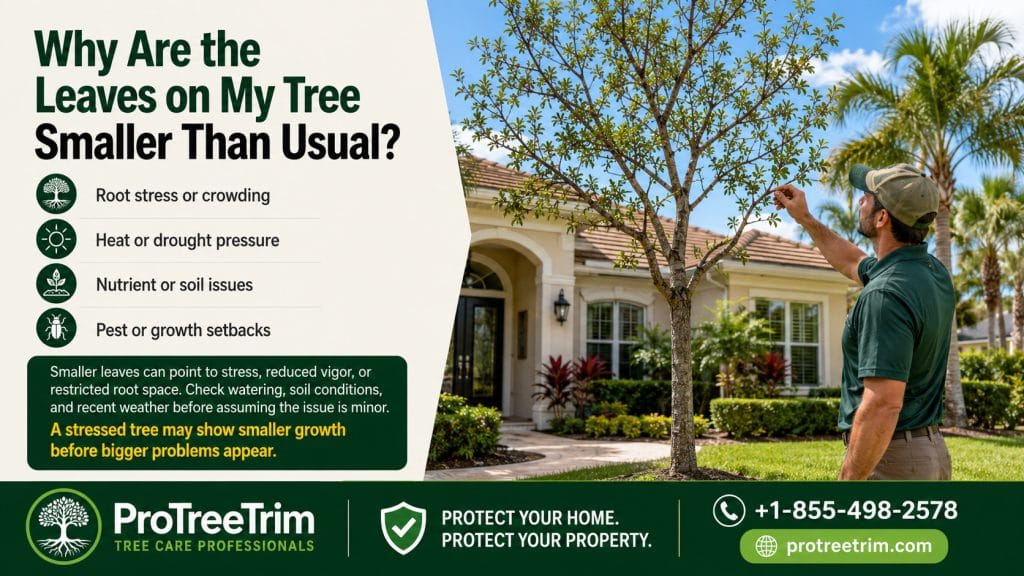
Smaller-than-usual leaves are easy to overlook because the tree may still look “green enough” from the street. But reduced leaf size can be a clue that the tree is conserving energy, dealing with root stress, recovering from damage, or struggling with water, soil, pest, or nutrient issues. The pattern matters more than one branch.
Small Leaves Usually Point Back to Stress
A tree does not make smaller leaves for no reason. Sometimes it is a normal seasonal response. Sometimes it happens after transplanting, drought, heavy pruning, root disturbance, or a rough weather cycle. A tree may still leaf out, but the new growth looks thinner, smaller, or weaker than last year.
Start with the whole canopy. Are all leaves smaller, or only one side? Is the top thin? Are branches at the tips dying back? Did the issue appear after driveway work, trenching, paver repair, irrigation changes, or storm damage?
ISA’s TreesAreGood plant health guidance lists discolored leaves, dead branches, and early leaf drop as symptoms that may justify a closer look by an arborist; small leaves fit into that same “watch the pattern” mindset rather than a quick diagnosis.
| What you notice | What to check first |
|---|---|
| Smaller leaves across the whole tree | Drought stress, root health, soil moisture |
| Smaller leaves on one side | Root damage, reflected heat, irrigation pattern |
| Small leaves plus dead branch tips | Root stress, drought, construction injury, decline |
| Small leaves after heavy pruning | Recovery stress or weak regrowth |
| Small leaves near driveway or pavers | Heat, compacted soil, root restriction |
| Small leaves plus yellowing | Water, nutrients, soil pH, or root problems |
| Small leaves plus insects or sticky residue | Pest pressure may be involved |
Look at Water Before Fertilizer
The first fix many homeowners think of is fertilizer. Sometimes soil nutrition matters, but small leaves are often tied to water movement and root function.
Drought-stressed trees may develop a sparse canopy and fewer new branches, according to Utah State University Extension guidance on trees adapting to low-water landscapes. Heat can also make trees show drought-like stress because so much of a tree’s water use goes toward cooling leaf surfaces. Oregon State University Extension explains that on very hot days, a tree may not move enough water to meet cooling needs even when some moisture is present in the soil.
But more water is not always the answer. Overwatering can create similar stress signs because saturated soil limits oxygen around roots. Utah State University’s irrigation guidance notes that overwatering can cause browning symptoms and leaf drop because roots need oxygen to survive.
Before changing anything, check the soil a few inches down. Is it dry, damp, soggy, compacted, or sour-smelling? Does mulch hide the root flare? Is a sprinkler head soaking one side every day? Is roof runoff or pool deck drainage flowing into the same tree bed?
Root Trouble Can Show Up in the Leaves
Small leaves may be the canopy’s way of showing a root-zone problem. The tree may not be able to support normal growth if roots were cut, buried, compacted, dried out, flooded, or damaged by construction.
This is common around real homes. A walkway gets reset. A fence post is dug. A driveway edge is widened. A stump is ground nearby. Irrigation work cuts through a bed. Months later, the homeowner notices the leaves are smaller and the canopy is thinner.
Do not dig around major roots to investigate. That can make the problem worse. Instead, document what you can see:
- exposed roots or soil washout
- lifted pavers or driveway edges
- mulch piled against the trunk
- soft soil near the base
- mushrooms or sawdust-like material
- trunk cracks or bark loss
- recent digging, grading, trenching, or hardscape work
If the tree is near a roof, driveway, pool cage, fence, walkway, or utility area, small leaves become part of a broader decision. The issue may not be urgent by itself, but it can help explain a pattern of decline before larger limbs become a concern.
When Small Leaves Deserve More Attention
A tree with slightly smaller leaves but otherwise steady growth may simply need monitoring. Take photos from the same spot every couple of weeks and compare them to older yard photos if you have them.
Pay closer attention if smaller leaves appear with:
- dead branches
- early leaf drop
- one-sided canopy thinning
- trunk cracks
- mushrooms near the base
- bark peeling or oozing
- sawdust at the trunk
- a new lean
- large limbs over high-use areas
Small leaves are not a removal sign by themselves. They are a reason to slow down and read the whole tree. The decision is not “fertilize or remove.” It is: what changed, where is the stress showing, and does the tree create a property risk if decline continues?
If you are unsure whether small leaves, root stress, canopy thinning, or dead limbs point to a larger tree issue, ProTreeTrim can help connect homeowners with local tree service support. Call +1-855-498-2578 or visit protreetrim.com.
FAQs
Do small leaves mean my tree is dying?
Not necessarily. Small leaves can come from drought, root stress, transplant shock, pruning recovery, pests, or soil issues. Look for spreading decline, dead branches, or trunk and root problems.
Should I fertilize a tree with smaller leaves?
Not as the first step. Check water, soil, root damage, mulch depth, and recent yard work first. Fertilizer will not fix compacted, damaged, dry, or waterlogged roots.
Can heat make tree leaves smaller?
Heat and water stress can reduce normal growth. A tree may produce smaller leaves or a thinner canopy when it cannot move enough water to support full growth.
When should I get help for small leaves?
Get help sooner if small leaves appear with dead limbs, canopy thinning, root movement, trunk cracks, mushrooms, bark loss, or branches over a roof, driveway, pool cage, walkway, or utility area.
ProTreeTrim™ can help you take the next step.
If you are dealing with a damaged tree, fallen branch, stump, root issue, palm concern, or storm cleanup question in Florida, call ProTreeTrim for tree service support.