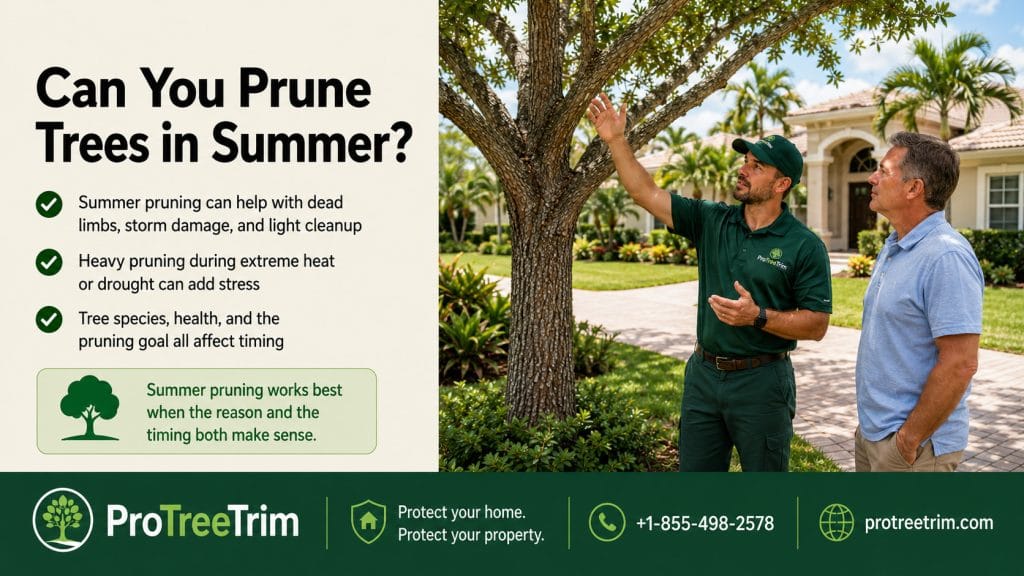
You can prune some trees in summer, but summer is not always the best time for every pruning job. Light pruning, dead branch removal, clearance pruning, and storm-damage cleanup may be appropriate when there is a clear reason. Heavy pruning during extreme heat, drought, or active stress can make a tree’s condition worse.
The key question is not simply “Can I prune in summer?”
It is “What am I removing, why am I removing it, and is the tree healthy enough for that cut?”
Summer Pruning Is Not Automatically Bad
There is a common belief that trees should never be pruned in summer. That is too simple. Some summer pruning can be useful, especially when it is light, selective, and focused on a real problem.
Summer pruning may make sense when:
- a dead branch is hanging over a driveway
- a limb is touching the roof
- branches block a walkway or street view
- storm damage left broken limbs
- a young tree needs minor correction
- a palm has dead fronds over a pool cage
- a branch is rubbing a structure
- a tree has dangerous hanging material
Pruning becomes risky when homeowners use summer as an excuse for heavy shaping, topping, aggressive thinning, or cutting a stressed tree too hard.
Heat and Drought Change the Decision
Summer heat increases stress on trees. If the soil is dry, leaves are browning, the canopy is thin, or the tree recently experienced root damage, heavy pruning can remove energy-producing leaf area at the wrong time.
Be more cautious when the tree is already dealing with:
| Stress sign | Why summer pruning may be risky |
|---|---|
| Brown leaf edges | Heat or water stress may already be present |
| Wilting leaves | Roots may not be keeping up |
| Early leaf drop | Tree may be reducing demand |
| Thin canopy | Tree has less energy-producing foliage |
| Recent transplanting | Roots are still recovering |
| Construction near roots | Root system may already be damaged |
| Standing water | Roots may be oxygen-stressed |
| Pest activity | Tree may already be weakened |
A stressed tree may need dead or hazardous branches removed, but it usually does not need aggressive cosmetic pruning.
Dead Branches Can Be Removed Any Time
Dead branches do not follow a seasonal calendar. If a branch is dead, broken, cracked, or hanging over a high-use area, it may need attention even in summer.
This is especially true when deadwood is over:
- driveways
- sidewalks
- patios
- pool cages
- rooflines
- fences
- parked vehicles
- outdoor seating areas
- children’s play areas
- neighbor property
A dead branch over open lawn may be less urgent. A dead branch over a driveway is different.
Light Clearance Pruning May Be Reasonable
Summer can be a practical time to correct small clearance problems because the canopy is full and the conflict is visible. You can see which branches are touching the roof, blocking the walkway, hanging into the driveway, or rubbing against a fence.
Light clearance pruning may help with:
- branches touching gutters
- limbs brushing siding
- driveway clearance
- walkway clearance
- branches blocking windows
- limbs interfering with gates
- branches touching pool cages
- small branches rubbing a roofline
The work should be limited and specific. It should not turn into a heavy canopy reduction unless there is a strong reason and the tree can tolerate it.
Avoid Heavy Summer Pruning on Stressed Trees
Heavy pruning removes a lot of foliage. In summer, that can expose bark and branches to sun, reduce the tree’s food production, and add stress during hot weather.
Avoid heavy summer pruning when:
- the tree is drought-stressed
- leaves are already browning
- the tree was recently planted
- roots were recently disturbed
- the tree is recovering from storm damage
- the canopy is already thin
- pests or disease are active
- the goal is only to “make it smaller”
- the work would remove large healthy limbs
A tree that is already struggling needs careful support, not a major haircut.
Summer Pruning Can Reveal Problems
One advantage of summer pruning is that the tree is in leaf. That makes it easier to see dead branches, weak areas, thinning sections, and branches that are not producing foliage.
In summer, you may notice:
- one branch with no leaves
- one side of the canopy thinning
- dead tips at the top
- branches rubbing the roof
- leaves browning only beyond a certain branch point
- storm cracks hidden earlier
- branches shading or crowding the house
Summer visibility can help identify what needs attention. It does not mean everything visible should be cut.
Palms Are Different
Palm pruning is not the same as pruning an oak, maple, pine, or crape myrtle. Palms may be trimmed in summer when there are dead fronds, broken fronds, heavy seed pods, or fronds touching roofs, pool cages, driveways, or walkways.
But palms should not be hurricane-cut or stripped of healthy green fronds just because it is summer or storm season.
A good summer palm pruning scope might include:
- remove fully dead fronds
- remove broken hanging fronds
- remove seed pods over the pool deck
- clear fronds touching the pool cage
- preserve healthy green crown
A poor scope would be cutting off most green fronds to make the palm look “clean.”
Oaks Need Extra Care
Oak pruning should always be purposeful. Large oaks can be sensitive to poor cuts, over-thinning, and removal of major live limbs. Summer pruning may be appropriate for deadwood, storm damage, or roof clearance, but heavy cutting should be considered carefully.
Prune an oak in summer only when there is a clear reason, such as:
- dead limb over driveway
- branch touching roof
- broken storm limb
- cracked branch
- rubbing branch
- clearance issue
- hazardous hanging limb
Avoid topping, excessive thinning, or removing large healthy limbs just for appearance.
Newly Planted Trees Should Usually Be Left Alone
A newly planted tree is already under stress. Its roots are adjusting, and the canopy is trying to stay alive while the tree establishes. Summer pruning can add stress if too much live foliage is removed.
For new trees, only remove:
- broken branches
- dead branches
- damaged branches
- branches that create immediate safety issues
- small structural problems if correction is clearly needed
Do not shape a newly planted tree heavily in summer. Let it establish first.
Summer Storm Damage Is an Exception
Storm damage should be handled when it happens, not months later, especially if branches are broken, hanging, or resting on structures.
After a summer storm, focus on safety first:
- stay away from power lines
- keep people away from hanging limbs
- photograph damage before cleanup
- remove broken hazardous branches
- avoid over-pruning the remaining canopy
- check for trunk splits or root movement
- do not assume every damaged tree must be removed
Storm cleanup should make the tree and property safer without cutting more than necessary.
Do Not Top Trees in Summer
Topping is not good summer pruning. It removes major parts of the canopy, creates large wounds, triggers weak regrowth, and can permanently damage structure.
Topping is especially harmful when the tree is already under heat or drought stress.
Avoid requests like:
- “Cut it in half.”
- “Take the top off.”
- “Make it much smaller.”
- “Remove most of the branches.”
- “Thin it out hard.”
- “Cut everything back from the house.”
A better approach is selective pruning based on branch structure, clearance, and risk.
Watch for Sunscald After Heavy Cuts
When a tree is heavily pruned in summer, bark that was previously shaded may suddenly be exposed to intense sun. This can increase the risk of sunscald or bark injury, especially on thin-barked trees.
This is one reason aggressive summer thinning can backfire.
Be cautious with heavy pruning on:
- young trees
- thin-barked trees
- recently planted trees
- trees near reflected heat
- trees with already exposed trunks
- trees that were previously shaded
- trees in hot front yards or near pavement
Shade from the canopy protects parts of the tree. Removing too much at once changes that environment.
Fruit and Ornamental Trees May Have Special Timing
Some fruiting and flowering trees have pruning windows that depend on bloom timing, fruiting, disease concerns, and local climate. Summer pruning may be useful in some cases and harmful in others.
For ornamental trees like crape myrtle, the bigger concern is often poor pruning style. Cutting them back hard every year is not good care, no matter the season.
For flowering and fruiting trees, ask:
- Does this tree bloom on old or new growth?
- Am I removing next season’s flower buds?
- Is the tree healthy or stressed?
- Is the goal fruit, flowers, structure, or clearance?
- Am I cutting because of a real issue or just habit?
The timing should match the tree’s purpose.
Summer Pruning Near Roofs and Gutters
Summer is often when homeowners notice branches touching the roof because leaves are full and storms are frequent. If branches are rubbing shingles, pressing into gutters, or dropping debris into roof valleys, selective pruning may make sense.
Roof-related pruning should focus on:
- removing rubbing branches
- clearing gutter contact
- reducing branch contact with shingles
- removing deadwood above the roof
- avoiding large unnecessary cuts
- preserving tree structure
The goal is clearance, not cutting the entire side of the tree flat.
Summer Pruning Near Driveways and Walkways
Low branches can become more noticeable in summer when foliage is heavy. A branch that barely cleared the driveway in winter may hang lower in summer.
Pruning may be reasonable when branches:
- hit vehicles
- block walking paths
- hide signs or visibility
- interfere with gates
- obstruct service access
- hang over outdoor seating
- create repeated contact with people or property
Clearance pruning should be gradual and balanced. Removing all lower limbs at once can harm the tree’s form and stability.
When Summer Pruning Should Wait
Waiting may be better when the tree is healthy but the pruning goal is cosmetic.
Summer pruning may be better delayed if:
- the tree is drought-stressed
- the canopy is already thin
- the requested cuts are large
- the goal is only size reduction
- the tree was recently transplanted
- there is active construction stress
- the tree has widespread browning
- the cuts are not urgent
- pruning would remove a large amount of live canopy
If there is no safety issue, patience can be the better tree-care choice.
When Summer Pruning Should Not Wait
Summer pruning should not wait when the issue affects safety, access, or property damage.
Handle it sooner when:
| Situation | Why action may be needed |
|---|---|
| Broken branch hanging | Could fall unpredictably |
| Dead limb over driveway | People and vehicles are exposed |
| Branch touching roof | Can damage shingles or gutters |
| Limb blocking walkway | Access and safety concern |
| Palm frond over pool cage | Screen damage possible |
| Cracked branch after storm | Failure risk may increase |
| Branch near service lines | Safety issue; use proper help |
Urgent pruning should be limited to solving the urgent problem.
What Homeowners Should Ask Before Summer Pruning
Before approving summer pruning, ask:
- What exact branches are being removed?
- Why are they being removed?
- Are they dead, broken, rubbing, or hazardous?
- How much live canopy will be removed?
- Is the tree already stressed?
- Will the cuts expose bark to harsh sun?
- Is this pruning urgent or cosmetic?
- Can the work wait until a better season?
- Is the tree near wires or structures?
A good pruning plan should have specific reasons.
Final Homeowner Takeaway
Summer pruning can be fine when it is light, selective, and done for a clear reason such as deadwood, storm damage, clearance, or safety. It becomes risky when it removes too much live canopy, targets a stressed tree, or tries to force a large tree smaller during hot weather.
Do not top trees in summer. Do not heavily prune drought-stressed trees. Do remove hazardous dead or broken branches when needed. The best summer pruning is careful, limited, and based on the tree’s condition.
If you are unsure whether summer pruning is safe for your tree or whether the work should wait, ProTreeTrim can help connect homeowners with local tree service support. Call +1-855-498-2578 or visit protreetrim.com.
FAQs
Can trees be pruned in summer?
Yes, especially for deadwood, light clearance, storm damage, or safety issues. Heavy pruning during heat or stress should be avoided.
Is summer a bad time to trim trees?
Not always. It depends on the tree, weather, health, species, and pruning purpose.
Can I remove dead branches in summer?
Yes. Dead, broken, cracked, or hanging branches can usually be removed when they create a risk or clearance problem.
Should I heavily prune a tree during summer heat?
Usually no. Heavy pruning during heat, drought, or active stress can remove too much live canopy and make the tree weaker.
ProTreeTrim™ can help you take the next step.
If you are dealing with a damaged tree, fallen branch, stump, root issue, palm concern, or storm cleanup question in Florida, call ProTreeTrim for tree service support.