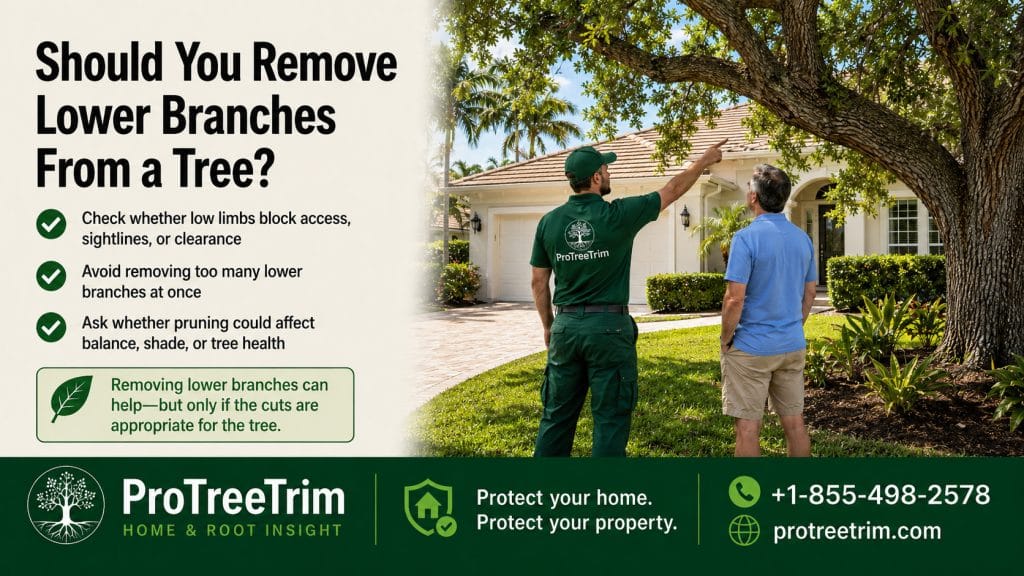
Lower branches should not be removed just because they look low. Sometimes they protect the trunk, feed the tree, and help the tree develop a stronger structure. Other times, low limbs block a driveway, scrape a roof, hit vehicles, crowd a walkway, or make the yard hard to use. The right decision depends on the tree’s age, health, branch size, location, and the reason for pruning.
Start With the Problem the Branch Is Causing
A low branch over open lawn may not need to be touched. A low branch hitting the roof, blocking the driveway, or forcing people to duck along a walkway is different.
This type of pruning is often called raising the canopy or crown raising. UF/IFAS pruning guidance notes that shortening or removing low branches can raise a tree’s crown, but also points out that regular pruning may be needed when clearance is being maintained around buildings, lights, or utility areas.
| Low branch situation | Better decision |
|---|---|
| Branch shades open lawn | Usually not urgent |
| Branch blocks sidewalk or entry path | Selective pruning may help |
| Branch scrapes vehicle roof | Clearance pruning may be needed |
| Branch touches roof or gutter | Address before damage worsens |
| Branch is dead or cracked | Remove carefully, especially over targets |
| Branch is large and attached low on trunk | Do not rush; removal may create a large wound |
| Branch is near utility lines | Contact utility first |
Young Trees and Mature Trees Need Different Thinking
On a young tree, lower branches can be part of good structure while the tree is still developing. Removing too many too early can leave a tall, thin trunk with less taper and less protection from sun and mechanical injury.
On a mature tree, removing a large lower limb can leave a major wound and change the look, shade, and balance of the canopy. That does not mean lower branches should never come off. It means the cut should have a clear reason.
University of Minnesota Extension recommends making pruning cuts close to the branch collar and avoiding stubs; it also explains that thinning cuts remove entire branches at the branch collar and are usually the preferred type of cut.
Do Not Remove a Big Lower Limb Just for a Cleaner Look
A large low limb can make a tree look heavy or messy, especially near a front yard, driveway, or patio. But removing it may not be simple.
Large lower limbs often contribute a lot of leaf area. They may also be part of the tree’s natural shape. Cutting them off can expose bark to sun, create a large pruning wound, or make the canopy look unbalanced. If the tree is already stressed by drought, root damage, construction, pests, or soil compaction, heavy live pruning can add pressure.
Before approving removal of a large lower limb, ask:
- Is the limb dead, damaged, or structurally weak?
- Is it touching the house, roof, driveway, or walkway?
- Is it blocking access or creating a real hazard?
- Is there a smaller branch that can be reduced instead?
- Would removing it create a large wound on the trunk?
- Is the tree healthy enough for this cut?
- Will the tree still look balanced afterward?
If the only reason is “make the tree look cleaner,” it may be better to wait.
Clearance Pruning Should Be Specific
Good clearance pruning solves a practical conflict without stripping the tree.
For example, if a branch blocks a driveway, the goal may be to create enough vehicle clearance. If it touches the roof, the goal is roofline separation. If it blocks a walkway, the goal is safe passage. The goal should not be to remove every low branch just because one branch is inconvenient.
A useful scope sounds like this:
- raise branches over the walkway
- clear limbs from the roofline
- remove deadwood over the driveway
- reduce rubbing branches near the fence
- keep healthy structure where possible
- avoid topping or over-thinning
The more specific the goal, the less likely the tree is to be over-pruned.
Watch the Branch Collar
Lower branches are often attached directly to the main trunk, so the cut location matters. Cutting too close can injure trunk tissue. Leaving a long stub can slow closure and invite decay.
University of Minnesota Extension explains that the branch collar is the swollen area where branch and stem tissue meet, and that cuts should remove branch tissue without damaging the collar.
For homeowners, the practical advice is simple: do not flush-cut limbs flat against the trunk, and do not leave awkward stubs. If the branch is large, high, or over property, it is not a casual DIY cut.
When Lower Branches Should Usually Be Left Alone
Lower branches may be better left alone when they are healthy, not blocking access, not touching structures, and not creating a safety issue. This is especially true on young trees where low temporary branches can help trunk development.
They may also be worth keeping when they provide shade to the trunk, privacy for the yard, or natural shape that makes the tree attractive. Removing them for appearance alone can make the tree look bare and unnatural.
When Removing Lower Branches Makes Sense
Removing lower branches can make sense when they are dead, cracked, diseased, rubbing the house, blocking a driveway, interfering with pedestrians, damaging a fence, pressing into a pool cage, or making routine yard access difficult.
It can also make sense as part of a planned structural pruning approach, especially for young trees, where selected limbs are gradually removed or subordinated over time rather than cut all at once.
If you are unsure whether a lower branch should be removed, shortened, or left alone, ProTreeTrim can help connect homeowners with local tree service support. Call +1-855-498-2578 or visit protreetrim.com.
FAQs
Is it bad to remove lower branches from a tree?
Not always. It can be helpful when branches block access, touch structures, or create hazards. But removing large healthy lower limbs without a clear reason can stress the tree or create large wounds.
What is crown raising?
Crown raising means removing or shortening lower branches to create clearance under the tree. It should be done selectively, not by stripping the trunk bare.
Can I cut low branches myself?
Small, reachable branches may be manageable for some homeowners. Large limbs, branches over structures, or branches near wires should be handled professionally.
Should young trees have their lower branches removed?
Not too quickly. Young trees often benefit from gradual structural pruning. Removing too much too early can affect trunk development and tree shape.
ProTreeTrim™ can help you take the next step.
If you are dealing with a damaged tree, fallen branch, stump, root issue, palm concern, or storm cleanup question in Florida, call ProTreeTrim for tree service support.