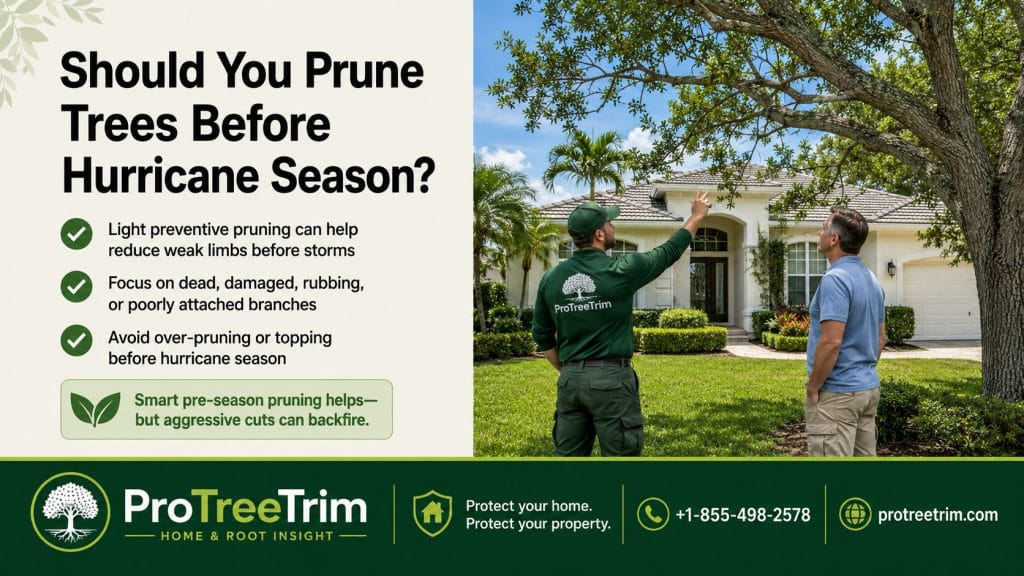
Pruning before hurricane season can be a smart move, but only when the work is targeted. Removing dead limbs, cracked branches, roof contact, and obvious defects may reduce problems around the home. Cutting too much live canopy, topping the tree, or stripping out interior branches can create a weaker tree right when you want it to be stronger.
Start With the Real Goal
The goal of pre-hurricane pruning is not to make the tree smaller. It is to reduce obvious weak points before wind and rain test the canopy.
A good storm-prep pruning job focuses on branches that are already dead, damaged, cracked, rubbing, overextended, or touching structures. It should not turn into a last-minute effort to “lighten the tree” by removing as much as possible.
| What you see before storm season | What may make sense |
|---|---|
| Dead limb over driveway | Remove before wind season if practical |
| Branch touching roof or gutter | Create selective clearance |
| Cracked limb over patio or pool cage | Address before it fails |
| Branches rubbing each other | Remove or reduce one of the rubbing branches |
| Dense but healthy canopy | Do not automatically over-thin |
| Tree topped in the past | Look for weak sprouts and old cuts |
| Tree leaning after rain | Check roots and trunk, not just branches |
The best pruning is specific. The worst pruning is panic cutting.
What Good Hurricane-Season Pruning Looks Like
Good pruning often looks less dramatic than homeowners expect. The tree may not look much smaller from the street. Instead, it looks cleaner, better balanced, and less cluttered with obvious problem branches.
A careful crew may remove deadwood, correct broken limbs, reduce a long overextended branch, clear the roofline, or raise low limbs over a driveway. The canopy should still have natural shape. Interior branches should not be stripped out completely. Large live limbs should not be removed without a clear reason.
A good scope might sound like:
- remove dead limbs over the driveway
- clear branches touching the roofline
- remove cracked limb above the pool cage
- reduce one overextended limb toward the patio
- clean storm-damaged branches from the canopy
- preserve healthy live canopy where possible
That kind of work helps the property without punishing the tree.
What to Avoid Before Hurricane Season
The worst time for bad pruning is right before storms.
Avoid:
- topping the tree
- cutting the canopy flat
- removing large healthy limbs without a clear reason
- stripping interior branches and leaving foliage only at the tips
- removing too much live canopy at once
- cutting near power lines yourself
- hiring someone whose only plan is “cut it way back”
A topped or over-thinned tree may look smaller, but smaller does not always mean safer. Poor cuts can create weak sprouts, sun-exposed limbs, large wounds, and a canopy that moves poorly in wind.
Do Not Forget the Roots and Trunk
Storm prep is not only about branches.
A tree with a clean canopy but weak roots can still be a concern. Before hurricane season, look at the base of the tree too. Are roots lifting soil? Is the tree leaning more than before? Are mushrooms growing near the trunk? Is the root flare buried under mulch? Did recent paver work, driveway repair, trenching, or construction disturb the roots?
Pay closer attention if you see:
- trunk cracks
- bark peeling near the base
- mushrooms or soft wood
- sawdust-like material
- exposed or cut roots
- soil lifting on one side
- a new lean after heavy rain
- large limbs over bedrooms, driveways, or pool cages
A tree with root or trunk concerns may need more than pruning. Removing dead branches will not fix a weak root plate or split trunk.
Timing Matters, but Safety Matters More
Ideally, storm-prep pruning should not be left until a storm is already approaching. Crews get busy, weather turns unsafe, and rushed work is more likely to be rough work.
It is better to inspect trees before the season gets active. That gives you time to remove deadwood, clear roof contact, schedule professional help, and avoid last-minute decisions.
But if a dangerous limb appears during the season, do not ignore it because the timing is imperfect. A cracked branch over a driveway or roof may need attention when it becomes unsafe.
When Pruning Is Not Enough
Sometimes pruning is not the right solution.
If a tree is dead, badly split, hollow, newly leaning, severely root-damaged, or repeatedly dropping large limbs, trimming a few branches may only delay a bigger decision. In those cases, removal may need to be discussed, especially if the tree could hit a house, driveway, pool cage, fence, walkway, vehicle, or utility area.
A good tree decision separates three questions:
- Can selective pruning reduce the problem?
- Is the tree healthy and stable enough to keep?
- Would removal be more responsible than repeated storm-season cutting?
Not every risky-looking tree needs removal. Not every tree can be saved by pruning.
Questions to Ask Before Hiring a Crew
Before approving pre-hurricane tree work, ask for a clear plan.
Ask:
- Are you removing deadwood, live branches, or both?
- Which branches are the main concern?
- Are any limbs cracked, overextended, or touching the roof?
- How much live canopy will be removed?
- Will the tree be topped or heavily thinned?
- Are there root, trunk, or lean concerns?
- Are utility lines involved?
- Will debris be hauled away before storms arrive?
A good crew should be able to explain the work in plain language. If the plan is vague or overly aggressive, slow down.
The Best Storm Prep Is Not Dramatic
A properly prepared tree may still look full. That is okay.
Storm prep is not about making a tree look bare. It is about removing clear defects, preserving healthy structure, and reducing obvious conflicts with the house and yard. The strongest result is often subtle: fewer dead limbs, better clearance, cleaner branch structure, and less avoidable risk around the property.
If you are unsure whether your tree needs hurricane-season pruning, deadwood removal, roofline clearance, or a larger safety decision, ProTreeTrim can help connect homeowners with local tree service support. Call +1-855-498-2578 or visit protreetrim.com.
FAQs
Should trees be pruned before hurricane season?
Often, yes, if they have dead limbs, cracked branches, roof contact, or obvious defects. Healthy trees should not be cut aggressively just because storm season is coming.
Does thinning a tree help it survive hurricanes?
Selective pruning can help address defects, but over-thinning can weaken branch structure. The goal should be better structure, not an empty canopy.
Is topping a tree good hurricane preparation?
No. Topping can stress the tree, create weak regrowth, and lead to future pruning problems.
How early should I schedule storm-prep pruning?
It is better to inspect and schedule work before storms are close. Last-minute pruning can be rushed, expensive, and harder to schedule safely.
ProTreeTrim™ can help you take the next step.
If you are dealing with a damaged tree, fallen branch, stump, root issue, palm concern, or storm cleanup question in Florida, call ProTreeTrim for tree service support.