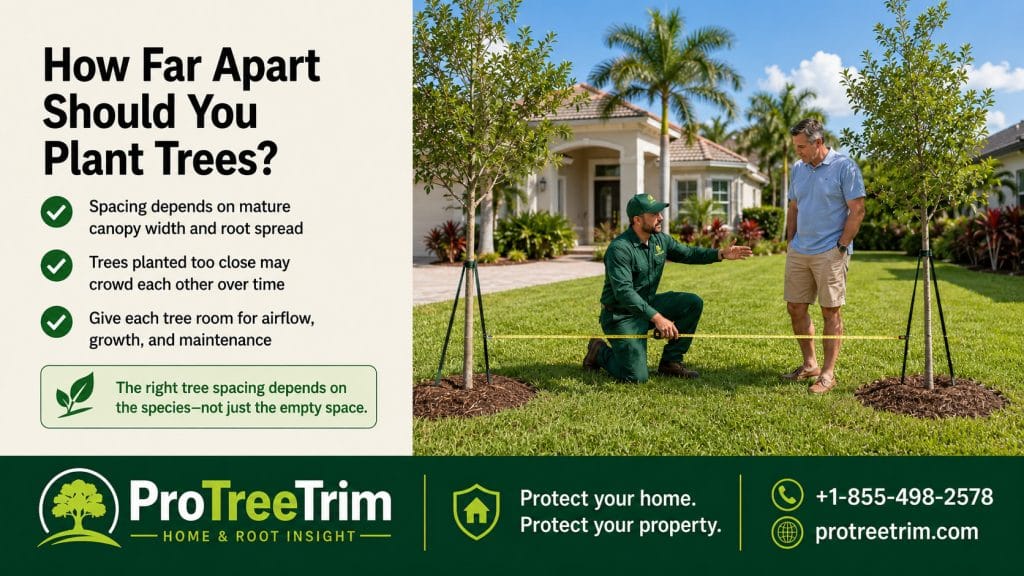
Trees should be planted far enough apart that their mature canopies, trunks, and roots can develop without crowding each other. The right spacing depends on the species, mature size, purpose, soil, drainage, and nearby structures. A row of young trees may look too empty at first, but planting too close often creates bigger problems later.
Do Not Space Trees Based on Nursery Size
Young trees are misleading. They may look small, thin, and far apart when first planted. That often tempts homeowners to plant more trees closer together for a fuller look.
The problem comes later. As the trees mature, their canopies overlap, lower branches die back, roots compete, and pruning becomes harder. What looked like a lush privacy row can become a crowded wall of stressed trees.
| Planting too close can lead to | Why it matters |
|---|---|
| Canopy crowding | Branches compete for light and space |
| Poor airflow | Dense rows may stay damp after rain |
| Dead lower branches | Shaded-out limbs decline over time |
| Root competition | Trees fight for water, oxygen, and nutrients |
| Uneven growth | Stronger trees may dominate weaker ones |
| More pruning | Crowded limbs require repeated correction |
| Harder removal later | Tight spacing limits access for crews |
A new planting should look a little spacious. That is usually a sign you are planning for the mature trees, not the first season.
Start With the Purpose of the Trees
Tree spacing depends heavily on why you are planting them.
A shade tree in the middle of a yard needs different spacing than a privacy row along a fence. A windbreak, orchard, driveway planting, poolside screen, or front-yard accent may each require a different layout.
Ask what the trees are supposed to do:
- create shade
- block a view
- frame the house
- line a driveway
- soften a fence
- create a backyard screen
- replace removed trees
- add curb appeal
- protect outdoor living areas from sun
Once the purpose is clear, spacing becomes easier to plan.
Shade Trees Need Room to Spread
Large shade trees usually need generous spacing because their canopies and roots expand widely. Planting large trees too close together can force them to grow unevenly, compete for light, and develop awkward branch structure.
Shade trees should not be planted like shrubs. A mature oak, maple, pine, magnolia, or similar large tree may need far more room than it appears to need when young.
Before planting multiple shade trees, ask:
- How wide will each canopy become?
- Will branches overlap heavily at maturity?
- Will roots compete in a narrow area?
- Will one tree shade out the other?
- Will there be room for mowing, mulch, and maintenance?
- Will future pruning access still be possible?
If two large trees will eventually grow into each other and both will need repeated pruning to fit, they are probably too close.
Privacy Rows Should Not Be Overcrowded
Privacy planting is where spacing mistakes happen most often.
Homeowners want an instant screen, so they plant trees close together. For the first year or two, it may look good. Then the row thickens, lower branches lose light, trunks crowd the fence, and one side may need constant cutting.
A good privacy row should be spaced for the mature width of the trees, not the width they are today.
Better privacy planning may include:
| Privacy goal | Better spacing idea |
|---|---|
| Block a specific window | Use fewer trees placed strategically |
| Screen a long fence | Space trees for mature width, not instant fullness |
| Create dense lower coverage | Add shrubs instead of crowding trees |
| Get quick privacy | Use temporary shrubs while trees mature |
| Keep neighbor side manageable | Leave room for pruning from your side |
| Avoid fence damage | Do not plant trunks too close to posts or panels |
A layered design usually works better than a tight row of trees doing all the work.
Roots Need Spacing Too
Tree spacing is not only about branches. Roots matter just as much.
When trees are planted close together, their roots compete for the same upper soil space. In a wide open yard, that may be manageable. In a narrow strip beside a fence, driveway, sidewalk, pool deck, or patio, competition can become stressful.
Crowded roots may also make watering harder. One tree may take up moisture faster than another. Soil may dry unevenly. Mulch beds may become full of surface roots. If one tree declines, removing it later may disturb the root zone of the trees beside it.
Good spacing gives each tree enough soil volume to grow without constant competition.
Avoid Planting Trees Too Close to Hardscape
When spacing multiple trees, also consider the hard surfaces around them. Two trees may be far enough apart from each other but still too close to a sidewalk, driveway, patio, pool cage, or fence.
Hardscape reduces available root space. It also limits future repair options.
Before planting a row or group, check:
- distance from sidewalks
- driveway edges
- patio or paver areas
- pool decks
- fence lines
- retaining walls
- septic components
- utility lines
- irrigation zones
- access gates
A tree row squeezed between a fence and patio may look attractive at first, but future root and pruning problems can be expensive.
Staggered Planting Can Work Better Than a Straight Line
A straight row may be appropriate in some yards, but it is not always the best choice. Staggered planting can create a fuller screen with fewer trees and less crowding.
Instead of planting every tree in one tight line, you may be able to plant in a gentle zigzag or layered pattern. This gives each tree more room to spread while still blocking views.
Staggered planting can be useful for:
- privacy screens
- wide backyard borders
- road noise softening
- mixed tree-and-shrub beds
- informal landscapes
- fence-line planting with more depth
It may not work in very narrow yards, but when there is room, it often looks more natural and ages better.
Do Not Plant for Instant Fullness Alone
A newly planted tree layout may look sparse. That is normal.
Many homeowners judge a planting too early and add extra trees to fill gaps. Later, those “extra” trees become the problem. They compete, lean, shade each other, or need removal.
A better approach is to use temporary filler plants that are easier to remove later:
- shrubs
- grasses
- perennials
- mulch beds
- container plants
- smaller accent plants
Let trees be trees. Use smaller plants for early fullness.
Think About Future Pruning Access
Trees planted too close together are harder to prune safely. Branches interlock. Crews have less room to work. Removing one tree may damage another. Stump grinding may become difficult if trunks and roots are crowded.
Before planting, imagine future maintenance:
- Can a crew walk between the trees?
- Can branches be lowered safely?
- Can deadwood be removed without damaging nearby trees?
- Can a stump grinder reach one tree if it dies?
- Will ladders, lifts, or climbing access be blocked?
- Will the trees crowd fences, roofs, or pool cages as they mature?
Spacing is not only about tree health. It is about making future care realistic.
Mixed Trees Need Extra Thought
Planting different tree species together can create a more interesting yard, but it also requires more planning. Different trees grow at different speeds, heights, widths, and root patterns.
A fast-growing tree may dominate a slower one. A broad canopy may shade a smaller ornamental. A messy tree may drop debris into the bed of a cleaner tree. A tree with aggressive roots may outcompete others nearby.
When mixing trees, consider:
| Trait | Why it matters |
|---|---|
| Growth rate | Fast trees can crowd slow trees |
| Mature height | Tall trees may shade smaller trees |
| Canopy width | Wide trees need more side space |
| Root behavior | Root competition can affect establishment |
| Water needs | Different trees may prefer different moisture levels |
| Debris habits | Messy trees may affect patios, pools, and walkways |
| Pruning needs | Some trees require more structure work than others |
A mixed planting should look good now and still function later.
When Trees Are Already Too Close Together
If existing trees are too close, do not rush to remove one without looking at the whole site.
Ask:
- Are both trees healthy?
- Is one tree clearly declining?
- Are branches rubbing or crossing badly?
- Are roots lifting nearby hardscape?
- Is one tree leaning away from competition?
- Would pruning help, or is crowding too advanced?
- Would removing one tree expose the other to sun or wind suddenly?
Sometimes selective pruning can manage the issue. Sometimes one tree should be removed to protect the better tree. Sometimes the crowding is acceptable if the trees are healthy and away from structures.
The decision depends on tree condition, location, and future risk.
Final Spacing Test
Before planting multiple trees, picture each one at full size.
Will their canopies overlap too much?
Will roots have enough soil?
Will lower branches die from crowding?
Will the row block fence repair or side-yard access?
Will one tree need removal later just because spacing was too tight?
Will this layout still make sense in 10 or 20 years?
Good spacing may look patient at first. But trees are long-term plants. A little extra room now can prevent years of pruning, root conflict, and removal decisions later.
If you are unsure whether trees in your yard are spaced properly or already too crowded, ProTreeTrim can help connect homeowners with local tree service support. Call +1-855-498-2578 or visit protreetrim.com.
FAQs
How far apart should trees be planted?
It depends on the mature size and purpose of the trees. Large shade trees need much more room than small ornamental trees or shrubs.
Is it bad for tree canopies to touch?
Light canopy overlap is not always a problem, but heavy crowding can reduce light, airflow, branch structure, and long-term health.
Can I plant privacy trees close together for faster screening?
You can, but it often creates future crowding. A layered planting with proper spacing usually ages better than a tight row.
What happens if trees are planted too close together?
They may compete for light, water, and root space. Lower branches may die, canopies may deform, and future pruning or removal may become harder.
ProTreeTrim™ can help you take the next step.
If you are dealing with a damaged tree, fallen branch, stump, root issue, palm concern, or storm cleanup question in Florida, call ProTreeTrim for tree service support.