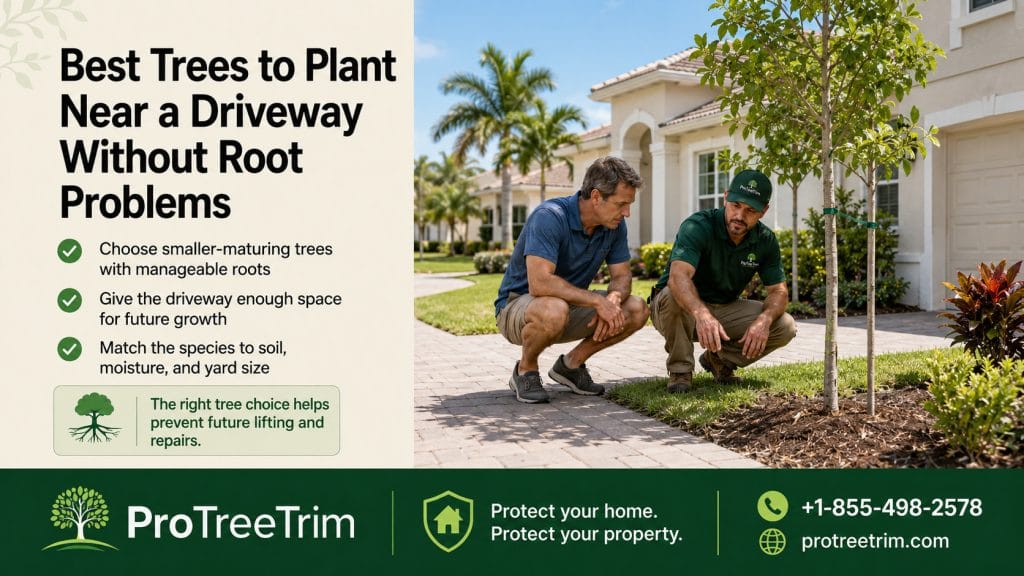
The best trees to plant near a driveway are not always the fastest-growing or largest shade trees. A driveway tree needs to fit the space above ground and below ground. It should have enough root room, a mature size that matches the yard, manageable debris, and branches that will not constantly hit vehicles, block visibility, or crowd the garage.
No tree is completely root-free. But some trees are much better choices near driveways because they stay smaller, grow more predictably, and create fewer long-term conflicts when planted with proper spacing.
Start With the Space, Not the Tree Name
Before choosing a tree, measure the planting area. A beautiful tree in the wrong place can become a driveway problem later.
Look at:
- distance from driveway edge
- distance from garage or house
- sidewalk or walkway nearby
- overhead utility lines
- underground irrigation or utility lines
- mature canopy spread
- mature root spread
- vehicle clearance needs
- drainage and runoff patterns
- visibility when backing out
The best driveway tree is the one that fits the mature space, not just the nursery pot.
Smaller Mature Size Usually Means Lower Risk
Large shade trees can be valuable, but many are not ideal close to driveways. Their roots and canopies need room. When a large tree is squeezed beside concrete, asphalt, or pavers, conflict becomes more likely.
Near driveways, smaller or medium-sized ornamental trees are often easier to manage.
| Tree trait | Why it helps near driveways |
|---|---|
| Modest mature height | Less roof, wire, and branch conflict |
| Moderate canopy spread | Easier vehicle clearance |
| Slower to moderate growth | Fewer sudden structure issues |
| Manageable roots | Lower hardscape conflict risk |
| Strong branch structure | Less frequent corrective pruning |
| Low heavy-fruit drop | Less driveway mess |
| Good local climate fit | Healthier tree with less stress |
A tree that stays in scale is usually better than one that needs constant cutting.
Avoid Calling Any Tree “Non-Invasive”
Many homeowners search for trees with non-invasive roots. That phrase can be misleading. Every tree has roots. Every tree can create problems if planted too close to hardscape, in compacted soil, or in a narrow strip with poor drainage.
A better goal is choosing a lower-conflict tree.
A lower-conflict driveway tree should:
- stay appropriately sized
- have enough soil area
- be planted far enough from pavement
- not need repeated heavy pruning
- not drop large messy material on vehicles
- not grow into rooflines or power lines
- tolerate local soil and weather conditions
The planting design matters as much as the species.
Trees to Be Careful With Near Driveways
Some trees become too large or root-aggressive for tight driveway areas. This does not mean they are bad trees. It means they may need more open space.
Be cautious with trees that:
- become very large shade trees
- develop large surface roots
- grow fast and brittle
- drop heavy fruit, seed pods, or limbs
- need frequent pruning for clearance
- spread wide over vehicles
- are known for aggressive root conflicts in your region
- require more soil space than the site provides
A tree that belongs in a large open lawn may not belong two feet from a driveway.
Good Driveway Trees Are Often Small Ornamentals
Small ornamental trees often work well near driveways when they are planted with enough space. They can provide curb appeal, seasonal flowers, light shade, and structure without overwhelming the hardscape.
Depending on region and site conditions, homeowners often consider smaller ornamental options such as:
- crape myrtle
- redbud
- serviceberry
- yaupon holly
- small magnolia cultivars
- ornamental pear alternatives where appropriate
- Japanese maple in suitable climates
- small native flowering trees
- compact palm choices in warm climates
The exact best tree depends on climate, soil, mature size, and local pest or disease concerns. A tree that works in one state may not be the best choice in another.
In Florida, Think About Heat, Storms, and Driveway Clearance
For Florida and other warm-climate yards, driveway trees should handle heat, humidity, heavy rain, and storm-season conditions. They should also avoid becoming a maintenance problem over vehicles, garages, and pool areas.
Florida homeowners should think about:
- wind exposure
- branch strength
- palm frond drop
- driveway heat reflection
- sandy or compacted soil
- irrigation coverage
- hurricane-season pruning needs
- proximity to rooflines and pool cages
- mature size in a warm growing season
A tree near a driveway should not become a storm-season anxiety point every year.
Palms Near Driveways Can Work, but Choose Carefully
Palms are often planted near driveways because they provide vertical form without a broad spreading canopy. Some palms may create fewer hardscape-lifting issues than large shade trees, but they still need planning.
Palm driveway concerns include:
- falling fronds
- fruit or seed drop
- trunk lean
- crown health
- roots near pavers
- clearance for vehicles
- proximity to pool cages or rooflines
- maintenance access
A palm that drops messy fruit over parked cars may not be a good driveway choice, even if its roots are less concerning.
Crape Myrtles Can Be Good, but Do Not Plant Too Close
Crape myrtles are popular near driveways because they stay smaller than many shade trees and offer flowers and attractive bark. But they still need space.
Avoid planting them where they will:
- scrape vehicles
- grow into a garage entry
- block driveway visibility
- crowd a sidewalk
- require repeated hard pruning
- drop flowers or seed heads where cleanup is a problem
A crape myrtle should be allowed to grow naturally. It should not be cut back hard every year just because it was planted too close.
Consider Native or Regionally Adapted Trees
Native and regionally adapted trees are often better choices because they are more likely to handle local soil, weather, pests, and rainfall patterns. That does not mean every native tree is driveway-safe. Mature size still matters.
A regionally appropriate driveway tree should match:
- local hardiness zone
- soil drainage
- rainfall pattern
- drought tolerance
- pest pressure
- available root space
- mature canopy width
- maintenance expectations
A locally adapted small tree is often a better long-term choice than an impressive large tree squeezed into a narrow strip.
Root Space Is More Important Than Homeowners Expect
Driveway trees need usable soil. If the tree is trapped between driveway, sidewalk, house, and street, roots will have limited options. That is when conflicts become more likely.
A poor driveway planting spot may have:
| Site issue | Why it matters |
|---|---|
| Narrow strip | Roots have little room |
| Compacted soil | Roots may stay near surface |
| Concrete on several sides | Heat and root restriction increase |
| Poor drainage | Root stress may develop |
| Downspout discharge | Roots may grow toward moisture |
| Irrigation leaks | Roots may follow the wet zone |
| Overhead wires | Future pruning conflict |
| Garage clearance needs | Branch conflicts may develop |
A good tree in a bad planting strip can still become a problem.
Plant Farther From the Driveway Than You Think
A tree planted too close to the driveway may look fine for a few years. The problem appears later as roots thicken, branches spread, and the trunk expands.
Planting farther away helps reduce:
- root lifting
- driveway cracking
- branch scraping
- vehicle clearance issues
- repeated pruning
- trunk damage from vehicles
- irrigation conflicts
- paver movement
The exact distance depends on the tree’s mature size and root behavior. The larger the tree, the farther it should be from the driveway.
Watch Overhead and Underground Utilities
Before planting near a driveway, look up and look down. A tree that stays clear of roots but grows into power lines or service wires is still the wrong choice.
Check for:
- overhead power lines
- service drops to the house
- buried utilities
- irrigation pipes
- drainage lines
- septic components
- lighting wires
- gas or water service paths
- fiber or cable lines
Do not plant first and discover utility conflicts later.
Think About Branch Clearance Over Vehicles
Even a lower-root-risk tree can become a problem if its branches hang over cars. A driveway tree should allow safe clearance for vehicles, people, delivery drivers, and garage access.
Plan for:
- mature branch height
- canopy spread
- delivery truck access
- garage door clearance
- vehicle doors opening
- walking space beside parked cars
- future pruning access
A tree that constantly needs crown raising may have been planted too close or chosen poorly.
Avoid Messy Drop Over Parking Areas
Some trees drop fruit, seed pods, cones, sticky sap, flowers, bark, or heavy debris. That may be acceptable in a back corner of the yard. It is less pleasant over cars and driveways.
Before planting, ask:
- Will it drop fruit on cars?
- Will flowers stain pavement?
- Will seed pods create cleanup?
- Will sap or honeydew affect vehicles?
- Will birds gather and create mess?
- Will cones or nuts create tripping hazards?
- Will leaves clog nearby drains?
Driveway trees should be chosen for maintenance, not just appearance.
Driveway Heat Can Stress Young Trees
Driveways reflect heat. A young tree planted beside concrete, asphalt, or pavers may face hotter soil and more water stress than the same tree planted in open lawn.
Young driveway trees need:
- correct planting depth
- visible root flare
- consistent watering during establishment
- mulch kept away from the trunk
- protection from mower and vehicle damage
- enough soil space
- good drainage
- room for roots to expand
A heat-stressed young tree may show wilting, brown edges, slow growth, or leaf drop.
Mulch Helps, but Do Not Volcano Mulch
A shallow mulch bed around a driveway tree can protect roots, reduce mower damage, and improve soil moisture. But mulch should not be piled against the trunk.
Good mulch near a driveway:
- is wide and shallow
- stays away from the trunk
- leaves the root flare visible
- does not spill onto the driveway
- avoids landscape fabric around roots
- is refreshed lightly, not stacked deeply
- protects roots from mower damage
Mulch should protect the tree, not bury it.
What If a Tree Is Already Too Close to the Driveway?
If an existing tree is already lifting the driveway, scraping vehicles, or blocking access, planting advice may be too late. The decision becomes whether pruning, hardscape adjustment, root protection, or removal is the better path.
Ask:
- Is the tree healthy?
- How close is it to the driveway?
- Are roots lifting the surface?
- Are branches hitting vehicles?
- Has the driveway been repaired before?
- Would root cutting be risky?
- Is the tree too large for the site?
- Would replacement solve the problem long term?
A tree that constantly conflicts with the driveway may not be a good long-term fit.
Better Trees Still Need Maintenance
Even a well-chosen driveway tree needs maintenance. The difference is that maintenance should be reasonable, not constant emergency correction.
Plan for:
- young structural pruning
- gradual clearance pruning
- deadwood removal when needed
- storm checks
- mulch maintenance
- irrigation checks
- root flare inspection
- monitoring for driveway lifting
Good tree choice reduces problems. It does not eliminate all care.
Questions to Ask Before Buying a Driveway Tree
Before buying, ask the nursery, arborist, or local extension-style resource:
- What is the mature height and spread?
- How far should it be planted from a driveway?
- Does it develop large surface roots?
- Does it drop fruit, seed pods, or messy material?
- Does it need frequent pruning?
- Is it suitable for local soil and weather?
- Will it conflict with overhead lines?
- Is it storm-resilient for this location?
- Will it block driveway visibility?
- Is there a smaller cultivar that fits better?
The right question before planting can prevent years of repair.
Final Homeowner Takeaway
The best trees near driveways are usually smaller, well-matched, regionally adapted trees with enough root space and manageable mature size. Avoid planting large shade trees in narrow strips beside concrete, asphalt, or pavers. Avoid trees that will drop heavy debris, grow into vehicles, or require constant pruning.
No tree is truly root-free. The safest driveway planting decision is to choose a tree that fits the site at maturity and plant it far enough from hardscape to grow without becoming a repair problem.
If you are unsure what to plant near a driveway—or whether an existing tree is already too close—ProTreeTrim can help connect homeowners with local tree service support. Call +1-855-498-2578 or visit protreetrim.com.
FAQs
What kind of tree is best near a driveway?
A smaller, regionally adapted ornamental tree with modest mature size, manageable roots, and low heavy-debris drop is usually best.
Are there trees with roots that will not damage a driveway?
No tree is completely root-free, but smaller trees planted with enough distance and soil space are usually lower risk.
How far should a tree be from a driveway?
It depends on the tree’s mature size and root behavior. Larger trees need more distance than small ornamentals.
Should I plant a large shade tree next to a driveway?
Usually not close to the driveway. Large shade trees need more root and canopy space than narrow driveway edges usually provide.
ProTreeTrim™ can help you take the next step.
If you are dealing with a damaged tree, fallen branch, stump, root issue, palm concern, or storm cleanup question in Florida, call ProTreeTrim for tree service support.