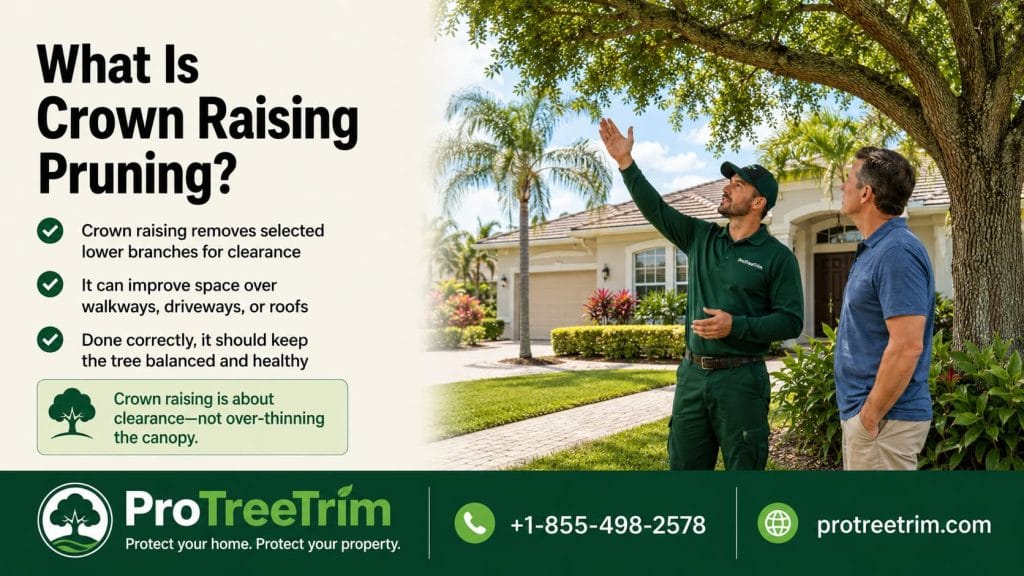
Crown raising is a type of tree pruning that removes selected lower branches to create more clearance under the canopy. Homeowners often ask for crown raising when branches hang over a driveway, block a sidewalk, touch a roof, interfere with mowing, crowd a fence, or make the yard feel dark and hard to use.
Done carefully, crown raising can improve access, visibility, and property maintenance. Done poorly, it can leave the tree top-heavy, over-lifted, stressed, or structurally weaker.
The goal is not to remove every lower limb. The goal is to create practical clearance while keeping the tree balanced and healthy.
Crown Raising Means Lifting the Lower Canopy
Crown raising is sometimes called “lifting” the canopy. It usually focuses on lower branches, not the top of the tree.
Homeowners may request it for:
- driveway clearance
- sidewalk clearance
- lawn mowing access
- roofline clearance
- patio or seating clearance
- street visibility
- fence-line access
- pool cage or screen clearance
- better light under the tree
The work should be selective. A tree should not look like a tall pole with a small tuft of branches at the top.
Crown Raising Is Not the Same as Topping
Crown raising removes selected lower branches. Topping cuts the upper canopy or major limbs back to stubs. These are completely different practices.
| Pruning term | What it means |
|---|---|
| Crown raising | Removes selected lower branches for clearance |
| Crown cleaning | Removes dead, broken, diseased, or damaged branches |
| Crown reduction | Carefully reduces height or spread where appropriate |
| Crown thinning | Selectively reduces canopy density |
| Topping | Cuts major limbs or tree tops to stubs; should be avoided |
If someone says they will “raise the canopy” but starts cutting the top or large upper limbs back hard, that is not crown raising.
When Crown Raising Makes Sense
Crown raising is useful when lower branches are causing a real access or property conflict.
It may make sense when branches:
- hit vehicles in the driveway
- block people from walking under the tree
- scrape the roof or gutters
- interfere with mowing
- block a sidewalk
- hang over a patio or seating area
- crowd a fence or gate
- reduce visibility near a driveway entrance
- make a front yard look closed-in
The best crown raising solves a specific problem without removing more live canopy than necessary.
Driveway Clearance Is a Common Reason
Low branches over a driveway can scratch vehicles, block visibility, or make parking awkward. Crown raising can help, but the cuts should be planned carefully.
A good driveway-clearance scope might sound like:
- remove selected low branches over the driveway
- keep the main canopy balanced
- avoid large unnecessary limb removal
- remove deadwood over parking areas
- preserve healthy branches where possible
A poor scope would be: “Cut everything high enough so nothing hangs low anywhere.” That can over-lift the tree and damage its natural form.
Sidewalk and Walkway Clearance
Trees near sidewalks and walkways often need enough clearance for people to pass safely. Crown raising may help when low branches brush faces, block paths, or force people to duck.
This is especially important near:
- front entries
- public sidewalks
- garden paths
- side yards
- rental properties
- homes being prepared for sale
- outdoor seating areas
Clearance pruning should remove the conflict, not strip the entire lower half of the tree.
Roofline Clearance Needs Precision
When branches touch a roof, gutter, fascia, or siding, pruning may be needed. But crown raising near a roof should not mean cutting the whole side of the tree flat.
Roofline crown raising should focus on:
| Roof conflict | Better pruning goal |
|---|---|
| Branch touching shingles | Create modest clearance |
| Limb rubbing gutter | Remove or redirect the specific limb |
| Dead branch over roof | Remove deadwood |
| Branch dropping debris in roof valley | Improve clearance where practical |
| Canopy pressing against siding | Selectively reduce contact |
| Large limb over roof | Evaluate structure before cutting |
A tree can often be cleared from the roof without being heavily disfigured.
Do Not Raise the Crown Too High
Over-raising is a common mistake. Removing too many lower branches can leave a tree with most of its foliage high above the trunk. This may look unnatural and can affect structure, shade, and trunk protection.
Over-raised trees may have:
- a long bare trunk
- a small canopy only at the top
- poor balance
- more wind exposure
- sun exposure on previously shaded bark
- fewer lower branches supporting natural form
- a “lion-tailed” appearance if interior branches are also stripped
A healthy tree should keep enough lower and interior structure to look natural and stable.
Young Trees Need Gradual Crown Raising
Young trees may need lower branches removed over time as they grow. But this should be gradual. Removing too many lower limbs too early can slow trunk development and create a weak or awkward form.
Young-tree crown raising should be done in stages.
A better approach:
- identify future clearance needs
- remove only the worst low conflicts first
- keep temporary lower branches when useful
- avoid stripping the trunk
- guide structure over several years
- use small cuts before branches become large
A young tree should be trained, not rushed into a mature shape.
Mature Trees Require More Care
Crown raising a mature tree can involve larger branches. Larger cuts create larger wounds. That means the decision should be more careful than on a young tree.
For mature trees, ask:
- Is this branch truly causing a problem?
- Is the branch large?
- Will removing it create imbalance?
- Is there decay or cracking near the branch union?
- Is the branch over a roof, driveway, or walkway?
- Can clearance be achieved with a smaller cut?
- Will removing this branch expose the trunk or roof to more sun or wind?
Mature trees should not be over-lifted just to make the yard look more open.
Crown Raising Can Improve Curb Appeal
A well-raised canopy can make a front yard look cleaner. It can reveal the home’s entry, improve lawn visibility, and make the property feel more maintained.
This can matter before:
- listing a home for sale
- exterior photography
- storm-season cleanup
- driveway repair
- fence repair
- landscaping updates
- insurance or property documentation
- routine maintenance visits
But curb appeal should not override tree health. A natural-looking tree is usually better than a tree that looks stripped.
Crown Raising Around Pools and Patios
Trees near pools, patios, and outdoor seating areas can benefit from selective crown raising when low branches drop debris, block access, or touch screens and structures.
Crown raising may help with:
- branches over pool decks
- limbs brushing patio furniture
- branches touching pool cages
- low limbs over grills or outdoor kitchens
- shaded areas that stay damp
- debris falling into high-use spaces
However, if the tree drops heavy fruit, seed pods, acorns, or messy leaves, crown raising may not solve the entire maintenance issue. Placement and tree species still matter.
Crown Raising Is Not a Fix for Every Tree Problem
Crown raising can improve clearance, but it does not solve every issue.
It will not fix:
- root damage
- trunk decay
- severe lean
- major canopy decline
- poor species placement
- tree too large for the yard
- dead top
- internal decay
- repeated storm failure
- branches near power lines
If the tree has structural or health problems, crown raising may be only one part of the decision—or not the right decision at all.
Avoid Lion-Tailing
Lion-tailing happens when too many inner and lower branches are removed, leaving foliage mostly at the ends of branches. This can make limbs look like long bare poles with leafy tips.
This is not good crown raising.
Lion-tailing can:
- reduce interior structure
- increase branch-end weight
- expose branches to sun
- create weak-looking form
- encourage poor regrowth
- make the tree look unnatural
- reduce the tree’s ability to buffer wind naturally
Good crown raising preserves structure. It does not strip the inside of the tree.
Palms Are Different
Crown raising is usually discussed with broadleaf shade trees, not palms. Palms do not have branching canopies in the same way. Removing lower palm fronds is palm trimming, not crown raising.
For palms, the rule remains:
- remove fully dead fronds
- remove broken fronds
- remove hazardous hanging fronds
- remove seed pods when needed
- avoid stripping healthy green fronds
- avoid hurricane cuts
Do not apply shade-tree crown raising logic to palms.
Oaks Need Conservative Crown Raising
Large oaks often have broad lower limbs that define their shape and strength. Raising an oak too much can change its character and create large wounds.
Oak crown raising may make sense for:
- driveway clearance
- roofline clearance
- sidewalk clearance
- dead lower limbs
- branches rubbing structures
- storm-damaged lower limbs
But removing large healthy lower limbs from an oak should not be casual. If the branch is a major part of the tree’s structure, the decision deserves extra care.
What Homeowners Should Ask Before Crown Raising
Before approving crown raising, ask:
- What clearance problem are we solving?
- Which lower branches will be removed?
- Are any branches large?
- Will the tree still look balanced?
- How much live canopy will be removed?
- Are dead branches included?
- Will roof or driveway clearance be enough?
- Are any branches near utility lines?
- Can the work be staged over time?
A good crown raising plan should sound specific, not like a general “cut all the lower stuff.”
When Crown Raising Should Wait
Crown raising may be better delayed when:
- the tree is drought-stressed
- the canopy is already thin
- the tree was recently transplanted
- roots were recently damaged
- the lower branches are not causing a real problem
- cuts would be large and mostly cosmetic
- the tree was already over-pruned
- the tree has trunk cracks or decay that need evaluation first
If there is no urgent clearance or safety issue, waiting can be better than over-cutting.
When Crown Raising Should Not Wait
Crown raising or lower-branch removal may be needed sooner when branches are creating a clear property or safety issue.
Handle it sooner when:
| Situation | Why action may be needed |
|---|---|
| Branches hit vehicles | Driveway access problem |
| Limbs block sidewalk | Pedestrian clearance issue |
| Branch touches roof | Roof and gutter concern |
| Dead lower limb over walkway | Falling-branch risk |
| Branch rests on pool cage | Screen damage possible |
| Limb blocks gate or fence repair | Property access issue |
| Branch near service line | Safety issue; proper help needed |
The work should solve the issue without over-lifting the tree.
What a Good Crown Raising Scope Sounds Like
A good scope:
- “Raise selected lower limbs over the driveway.”
- “Create walkway clearance without removing large structural limbs.”
- “Remove dead lower branch over the patio.”
- “Clear branches touching the roofline.”
- “Preserve the natural canopy shape.”
- “Stage additional clearance over time if needed.”
A poor scope:
- “Cut all lower branches off.”
- “Make the trunk clean up to the top.”
- “Lift it as high as possible.”
- “Remove everything below the roof.”
- “Thin out the whole inside too.”
- “Make it look like a palm.”
Specific and restrained is better.
Final Homeowner Takeaway
Crown raising is a useful pruning method when lower branches interfere with driveways, walkways, roofs, patios, pool cages, fences, or lawn access. It can improve clearance and curb appeal when done carefully.
The risk is overdoing it. Removing too many lower limbs can leave the tree unbalanced, over-lifted, or structurally weaker. Good crown raising solves a clear clearance problem while preserving the tree’s natural shape.
If you are unsure whether your tree needs crown raising, roof clearance, driveway clearance, or a different type of pruning, ProTreeTrim can help connect homeowners with local tree service support. Call +1-855-498-2578 or visit protreetrim.com.
FAQs
What does crown raising mean?
Crown raising means removing selected lower branches to create more clearance under the tree canopy.
Is crown raising bad for trees?
Not when done carefully. It can be harmful if too many lower limbs are removed or large structural branches are cut unnecessarily.
When should a tree canopy be raised?
It may make sense when branches block a driveway, sidewalk, roofline, patio, pool cage, fence, or lawn access.
Can you raise the crown of a mature tree?
Sometimes, but mature trees require more caution because large branch removal creates larger wounds and can affect structure.
ProTreeTrim™ can help you take the next step.
If you are dealing with a damaged tree, fallen branch, stump, root issue, palm concern, or storm cleanup question in Florida, call ProTreeTrim for tree service support.