
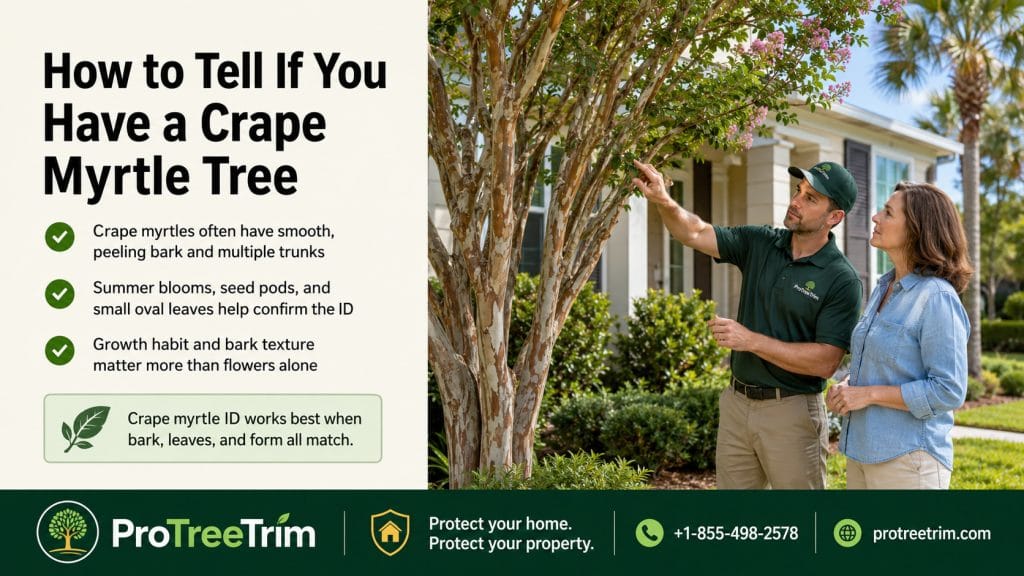
Crape myrtle, also spelled crepe myrtle, is one of the most recognizable flowering trees in many warm-climate yards. It is known for bright summer flowers, smooth peeling bark, small oval leaves, seed capsules, and often a multi-stem shape. But homeowners do not always know what they have until the tree needs pruning, starts dropping bark, develops black residue, or gets cut back too hard.
Identifying a crape myrtle matters because these trees are often over-pruned, planted too close to houses, or mistaken for larger shade trees when they need different care.
Start With the Flowers
The easiest time to identify a crape myrtle is when it is blooming. The flowers usually appear in clusters at branch tips and can be white, pink, red, lavender, purple, or similar shades depending on the variety.
The blooms often have a crinkled or crepe-paper look, which is where the common name comes from.
| Feature | What to look for |
|---|---|
| Flower clusters | Showy blooms at branch tips |
| Flower texture | Crinkled, delicate-looking petals |
| Bloom colors | White, pink, red, lavender, purple, or related shades |
| Bloom timing | Often noticeable in warm-season months |
| Tree shape | Small tree or large shrub form |
| Location | Front yards, driveways, patios, fence lines, and street-side beds |
If your tree has colorful summer flower clusters and smooth mottled bark, crape myrtle is a strong possibility.
Look at the Bark
Crape myrtles often have attractive smooth bark that peels or sheds in patches. The trunk may show tan, cinnamon, gray, cream, or brownish tones underneath. This peeling bark can worry homeowners who think the tree is damaged.
In many cases, peeling bark on a crape myrtle is normal.
Normal-looking bark shedding is usually:
- thin and patchy
- smooth underneath
- not paired with soft wood
- not oozing
- not exposing large wounds
- not accompanied by major dieback
- part of the trunk’s natural appearance
Bark peeling becomes more concerning if the trunk also has cracks, soft spots, wounds from mowers, insect activity, or branches dying back.
Check the Leaves
Crape myrtle leaves are usually small, simple, and oval-shaped. They are not compound like ash leaves or palm-like fronds. They often grow densely along smaller branches during the growing season.
Depending on the variety and season, leaves may be green, then change color before dropping.
Look for:
- small oval leaves
- simple leaves rather than leaflets
- smooth or slightly wavy leaf edges
- dense growth on smaller twigs
- leaves arranged along slender branches
- seasonal color change in some varieties
Leaf shape alone may not confirm the tree, but it helps when combined with flowers, bark, and seed pods.
Seed Pods Are Another Clue
After flowering, crape myrtles often form small round seed capsules. These may remain on branch tips after blooms fade. Homeowners sometimes confuse old seed pods with a disease, pest problem, or dead flower clusters.
Seed pods are usually normal.
They may look like:
- small round capsules
- clusters at the ends of branches
- brown or dry balls after flowers fade
- old flower remnants during late season
- persistent pods on bare winter branches
Seed pods by themselves are not usually a problem. But if the tree is also thin, blackened, sticky, or covered in insects, look closer.
Many Crape Myrtles Have Multiple Stems
Crape myrtles often grow as multi-stem trees or large shrubs. Some are trained into a single-trunk tree form, but many have several trunks rising from the base.
This shape is one reason they are popular in front yards and along driveways. It also means pruning choices matter. Cutting them harshly can create awkward knobs, weak shoots, and a cycle of repeated ugly pruning.
A crape myrtle may have:
| Growth habit | What it means for homeowners |
|---|---|
| Multi-stem base | Normal for many crape myrtles |
| Smooth ornamental trunks | Part of the tree’s appeal |
| Upright branching | Can fit smaller yards if placed well |
| Dense sprouts after hard cuts | Often a response to poor pruning |
| Shoots from base | May need selective removal |
| Flower clusters at tips | Pruning affects future shape and bloom display |
A crape myrtle should not be treated like a hedge or topped like a utility clearance tree.
Do Not Confuse Crape Myrtle Bark Shedding With Disease
One of the most common homeowner concerns is peeling bark. On crape myrtles, bark shedding can be normal and even attractive. The trunk may look patchy, mottled, or polished underneath.
Do not panic if the bark is peeling evenly and the tree otherwise looks healthy.
Worry more if peeling bark appears with:
- soft or sunken trunk areas
- oozing
- sawdust-like material
- branch dieback
- black staining with sticky residue
- large wounds
- mower or string-trimmer damage
- cracks running deeply into the trunk
Normal bark shedding is cosmetic. Trunk damage is different.
Watch for Black Residue or Sticky Leaves
Crape myrtles can sometimes develop sticky leaves, black sooty-looking buildup, or insect activity. This may be related to pests such as aphids, scale-type insects, or other sap-feeding insects that leave sticky honeydew. The black coating often develops on that sticky residue.
This can make the tree, driveway, patio, or nearby furniture look dirty.
Look for:
- sticky leaves
- black coating on leaves or branches
- black residue on surfaces below
- tiny insects on new growth
- white or grayish bumps on bark or branches
- ants moving along stems
- leaves curling or yellowing
If the tree is otherwise strong, this may be a manageable pest and maintenance issue. If it is paired with dieback or severe decline, the tree needs a closer look.
Crape Myrtle Pruning Is Often Done Wrong
Crape myrtles are famous for being cut back too hard. Many homeowners see them chopped into thick stubs every year. This is often called “crape murder” by tree-care professionals and gardeners.
Hard topping may produce new shoots, but it can also leave ugly cut points, weak sprout growth, and an unnatural shape. The tree may bloom again, but that does not mean the pruning was good.
Better crape myrtle pruning usually focuses on:
- removing dead branches
- removing crossing or rubbing branches
- cleaning small sprouts from the base when needed
- improving structure gradually
- preserving natural trunk form
- avoiding large unnecessary cuts
- keeping branches away from roofs, walkways, and driveways
A crape myrtle should look like a small ornamental tree, not a row of cut poles.
When Base Shoots Should Be Removed
Crape myrtles may send up shoots from the base or lower trunk. Some are normal, but too many can make the tree look messy and hide the trunk structure.
Base shoots may be removed when they:
- crowd the main trunks
- block walkways
- grow into the driveway
- hide trunk wounds
- make the front yard look unmaintained
- interfere with mulch beds
- grow from unwanted root areas
Remove small shoots early and cleanly. Do not hack into the main trunks or damage the base.
Placement Matters More Than People Think
A crape myrtle can be a good small-yard tree, but it still needs proper placement. It may be smaller than an oak or pine, but it can still crowd a wall, driveway, sidewalk, fence, or patio if planted too close.
Before keeping or planting one, ask:
- Is it too close to the house?
- Will branches touch the roof or gutters?
- Will it block the front entry?
- Is it dropping flowers or seed pods onto a driveway?
- Are roots or trunks crowding a walkway?
- Is it planted under utility lines?
- Can it be pruned naturally without topping?
- Will it still fit the space in several years?
A crape myrtle in the right place is low-conflict. A crape myrtle in the wrong place may need constant trimming.
Is a Crape Myrtle a Tree or a Shrub?
It can function as either, depending on variety and pruning. Some stay more shrub-like, while others grow into small ornamental trees. This is why homeowners sometimes get confused.
In practical terms, call it what matters for the yard:
- If it has multiple stems and is kept low, it may behave like a large shrub.
- If it has visible trunks and a canopy, it functions like a small tree.
- If it is planted near structures, it should be maintained like a tree.
- If it blocks access, windows, or walkways, its size matters more than the label.
The maintenance decision depends on form and location.
When a Crape Myrtle Looks Unhealthy
A crape myrtle may need closer attention if it has more than routine bark shedding or seasonal leaf changes.
Watch for:
| Warning sign | Why it matters |
|---|---|
| Major branch dieback | Tree stress or pest pressure may be involved |
| Sticky leaves and black residue | Sap-feeding insects may be present |
| Heavy white or gray bumps on branches | Scale-type pests may be possible |
| Repeated weak shoots after topping | Past pruning may have damaged structure |
| Trunk wounds | Mower, trimmer, or pruning injury may exist |
| Roots lifting hardscape | Placement issue may be developing |
| Branches rubbing roof or wall | Clearance pruning may be needed |
| Severe lean or root movement | More serious structural concern |
A crape myrtle can be tough, but it is not maintenance-free.
Should You Remove a Crape Myrtle?
Removal is not usually needed just because the tree sheds bark, drops flowers, or produces seed pods. Those are often normal. Removal becomes more reasonable when the tree is badly placed, repeatedly cut wrong, structurally poor, declining, or interfering with property use.
Removal may be worth discussing if the tree:
- is too close to the house
- blocks the driveway or entry
- has severe trunk damage
- repeatedly grows into the roofline
- has major dieback
- is infested and declining badly
- was topped for years and has poor structure
- crowds utilities, walkways, or sightlines
- no longer fits the landscape plan
Sometimes corrective pruning is enough. Sometimes replacement with a better-positioned tree is smarter.
What Homeowners Should Photograph
If you are unsure whether your tree is a crape myrtle or whether it needs care, take photos.
Useful photos include:
- full tree from the front
- close-up flowers
- leaves
- bark on the trunk
- seed pods
- base shoots
- any black residue or sticky leaves
- any dead branches
- distance from house, driveway, or walkway
Photos make it easier to identify the tree and decide whether the issue is normal, cosmetic, or maintenance-related.
Final Homeowner Takeaway
You may have a crape myrtle if the tree has showy flower clusters, smooth peeling bark, small oval leaves, seed capsules, and often multiple ornamental trunks. Peeling bark and seed pods are often normal. Sticky leaves, black residue, heavy insect activity, severe dieback, or repeated topping damage deserve more attention.
A crape myrtle can be a beautiful small tree when it is placed and pruned correctly. The biggest homeowner mistake is cutting it back hard every year or ignoring placement until it crowds the roof, driveway, walkway, or front entry.
If you are unsure whether you have a crape myrtle or whether it needs pruning, pest attention, or removal planning, ProTreeTrim can help connect homeowners with local tree service support. Call +1-855-498-2578 or visit protreetrim.com.
FAQs
How do I identify a crape myrtle tree?
Look for showy flower clusters, smooth peeling bark, small oval leaves, seed capsules, and often a multi-stem trunk form.
Is peeling bark normal on crape myrtles?
Yes, peeling or shedding bark is often normal on crape myrtles, especially when the trunk underneath looks smooth and healthy.
Should crape myrtles be cut back every year?
Not usually. Hard annual topping can create weak shoots and ugly structure. Selective pruning is usually better.
Why is my crape myrtle sticky or black?
Sticky residue and black sooty buildup may point to sap-feeding insects such as aphids or scale-type pests. The tree should be checked before random treatment.
ProTreeTrim™ can help you take the next step.
If you are dealing with a damaged tree, fallen branch, stump, root issue, palm concern, or storm cleanup question in Florida, call ProTreeTrim for tree service support.