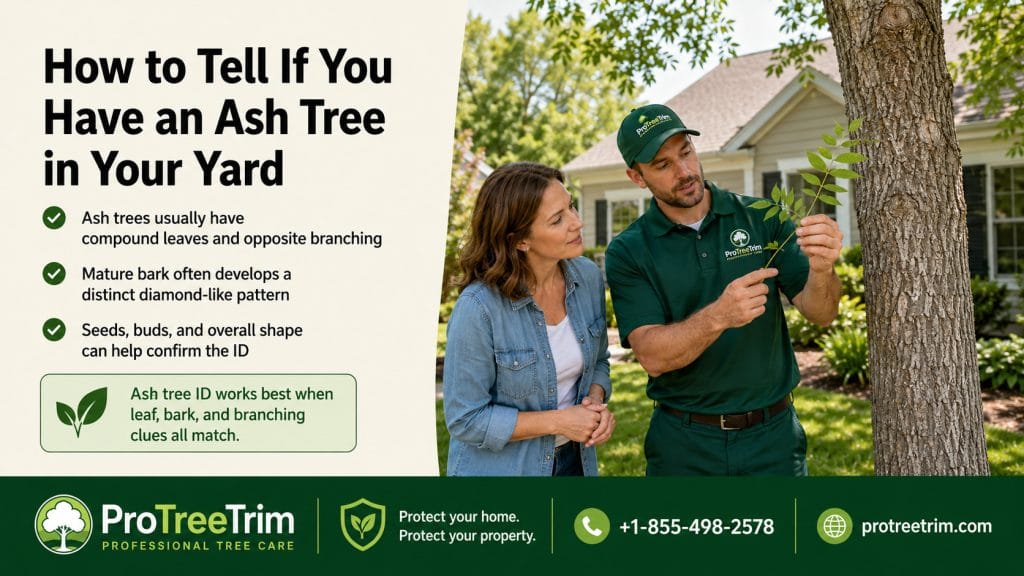
Ash trees can be valuable shade trees, but homeowners often do not know they have one until a branch drops, leaves thin out, or an insect problem raises questions. Identifying an ash tree starts with a few simple clues: opposite branching, compound leaves, bark pattern, seed clusters, overall shape, and where the tree is growing.
Tree identification is not just a curiosity. If you know what kind of tree you have, you can make better decisions about pruning, pests, storm risk, root conflicts, and whether a declining tree deserves professional attention.
Start With the Branching Pattern
One of the best ash tree clues is opposite branching. That means branches and buds grow directly across from each other on the stem, instead of alternating from side to side.
Not every branch will look perfect, especially on older trees that have been pruned or storm-damaged. But if the younger twigs show a clear opposite pattern, ash becomes more likely.
| Feature to check | What to look for |
|---|---|
| Branch arrangement | Pairs of branches or buds opposite each other |
| Leaf structure | Several leaflets attached to one central stem |
| Bark | Furrowed or diamond-like pattern on mature trees |
| Seeds | Paddle-shaped seed clusters on some trees |
| Canopy shape | Upright shade-tree form, depending on species |
| Location | Yard, street, parkway, fence line, or wooded edge |
The branching pattern is a starting clue, not the only proof.
Look at the Leaves
Ash leaves are usually compound. That means what looks like one large leaf is actually made of several smaller leaflets attached to a central stem. Many ash leaves have multiple leaflets arranged in pairs, often with one leaflet at the tip.
If you are looking at a simple single leaf, it may not be ash. If you see a central stem with several leaflets, ash becomes more possible.
Check:
- Are there several leaflets on one leaf stem?
- Are the leaflets arranged across from each other?
- Is there one leaflet at the end?
- Are the leaflet edges smooth or lightly toothed?
- Are leaves growing opposite on the twig?
- Are fallen leaves compound rather than single?
This is easiest during the growing season. In winter, bark, buds, and branching pattern become more important.
Check the Bark on Mature Trees
Mature ash bark often develops a furrowed, ridged texture. Some trees show a diamond-like pattern in the bark. Younger ash trees may have smoother bark, so bark alone is not always enough for identification.
Bark can also be misleading when the tree is stressed, wounded, covered in vines, damaged by mowers, or affected by pests.
Look for bark clues, but also check the canopy and leaves.
A mature ash may show:
- gray or brownish bark
- vertical ridges
- furrows between ridges
- diamond-like patterns
- older bark that looks rougher with age
- branch bark that is smoother than trunk bark
If bark is peeling, splitting, or falling off in large sections, that may be a health concern rather than just an identification clue.
Look for Seeds
Some ash trees produce clusters of winged seeds. These can look like narrow paddles, keys, or small hanging blades. They may appear in groups and can be noticeable when they fall around driveways, lawns, patios, and sidewalks.
Seeds can help with identification, but not every ash tree will show obvious seeds every time you look. Timing, tree sex, age, stress, and season can all affect what you see.
If seed clusters are present, take photos. They can help confirm the tree type later.
Do Not Confuse Ash With Similar Trees
Homeowners often confuse ash with other shade trees because many trees have compound leaves or rough bark. Walnut, hickory, boxelder, elm, maple, and young trees of several species may create confusion.
The key is to use several clues together.
| Possible confusion | How to separate it |
|---|---|
| Ash vs. walnut | Check branching pattern, leaflet shape, fruit/nut clues |
| Ash vs. hickory | Look at bark, nuts, leaf arrangement, and overall form |
| Ash vs. boxelder | Boxelder is a maple relative and may have different leaflet count and growth habit |
| Ash vs. elm | Elm usually has simple leaves, not compound ash-like leaves |
| Ash vs. maple | Most maples have simple leaves, though boxelder is an exception |
Do not rely on one fallen leaf from the lawn. Look at the live tree, twigs, bark, seeds, and canopy.
Why Identifying Ash Matters
Ash identification matters because ash trees can face specific pest, health, and structural concerns. A homeowner who knows they have an ash can watch for canopy thinning, bark changes, branch dieback, insect activity, and deadwood more carefully.
It also matters for property decisions. An ash near a driveway, roof, fence, sidewalk, pool cage, or utility area should be monitored differently from an ash in open lawn.
Knowing the tree type can help with questions like:
- Should this dead branch be removed?
- Is the canopy thinning normally or declining?
- Are bark holes or galleries a concern?
- Is the tree safe near the driveway?
- Could roots affect nearby hardscape?
- Should the tree be inspected before storm season?
- Is removal more realistic than repeated pruning?
Identification helps you ask better questions.
Signs an Ash Tree May Be in Trouble
Once you suspect the tree is ash, look at its condition. Identification is useful, but health and location matter more for homeowner decisions.
Warning signs may include:
- thinning canopy
- dead branches at the top
- branch-tip dieback
- bark splitting or peeling
- unusual holes in bark
- sawdust-like material
- sprouts growing from the trunk or base
- large dead limbs
- mushrooms near the base
- new leaning after wind or rain
A few dead twigs may be routine. Large dead limbs over a roof, driveway, walkway, or patio deserve more attention.
Can Ash Trees Become Hazard Trees?
Any tree can become risky if it has major deadwood, trunk decay, root problems, storm damage, or structural defects. Ash trees are no exception.
An ash tree becomes more concerning when it stands near important targets:
| Nearby target | Why tree condition matters more |
|---|---|
| Roof | Dead limbs or trunk failure can damage the home |
| Driveway | Vehicles and people may be exposed |
| Sidewalk | Falling branches can affect pedestrians |
| Pool cage | Limbs can damage screens and frames |
| Fence | Tree failure may create neighbor or repair issues |
| Utility lines | Safety and service concerns increase |
| Patio | People may spend time under the canopy |
A declining tree in open space is one issue. A declining tree over daily-use areas is another.
Do Not Prune Just to Identify the Tree
Homeowners sometimes cut branches to inspect leaves or seeds. Avoid unnecessary cutting. Identification can usually be done with photos, fallen leaves, low reachable twigs, and visual inspection from the ground.
Do not climb, cut high limbs, or use pole tools just to confirm a tree type. If branches are near wires, do not touch them.
Take photos instead:
- full tree shape
- leaves close up
- twig branching pattern
- bark on trunk
- any seeds
- dead limbs if present
- trunk base and root flare
- nearby structures below the canopy
Good photos can make identification easier without damaging the tree.
What If the Ash Is Already Declining?
If the ash is thinning, dropping dead branches, or showing trunk problems, do not focus only on naming it. Focus on the decision.
Ask:
- Is the tree mostly healthy or declining?
- Are dead limbs over structures?
- Is the trunk sound?
- Are roots damaged or exposed?
- Is the tree leaning?
- Has recent construction affected the root zone?
- Is the tree worth preserving?
- Would removal be safer or more practical?
A tree can be correctly identified and still need action.
Ash Trees Near Driveways and Sidewalks
Ash trees can become large enough that their location matters. If an ash grows near a driveway, sidewalk, patio, or pavers, roots and canopy clearance may become part of the maintenance story.
Check for:
- lifted sidewalk panels
- cracked driveway edges
- exposed roots
- low limbs over vehicles
- deadwood over parking areas
- branches touching rooflines
- leaves and seed debris in gutters or drains
A healthy ash may still need thoughtful pruning and monitoring if it is close to hardscape.
When to Get Help
Professional help makes sense if the tree may be ash and has symptoms that affect safety, structure, or long-term care.
Get help when:
- large limbs are dead
- canopy thinning is obvious
- bark is splitting or peeling
- holes or sawdust-like material appear
- the tree is leaning
- roots are damaged
- branches hang over a roof, driveway, pool cage, or walkway
- you are deciding between pruning and removal
Identification is useful, but condition and location drive the decision.
Final Homeowner Takeaway
You may have an ash tree if you see opposite branching, compound leaves with multiple leaflets, mature ridged bark, and winged seed clusters. Use several clues together instead of relying on one feature.
Once you suspect the tree is ash, look at its health. A healthy ash can be a valuable shade tree. A declining ash near a house, driveway, sidewalk, pool cage, or utility area deserves closer attention.
If you are unsure whether you have an ash tree or whether it is showing signs of decline, ProTreeTrim can help connect homeowners with local tree service support. Call +1-855-498-2578 or visit protreetrim.com.
FAQs
How can I tell if I have an ash tree?
Look for opposite branching, compound leaves with several leaflets, mature ridged bark, and sometimes clusters of winged seeds.
Do ash trees have simple or compound leaves?
Ash trees usually have compound leaves, meaning several leaflets are attached to one central leaf stem.
Is bark enough to identify an ash tree?
Not by itself. Mature ash bark can be ridged or diamond-patterned, but you should also check leaves, branching, seeds, and overall tree shape.
When should I worry about an ash tree?
Worry more if it has canopy thinning, dead limbs, bark splitting, holes, sawdust-like material, root damage, leaning, or branches over structures.
ProTreeTrim™ can help you take the next step.
If you are dealing with a damaged tree, fallen branch, stump, root issue, palm concern, or storm cleanup question in Florida, call ProTreeTrim for tree service support.