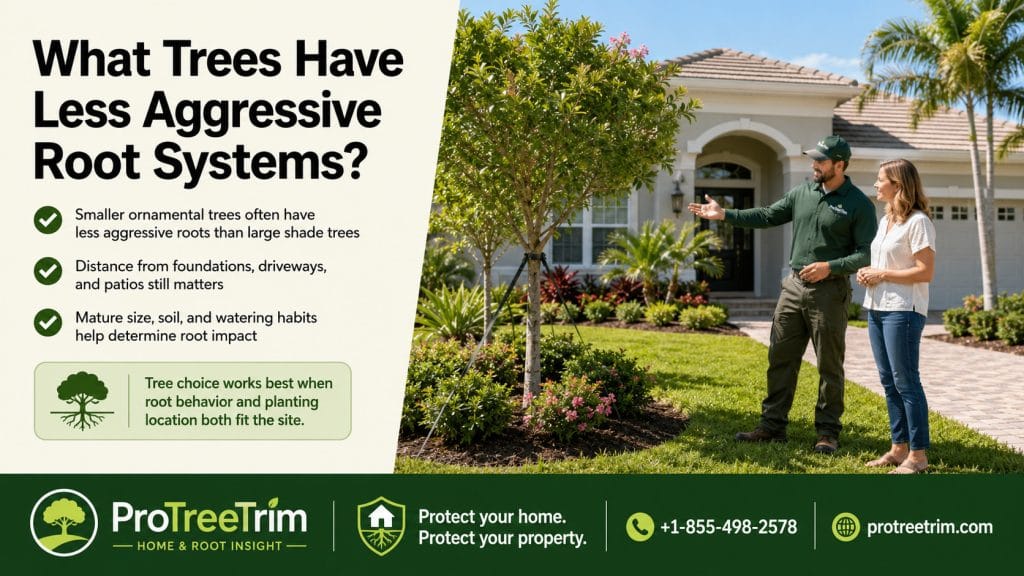
No tree has a completely non-invasive root system. Every tree needs roots to anchor itself, absorb water, and survive. But some trees are usually less likely to create major root conflicts when they are planted in the right place, given enough soil, and matched to the yard’s mature space.
The better question is not “Which tree has no roots?”
It is “Which tree is least likely to become a root problem in this specific spot?”
“Non-Invasive Roots” Can Be Misleading
Homeowners often search for trees with non-invasive roots because they want shade, privacy, or curb appeal without damaging the driveway, sidewalk, patio, pool deck, septic system, or foundation area.
That concern is reasonable. But the term “non-invasive” can create false confidence. Even a smaller tree can create problems if it is planted too close to hardscape, in poor soil, or in a narrow strip with nowhere else for roots to grow.
| What homeowners want | What actually matters |
|---|---|
| A tree with no root problems | No tree is completely root-free |
| A safe tree near the house | Mature size and distance matter |
| Shade near a driveway | Root space and canopy spread matter |
| Privacy near a fence | Spacing and future pruning matter |
| A patio-friendly tree | Debris, roots, shade, and access all matter |
| A poolside tree | Roots plus leaf/fruit drop matter |
| A septic-safe tree | Location and service access matter most |
A “good” tree in the wrong place can still become a problem.
Smaller Mature Size Usually Means Lower Root Conflict
In many yards, the safest root decision is to choose a tree that stays smaller at maturity. Smaller trees generally need less root space than large shade trees, and they are easier to place near homes, patios, fences, and walkways.
That does not mean every small tree is automatically safe. It means the risk is often easier to manage.
Lower-conflict tree traits usually include:
- modest mature height
- modest canopy spread
- slower to moderate growth
- fewer large surface roots
- good fit for local soil and climate
- manageable debris
- strong branch structure
- enough room away from hardscape
A smaller tree planted with proper spacing is usually better than a large tree squeezed into a narrow bed.
Roots Become Problems When Space Is Limited
Tree roots often become a problem because the planting site gives them nowhere reasonable to grow.
A tree planted in open soil may perform well. The same tree planted between a sidewalk, driveway, fence, pool cage, and irrigation line may become a future conflict.
Root problems are more likely near:
- narrow planting strips
- sidewalks
- driveways
- patios
- pool decks
- pavers
- retaining walls
- septic systems
- utility trenches
- compacted soil
- foundation-side beds
- fence lines
The tree species matters. But the site often matters just as much.
Avoid Large Shade Trees in Tight Spaces
Large shade trees can be beautiful and valuable, but they usually need serious room. If planted too close to structures or hardscape, their roots and canopy may become difficult to manage.
Be cautious with large trees near:
| Area | Why caution matters |
|---|---|
| Driveways | Roots may lift edges or create cracks |
| Sidewalks | Roots may contribute to uneven panels |
| Pool decks | Roots, debris, and access problems can overlap |
| Patios | Pavers may lift or settle near roots |
| Septic systems | Roots and service access can become concerns |
| Fences | Roots may affect posts or repair access |
| House walls | Canopy and roots may both create future issues |
A large tree belongs where it can become large without being punished for growing.
Look for Trees That Fit the Available Soil
A tree needs enough soil volume to support its future size. If the available planting bed is small, choose a tree that stays small.
Before choosing a tree, ask:
- How wide is the planting bed?
- Is the soil compacted?
- Is the area surrounded by concrete?
- Does water collect there?
- Are irrigation lines nearby?
- Is the root flare likely to stay visible?
- Will roots have room away from hardscape?
- Can the tree be maintained later?
If the tree will be surrounded by pavement on three sides, it needs to be chosen much more carefully.
“Low Root Risk” Does Not Mean “Plant Anywhere”
Some trees are marketed as good near patios, sidewalks, or homes. That may be true compared with larger, more aggressive trees. But no label replaces mature-size planning.
A lower-root-risk tree can still create trouble if it is:
- planted too close to the house
- planted in a tiny bed
- overwatered in poor drainage
- surrounded by pavers
- planted over utilities
- planted near septic components
- forced against a fence
- allowed to grow into a roofline
- never maintained
The tree may be lower risk, but the placement still has to be smart.
Think About Roots and Canopy Together
A homeowner may choose a tree for “safe roots” and forget about the canopy. That can create a different problem.
A tree with manageable roots may still drop fruit, flowers, seed pods, leaves, or sticky residue onto a patio, driveway, or pool deck. It may still grow branches into a roofline or fence. It may still block a walkway.
Choose the whole tree, not only the roots.
| Tree feature | Why it matters |
|---|---|
| Root behavior | Hardscape and underground conflicts |
| Mature height | Roofline, utility, and shade issues |
| Canopy spread | Fence, neighbor, patio, and driveway concerns |
| Debris | Pool, patio, gutter, and driveway cleanup |
| Growth rate | How quickly problems appear |
| Pruning needs | Future maintenance cost and access |
| Local fit | Soil, heat, rain, drought, and pests |
A “root-safe” tree that drops messy fruit over a pool may still be the wrong tree.
Good Places for Lower-Conflict Trees
Lower-conflict trees work best where they still have enough room.
They may fit well in:
- front yards with open planting space
- side yards only if the mature width is narrow
- patio edges with proper distance
- driveway-adjacent beds with enough soil
- fence-line areas with room for pruning
- poolside landscapes where debris is manageable
- small yards where large shade trees would be too much
The tree should fit the actual mature space, not just the nursery container.
Be Careful Near Foundations
Tree roots are often blamed for foundation problems, but the real situation is usually more complicated. Soil movement, drainage, construction, moisture changes, and existing cracks can all matter.
Still, planting large trees too close to the house is not a good idea. Even if roots do not “attack” the foundation, the tree may still create roofline, gutter, drainage, and access problems.
Near homes, prioritize:
- smaller mature size
- good drainage away from the structure
- enough distance from walls and rooflines
- no roots forced under hardscape
- no branches touching siding or gutters
- service access for future pruning
- no planting directly over utility lines
A tree near the house should stay in scale with the house.
Be Careful Near Septic Systems
If the yard has a septic system, tree choice and placement matter even more. Roots may grow toward moisture, and the system must remain accessible for inspection, pumping, and repair.
A tree with a “less aggressive” root system still should not be planted directly over a drain field, tank, access lid, or reserve area.
For septic areas, the safest approach is usually:
- locate the system first
- keep trees away from septic components
- preserve service access
- avoid moisture-seeking large trees
- choose grass or low plantings over sensitive areas
- avoid guessing where lines are
The best septic-safe tree may be the one planted somewhere else.
Be Careful Near Pools and Patios
Pools and patios are sensitive because people use those spaces closely. Root lifting is only one issue. Debris, stains, shade, slick surfaces, and future access also matter.
A good pool or patio tree should have:
- manageable roots
- low heavy-debris drop
- no staining fruit over pavers
- enough distance from the deck
- canopy placed away from screens and roofs
- future pruning access
- mature size that fits the yard
A tree that is root-friendly but messy may still be frustrating near a pool.
Do Not Ignore Surface Roots
Some trees naturally develop surface roots, especially when soil is compacted, shallow, wet, or low in oxygen. Surface roots may appear even when the tree is not “bad.”
Do not cut major surface roots just because they are visible. Large root cutting can stress the tree or affect stability.
If surface roots are already a problem, better options may include:
- expanding the mulch bed
- redirecting foot traffic
- avoiding mowing over roots
- adjusting pavers carefully
- improving drainage or compaction issues
- choosing a different planting location next time
- evaluating whether the tree still fits the space
Covering roots with deep soil or rocks is usually not the right fix.
Root Barriers Are Not a Magic Solution
Root barriers can sometimes help in specific situations, but they are not a substitute for choosing the right tree and planting location. A root barrier installed poorly can redirect roots, limit stability, or create false confidence.
Do not rely on a barrier to make a large tree safe in a tiny space.
Better first decisions:
- choose a smaller tree
- plant farther from hardscape
- provide more soil space
- avoid septic and utility conflicts
- maintain proper drainage
- keep the root flare visible
- avoid soil compaction
Design should reduce conflict before barriers are considered.
What About Palms?
Many palms have different root behavior than broadleaf shade trees, but that does not mean palms can be planted anywhere. Palms still need space, drainage, and maintenance access.
Palms can create problems when they are:
- too close to a pool cage
- too close to a house
- leaning toward a structure
- dropping heavy fronds over walkways
- producing fruit over pavers
- planted in tight side yards
- blocking service access
- growing near hardscape with no room
A palm may have less pavement-lifting risk than some large shade trees, but it can still become a placement problem.
What About Small Ornamental Trees?
Small ornamental trees are often a better fit for tight yards than large shade trees. They may offer flowers, seasonal color, privacy, or curb appeal without overwhelming the space.
But even ornamental trees need proper placement.
Before choosing one, check:
- mature height
- mature width
- flower or fruit drop
- root behavior
- pruning needs
- local climate suitability
- distance from house and walkways
- whether it will block windows or driveways
Small trees are usually lower risk, not no risk.
When the Existing Tree Is Already a Root Problem
If roots are already lifting a driveway, sidewalk, patio, or pool deck, do not rush into cutting them. The roots may be important to the tree’s stability and health.
First ask:
- How large are the roots?
- How close are they to the trunk?
- Is the tree healthy?
- Is the hardscape repair urgent?
- Can the surface be adjusted without cutting major roots?
- Is the tree too large for the site?
- Would removal be safer or more practical long term?
- Is the tree near a house, driveway, or pool cage?
Sometimes hardscape can be repaired around the tree. Sometimes the tree and hardscape are no longer compatible.
How to Choose a Lower-Root-Conflict Tree
Use this checklist before buying:
- Know the mature size.
- Match tree size to planting space.
- Avoid large trees in narrow strips.
- Keep trees away from septic components.
- Leave room from sidewalks, patios, driveways, and pool decks.
- Check overhead and underground utilities.
- Choose manageable debris habits.
- Consider local soil and drainage.
- Plan future pruning and removal access.
- Do not trust “non-invasive” labels blindly.
The best tree is the one that fits the site at maturity.
Final Homeowner Takeaway
Trees with less aggressive root systems can reduce future yard problems, but no tree is truly root-free. The safest choice depends on mature size, root behavior, planting distance, soil space, drainage, and nearby hardscape.
Choose smaller, well-matched trees for tight areas. Give roots room. Keep trees away from septic systems, utilities, and narrow concrete spaces. Avoid planting large shade trees where they will eventually fight the driveway, sidewalk, pool deck, patio, fence, or house.
If you are unsure which tree is safest near your home, driveway, patio, pool area, fence, or septic system, ProTreeTrim can help connect homeowners with local tree service support. Call +1-855-498-2578 or visit protreetrim.com.
FAQs
Are there trees with non-invasive roots?
No tree is completely root-free or risk-free, but smaller trees with moderate root systems are usually lower risk when planted in the right place.
What makes tree roots become a problem?
Roots are more likely to cause problems when trees are planted too close to hardscape, in compacted soil, in narrow strips, or near moisture sources such as septic or drainage areas.
Can a small tree still damage a sidewalk or patio?
Yes, if it is planted too close or in a poor site. Smaller trees are usually easier to manage, but spacing still matters.
Should I cut roots that are lifting pavers or concrete?
Not without careful evaluation. Cutting large roots can stress the tree or affect stability, especially if they are close to the trunk.
ProTreeTrim™ can help you take the next step.
If you are dealing with a damaged tree, fallen branch, stump, root issue, palm concern, or storm cleanup question in Florida, call ProTreeTrim for tree service support.