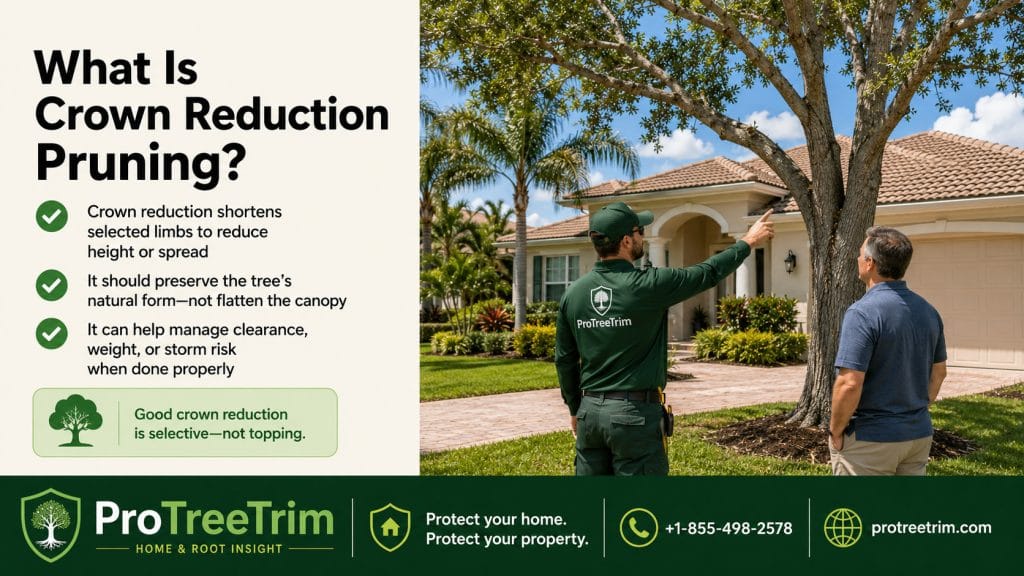
Crown reduction pruning is a careful method used to reduce the height or spread of a tree without topping it. Instead of cutting major limbs back to stubs, crown reduction uses selective cuts back to appropriate lateral branches. The goal is to make the tree slightly smaller, reduce a specific conflict, or lower stress on a branch while preserving natural structure.
Crown reduction is not the same as topping. Done correctly, it is precise and limited. Done poorly, it can become topping under a nicer name.
Crown Reduction Has a Specific Purpose
Crown reduction should solve a real problem. It is not a general instruction to “cut the tree way back.”
Homeowners may consider crown reduction when:
- branches are growing toward a roofline
- a limb is too extended over a driveway
- part of the canopy is crowding a structure
- a tree needs modest height or spread reduction
- storm damage created imbalance
- a branch needs weight reduced without full removal
- a tree has outgrown part of its space, but not completely
The word modest matters. Crown reduction cannot safely make every large tree small.
Crown Reduction vs. Tree Topping
This is the most important difference.
| Crown reduction | Tree topping |
|---|---|
| Uses selective cuts | Uses large stub cuts |
| Cuts back to suitable lateral branches | Cuts at random points |
| Preserves natural form | Destroys canopy shape |
| Limited and careful | Usually aggressive |
| May reduce specific conflicts | Often creates future problems |
| Requires skill | Often used as a shortcut |
If the tree is left with thick stubs, flat cuts, or a harsh chopped appearance, that is not proper crown reduction.
Why Homeowners Ask for Crown Reduction
Most homeowners ask about crown reduction because the tree feels too large for part of the property.
Common concerns include:
- branches over the roof
- limbs over the driveway
- canopy crowding a neighbor’s yard
- branches near a pool cage
- tree shading too much of the yard
- limbs extending over a patio
- tree height feeling risky before storms
- branches growing toward service lines
These concerns can be real. The mistake is assuming the solution is always heavy cutting.
Crown Reduction Cannot Make a Large Tree Small
A large tree is still a large tree after crown reduction. If a tree is fundamentally too big for the location, crown reduction may only delay the real decision.
Crown reduction may not be realistic when the tree:
- is planted too close to the house
- repeatedly grows into utility conflicts
- has major root damage
- has a severe trunk split
- has a large dead top
- is mostly dead or declining
- would need to be cut in half to satisfy the goal
- has already been topped repeatedly
If the only acceptable outcome is a much smaller tree, removal and replacement may be more honest than repeated reduction.
Good Crown Reduction Uses Lateral Branches
A proper crown reduction cut is usually made back to a lateral branch that is large enough to continue the limb’s growth pattern. This helps preserve the tree’s form and reduces the chance of weak, chaotic regrowth.
A poor cut leaves a stub with no meaningful lateral branch to take over.
A good reduction cut should:
- avoid large random stubs
- preserve natural branch direction
- avoid cutting flush into the trunk
- reduce only what is necessary
- avoid removing too much live canopy
- keep the tree balanced
- avoid creating a flat-topped look
Reduction pruning is about controlled redirection, not chopping.
When Crown Reduction May Help
Crown reduction may be useful when the issue is specific and limited.
It may help when:
| Situation | Why reduction may help |
|---|---|
| One limb extends too far over roof | Reduces branch spread without full removal |
| Branch over driveway is overextended | May reduce end weight |
| Canopy crowds a structure | Creates modest clearance |
| Storm damage left uneven canopy | Helps rebalance selected areas |
| A limb has too much end weight | May reduce leverage |
| Tree is healthy but slightly oversized | Limited size correction may be possible |
The tree must still have enough healthy structure to respond well.
When Crown Reduction Is the Wrong Choice
Crown reduction is not a cure for every problem.
It is usually the wrong choice when:
- the tree is mostly dead
- trunk decay is advanced
- roots are failing
- the tree is leaning dangerously
- the canopy is already thin
- the tree is severely storm-damaged
- the homeowner wants the tree reduced by half
- utility lines are involved and proper utility work is needed
- the tree has outgrown the site completely
In those cases, reduction may not solve the risk or may damage the tree further.
Crown Reduction Near Rooflines
Roof conflicts are one of the most common reasons for crown reduction. Branches may rub shingles, drop debris into gutters, or press against siding.
A good roofline reduction plan may include:
- reducing selected limbs away from the roof
- removing deadwood above the roof
- clearing gutter contact
- preserving natural canopy shape
- avoiding flat-sided cutting
- avoiding large unnecessary wounds
The goal is roof clearance with the least harmful cuts possible.
Crown Reduction Over Driveways and Patios
A long limb over a driveway, patio, walkway, or seating area may create concern, especially if it is heavy, cracked, or overextended. Crown reduction may sometimes reduce branch weight or spread.
But not every limb should be reduced. Some limbs should be removed. Some should be left alone. Some may indicate a larger structural issue.
Before reducing a limb, ask:
- Is the limb healthy?
- Is it cracked?
- Is the attachment strong?
- Is there decay?
- Is the limb over a target?
- Would reduction create a large wound?
- Would full removal be better?
- Would removal unbalance the tree?
A branch over a target deserves careful evaluation, not automatic reduction.
Crown Reduction for Storm Preparation
Crown reduction is sometimes requested before storm season. The idea is usually to make the tree smaller or reduce wind load. This must be handled carefully.
Good storm preparation usually focuses first on:
- dead branches
- cracked limbs
- hanging branches
- weak branch unions
- branches touching structures
- dead palm fronds
- trunk splits
- root movement or lean
Crown reduction may help in a specific case, such as an overextended limb. But reducing the whole tree aggressively before storms can backfire if it removes too much canopy or creates weak regrowth.
Crown Reduction Is Not Crown Thinning
Crown thinning reduces canopy density by selectively removing some branches inside the canopy. Crown reduction reduces height or spread by shortening selected branches back to appropriate laterals.
| If the goal is… | Better pruning type |
|---|---|
| Remove dead branches | Crown cleaning / deadwood pruning |
| Lift low branches | Crown raising |
| Reduce canopy density | Crown thinning |
| Reduce height or spread | Crown reduction |
| Remove storm damage | Corrective pruning |
| Make tree much smaller fast | Usually not safe; evaluate removal |
Using the wrong pruning method can damage the tree.
Crown Reduction Is Not Crown Raising
Crown raising removes lower branches to create clearance underneath the canopy. Crown reduction reduces the outer height or spread of the canopy.
A tree may need both in small amounts, but they solve different problems.
Examples:
- Branches hitting vehicles: crown raising may help.
- Branches extending over roof: crown reduction may help.
- Dead branches throughout canopy: crown cleaning may help.
- Tree too large for the entire yard: removal may be more realistic.
The problem determines the pruning type.
Large Cuts Should Be Avoided When Possible
Crown reduction should avoid large cuts whenever possible. Large cuts are harder for trees to close and may create decay risk.
Large cuts are more concerning when the tree is:
- mature
- drought-stressed
- root-damaged
- already thin
- decayed
- recently storm-damaged
- previously topped
- growing near important targets
A crown reduction that requires many large cuts may not be a good candidate.
Over-Reduction Can Harm the Tree
Too much crown reduction can look like topping. It can remove too much live canopy, expose bark, create large wounds, and trigger weak regrowth.
Signs of over-reduction include:
- canopy looks chopped
- many large stubs remain
- tree outline looks flat or unnatural
- too much foliage is removed
- major limbs are cut without laterals
- tree looks dramatically smaller
- sprouts appear heavily later
Good crown reduction should usually be subtle.
Previously Topped Trees Are Harder to Reduce
If a tree has already been topped, crown reduction becomes more complicated. The tree may have weak sprouts, old decay points, and poor structure around previous cuts.
A previously topped tree may need:
- careful corrective pruning
- deadwood removal
- monitoring for decay
- gradual structural improvement
- risk evaluation
- possible removal if structure is too poor
Repeated reduction of a topped tree can keep the damage cycle going.
Young Trees Usually Need Structural Pruning Instead
Young trees usually do not need crown reduction unless they have a specific conflict. They more often need structural pruning to guide future form.
Young-tree work may focus on:
- competing leaders
- crossing branches
- rubbing branches
- weak branch angles
- low limbs that will later block access
- branches growing toward structures
Trying to keep a young tree artificially small with repeated reduction is usually a sign the tree may be wrong for the location.
Mature Trees Need Conservative Reduction
Mature trees can sometimes receive crown reduction, but the work must be conservative. A mature tree has larger limbs, slower wound closure, and more established structure.
For mature trees, crown reduction should be considered only when:
- the tree is healthy enough
- the goal is limited
- cuts can be made to proper laterals
- large wounds can be avoided
- the tree will remain balanced
- the work solves a real property conflict
- removal is not the better option
Mature trees should not be forced into a smaller size repeatedly.
Palms Are Not Crown-Reduced
Palms do not have branching crowns like shade trees. You do not crown-reduce a palm by cutting green fronds or cutting into the top. Damaging the palm’s crown can seriously harm or kill it.
Palm work should focus on:
- fully dead fronds
- broken fronds
- seed pods when needed
- fronds touching rooflines or pool cages
- avoiding trunk damage
- preserving healthy green fronds
A palm that is too tall or poorly placed cannot be “reduced” like a shade tree.
Evergreens Need Special Caution
Pines, spruce, fir, arborvitae, and similar evergreens often do not respond well to hard reduction. Cutting into old bare wood may leave permanent gaps.
Crown reduction on evergreens is limited and species-dependent. Be especially cautious with:
- privacy rows
- arborvitae screens
- mature pines
- spruce near houses
- evergreens already browning
- trees with dead tops
- trees planted too close to structures
If an evergreen is too large for the site, reduction may not restore a good shape.
What Homeowners Should Ask Before Crown Reduction
Before approving crown reduction, ask:
- What exact height or spread problem are we solving?
- Can the cuts be made to suitable lateral branches?
- How much live canopy will be removed?
- Are large cuts required?
- Is the tree healthy enough for reduction?
- Will the tree still look natural?
- Is topping being avoided?
- Is removal a better long-term option?
- Are branches near utilities?
A good crown reduction plan should sound precise and limited.
What a Good Crown Reduction Scope Sounds Like
A good scope:
- “Reduce selected limbs away from the roofline.”
- “Make reduction cuts back to appropriate lateral branches.”
- “Avoid topping and stub cuts.”
- “Preserve natural canopy shape.”
- “Reduce one overextended limb over the driveway.”
- “Do not remove more live canopy than necessary.”
A poor scope:
- “Cut the whole top down.”
- “Make it half as tall.”
- “Cut everything back hard.”
- “Leave it short.”
- “Flat-top the tree.”
- “It will grow back.”
- “Reduce every limb the same amount.”
Crown reduction is not uniform haircut pruning.
When Crown Reduction Should Wait
Waiting may be better when:
- the tree is drought-stressed
- the canopy is already thin
- roots were recently damaged
- the tree was recently transplanted
- cuts would be large and mostly cosmetic
- the tree was recently over-pruned
- storm damage needs assessment first
- the tree may need removal instead
If the problem is not urgent, it may be better to plan carefully rather than cut quickly.
When Crown Reduction Should Not Wait
Crown reduction may need attention sooner when a specific branch conflict is creating risk.
Act sooner when:
| Situation | Why action may be needed |
|---|---|
| Limb extends over roof and is rubbing | Roof damage concern |
| Overextended branch over driveway | Branch-fall concern may increase |
| Storm damage left canopy imbalanced | Corrective pruning may help |
| Branch is pressing into pool cage | Screen/frame damage possible |
| Limb is cracked but partly attached | Failure risk may exist |
| Branch is near structure and worsening | Early action may reduce larger cuts later |
Urgent reduction should still be careful and limited.
Final Homeowner Takeaway
Crown reduction pruning can reduce a tree’s height or spread in a careful, structured way. It is not topping. Good crown reduction uses selective cuts back to proper lateral branches and preserves the tree’s natural form.
It can help with roofline conflicts, overextended limbs, storm damage correction, and modest size issues. But it cannot turn a large tree into a small tree, repair severe decay, or solve a tree planted in the wrong place. If the work would require cutting the tree in half, removal and replacement may be the better long-term answer.
If you are unsure whether your tree needs crown reduction, roof clearance, deadwood pruning, or removal instead, ProTreeTrim can help connect homeowners with local tree service support. Call +1-855-498-2578 or visit protreetrim.com.
FAQs
What is crown reduction pruning?
Crown reduction is selective pruning that reduces a tree’s height or spread by cutting branches back to appropriate lateral branches.
Is crown reduction the same as topping?
No. Crown reduction preserves structure and natural form. Topping cuts major limbs to stubs and should be avoided.
Can crown reduction make a tree much smaller?
Only to a limited degree. If a tree must be made dramatically smaller, it may be too large for the site.
When is crown reduction useful?
It may help when selected limbs are overextended, crowding a roofline, pressing into structures, or creating limited spread concerns.
ProTreeTrim™ can help you take the next step.
If you are dealing with a damaged tree, fallen branch, stump, root issue, palm concern, or storm cleanup question in Florida, call ProTreeTrim for tree service support.