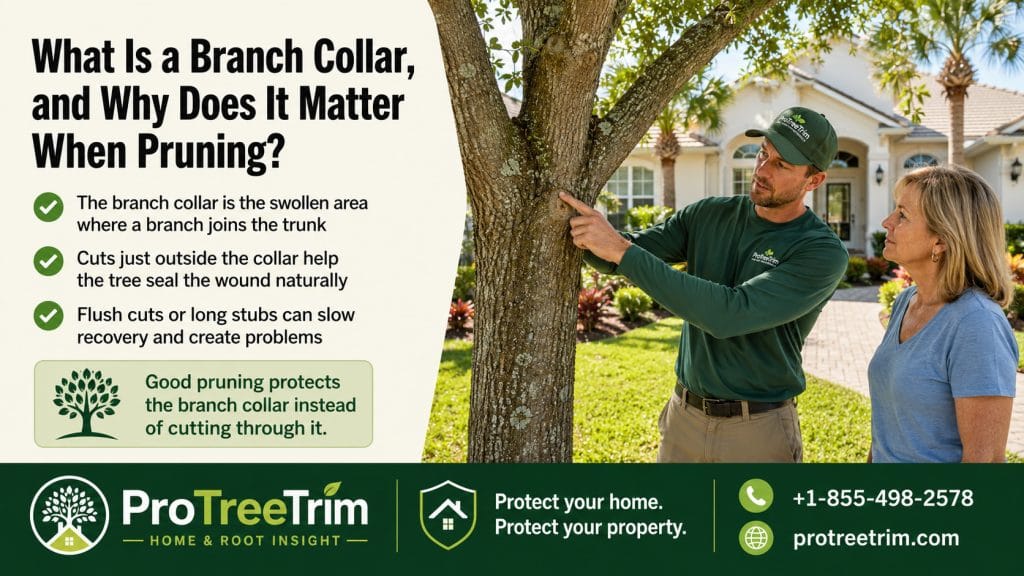
A branch collar is the slightly swollen or raised area where a branch connects to the trunk or a larger limb. It may look like a subtle ring, ridge, flare, or thicker shoulder at the base of the branch.
The branch collar matters because it helps the tree respond to pruning wounds. A good pruning cut respects this area. A bad cut removes it, damages the trunk, or leaves a long dead stub that the tree cannot close properly.
If you only remember one thing about pruning cuts, remember this: do not cut flush against the trunk, and do not leave a long stub.
The Branch Collar Is the Tree’s Natural Wound-Response Zone
Trees do not heal like human skin. They do not replace damaged tissue in the same way. Instead, they seal off damaged wood and grow around wounds over time.
The branch collar is important because it contains tissue that helps the tree close over a pruning cut. When a branch is removed just outside the collar, the tree has a better chance of sealing the wound properly.
| Pruning cut | Why it matters |
|---|---|
| Cut just outside the branch collar | Usually best for wound response |
| Flush cut into the trunk | Removes important tissue and creates a larger wound |
| Long stub left behind | Stub may die and decay before closure |
| Torn bark cut | Creates a larger wound than necessary |
| Large unnecessary cut | Harder for the tree to close |
| Cut on stressed tree | Recovery may be slower |
The cut location matters as much as the branch being removed.
What the Branch Collar Looks Like
The branch collar is not always obvious. On some trees, it looks like a clear swollen ring at the base of a branch. On others, it may be subtle. It is usually found where the branch meets the trunk or parent limb.
Look for:
- a raised ridge around the branch base
- a swollen shoulder where branch meets trunk
- a slight flare at the branch connection
- a change in bark texture near the union
- a branch bark ridge above the union
- a natural “neck” at the base of the limb
The goal is to cut outside that area, not through it.
A Proper Cut Is Not Flush
A flush cut is one of the most common pruning mistakes. It happens when someone cuts the branch flat against the trunk or parent limb. It may look clean at first, but it removes the branch collar and creates a larger wound than necessary.
Flush cuts can lead to:
- slower wound closure
- trunk tissue damage
- larger exposed wood area
- greater decay potential
- poor woundwood development
- long-term structural weakness
A cut can look neat and still be wrong if it is too close.
A Proper Cut Also Does Not Leave a Long Stub
Leaving a long stub is the opposite mistake. The branch stub usually dies back. Because the cut is too far from the collar, the tree cannot close over it efficiently.
Long stubs may:
- dry out and crack
- decay over time
- attract insects or fungi
- produce weak sprouts
- look unattractive
- make future correction harder
A good pruning cut removes the branch but leaves the branch collar intact.
Why Bad Cuts Matter More on Large Branches
Small pruning mistakes may be easier for a vigorous young tree to handle. Large bad cuts are different. The larger the branch, the larger the wound, and the harder it is for the tree to seal.
Before removing a large branch, ask:
- Is the branch dead or broken?
- Is it cracked or hazardous?
- Is it touching a roof, gutter, driveway, or walkway?
- Is there a smaller cut that solves the problem?
- Will removing it unbalance the tree?
- Is the tree already stressed?
- Is the branch important to the tree’s structure?
A proper branch collar cut helps, but it does not make every large cut a good idea.
Branch Collars Matter During Deadwood Pruning
Deadwood pruning removes dead branches. Even though the branch is dead, the cut still matters. A dead branch should usually be removed near the collar without cutting into the trunk.
Deadwood pruning is especially important when dead limbs hang over:
- driveways
- sidewalks
- patios
- roofs
- pool cages
- fences
- parked vehicles
- outdoor seating areas
- neighbor property
A dead branch can be removed for safety, but it should still be cut correctly.
Branch Collars Matter During Storm Cleanup
Storms can tear branches, split limbs, and leave jagged stubs. It may be tempting to cut quickly just to clean the tree up. But storm-damaged branches still need proper cuts.
After storm damage, pruning may involve:
- removing hanging limbs
- cleaning broken branch stubs
- making final cuts outside the collar
- avoiding bark tears
- checking for trunk cracks
- checking whether the branch union is split
- preserving healthy structure where possible
A storm tear should not be left as a ragged wound if it can be corrected safely.
Do Not Cut Into the Branch Bark Ridge
The branch bark ridge is another important clue. It is often the raised line of bark in the angle between the branch and trunk. It can help show where the branch attaches.
A proper cut usually stays outside both the branch bark ridge and the branch collar. Cutting into either can damage the tree’s natural wound-response area.
If you cannot identify the collar or ridge on a large branch, it may not be a good DIY cut.
The Three-Cut Method Helps Prevent Bark Tearing
Large branches should not be removed with one cut from the top. The branch’s weight can tear bark down the trunk before the cut is finished. That creates a much larger wound.
For larger limbs, a three-cut method is often used:
- An undercut is made partway through the branch away from the trunk.
- A second cut removes the branch weight farther out.
- A final cut removes the remaining stub just outside the branch collar.
This prevents the branch from peeling bark down the trunk.
Homeowners should not attempt large or high limb removal without proper equipment and experience.
Branch Collars Are Not Always Easy on Palms
Palms are different from branching shade trees. A palm does not have branch collars in the same way an oak, maple, or pine does. Palm trimming focuses on fronds, not branch unions.
For palms, the key is to avoid:
- cutting into the trunk
- shaving the trunk aggressively
- ripping off tight boots
- removing healthy green fronds unnecessarily
- damaging the crown
- creating wounds that did not need to happen
Do not apply shade-tree branch collar logic directly to palms.
Young Trees Need Good Cuts Early
Young trees benefit from proper pruning because small cuts made correctly can prevent larger problems later. If a young tree has crossing branches, competing leaders, or low limbs that will become clearance problems, pruning may help.
But even small cuts should respect the branch collar.
Good young-tree pruning:
- removes broken branches cleanly
- corrects crossing branches early
- reduces competing leaders carefully
- preserves enough live canopy
- avoids topping
- avoids stripping lower branches too soon
- makes small, correct cuts
Bad early cuts can shape the tree’s future problems.
Mature Trees Need Extra Caution
On mature trees, branch collar cuts become more important because branches are larger and wounds close more slowly. A mature tree may not recover well from unnecessary large cuts, flush cuts, or heavy canopy removal.
Be cautious with mature trees when:
- large limbs are involved
- the tree is already stressed
- roots were recently damaged
- the branch is over a structure
- decay is visible
- the branch union looks weak
- past pruning left stubs or cavities
- the tree has trunk cracks or mushrooms near the base
A mature tree should be pruned with restraint.
Why “Cut It Close” Is Bad Advice
Some homeowners ask for branches to be cut “as close as possible” to make the tree look cleaner. That can lead to flush cuts.
Close is not the same as correct.
A correct cut leaves the branch collar. It may not be perfectly flat against the trunk. That small raised area is important. Removing it for a cleaner appearance can slow the tree’s response and create a bigger wound.
The best-looking cut long-term is the one the tree can close properly.
Why “Leave a Little Extra” Can Also Be Bad Advice
Other homeowners worry about cutting too close and leave long stubs. That also creates problems. The dead stub may remain for years, decay, or interfere with wound closure.
A small collar is good. A long stub is not.
A correct cut finds the balance: outside the collar, but not far beyond it.
Should You Seal a Branch Collar Cut?
Usually no. A proper pruning cut is normally left uncovered. The tree needs to seal the wound naturally. Pruning paint, tar, caulk, glue, or wound dressing can trap moisture and hide problems.
Instead of sealing the cut, focus on:
- making the cut correctly
- avoiding bark tearing
- preserving the collar
- not removing unnecessary large limbs
- keeping the tree healthy
- avoiding further stress
- monitoring large cuts over time
A sealer cannot fix a bad cut.
What If a Bad Cut Already Happened?
If a tree already has a flush cut or long stub, do not panic. Many trees can tolerate some pruning mistakes, especially if they are otherwise healthy. But the cut should be monitored.
Watch for:
| Warning sign | Why it matters |
|---|---|
| Soft wood around cut | Decay may be developing |
| Mushrooms near wound | Fungal decay concern |
| Crack spreading from cut | Structural issue may exist |
| Bark peeling around wound | Tissue damage may be expanding |
| Oozing or dark staining | Tree stress or decay may be involved |
| Dead branch above cut area | More decline may be present |
| Insects entering wound | Wound may be attracting activity |
Old bad cuts may not need immediate action, but they should not be ignored if they worsen.
Can a Stub Be Corrected Later?
Sometimes a long stub can be corrected with a proper cut outside the branch collar. But this depends on where the stub is, how large it is, whether decay has started, and whether the collar can still be identified.
Do not recut old stubs casually on large limbs. A second bad cut can make the wound worse.
Correction may be reasonable when:
- the stub is small
- the branch collar is still visible
- the cut can be made safely
- the tree is otherwise healthy
- the correction will not create a larger wound
- the branch is not near utilities or structures
Large old stubs should be evaluated carefully.
Branch Collar Cuts Near Roofs and Driveways
Branches near roofs, gutters, driveways, and walkways are common pruning targets. The branch may need removal, but the final cut still matters.
For property-clearance pruning, avoid:
- cutting branches flush against the trunk
- leaving stubs above the roof
- making jagged cuts from awkward ladder positions
- tearing bark while removing heavy limbs
- cutting too many live branches at once
- cutting near service lines without proper help
Clearance pruning should protect the property and the tree.
What Homeowners Should Ask Before Pruning
Before a branch is removed, ask:
- Where is the branch collar?
- Is the branch dead, broken, rubbing, or hazardous?
- Is this branch large enough to need professional help?
- Will the cut tear bark?
- Is the tree already stressed?
- Is there a smaller cut that solves the problem?
- Is the branch near a roof, driveway, pool cage, or utility line?
- Will the tree keep a natural structure after the cut?
These questions prevent many pruning mistakes.
What a Good Branch Removal Scope Sounds Like
A good scope:
- “Remove the dead branch with a proper collar cut.”
- “Use proper cuts to avoid bark tearing.”
- “Remove the broken limb without cutting into the trunk.”
- “Preserve the branch collar.”
- “Avoid flush cuts and long stubs.”
- “Remove only the branches causing roof contact.”
A poor scope:
- “Cut it as close as possible.”
- “Leave a big stub just in case.”
- “Cut everything back hard.”
- “Make it flat on this side.”
- “Top it.”
- “Seal all cuts with paint.”
Specific pruning language leads to better results.
Final Homeowner Takeaway
The branch collar is the natural transition area where a branch connects to the trunk or a larger limb. It matters because it helps the tree seal pruning wounds.
Good pruning cuts are made just outside the branch collar. Bad cuts either remove the collar with a flush cut or leave a long stub that can die and decay. The best way to protect a tree is not to paint the wound afterward. It is to make the right cut in the first place.
If you are unsure whether a branch should be removed, where the cut should be made, or whether previous pruning damaged your tree, ProTreeTrim can help connect homeowners with local tree service support. Call +1-855-498-2578 or visit protreetrim.com.
FAQs
What is a branch collar?
A branch collar is the slightly swollen area where a branch joins the trunk or a larger limb. It helps the tree seal pruning wounds.
Should you cut above or below the branch collar?
A pruning cut should be made just outside the branch collar without cutting into it and without leaving a long stub.
Why are flush cuts bad for trees?
Flush cuts remove important collar tissue, create larger wounds, and can slow the tree’s natural wound response.
Do branch collar cuts need pruning sealer?
Usually no. Proper pruning cuts are normally left uncovered so the tree can seal the wound naturally.
ProTreeTrim™ can help you take the next step.
If you are dealing with a damaged tree, fallen branch, stump, root issue, palm concern, or storm cleanup question in Florida, call ProTreeTrim for tree service support.