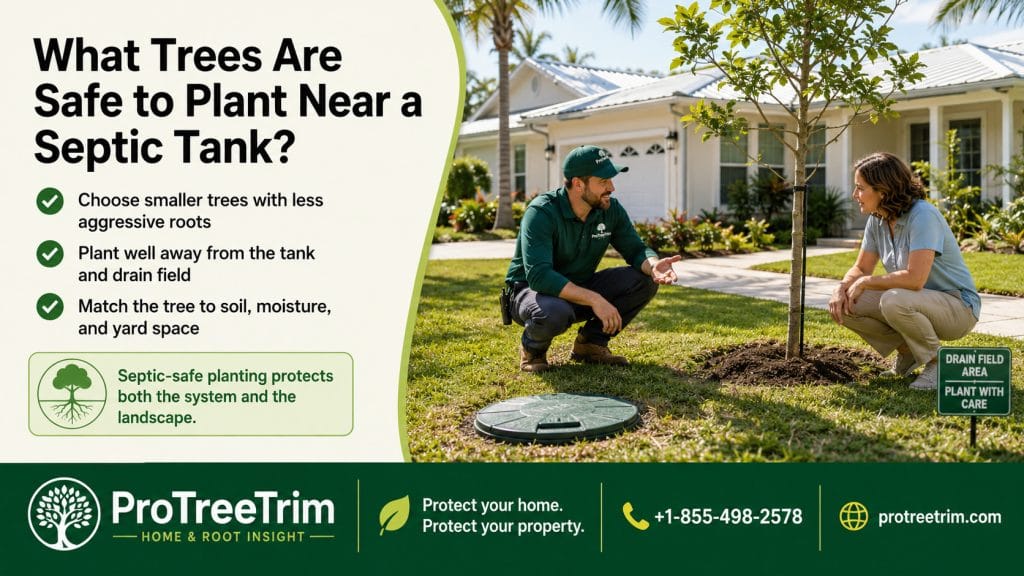
The safest trees to plant near a septic tank are usually small, slow-growing, regionally adapted trees planted far enough away from the tank, septic lines, and drain field. But in many cases, the best planting near a septic system is not a tree at all. Grass, shallow-rooted groundcover, and low-maintenance plants are often safer choices directly over or near septic components.
The most important rule is simple: know where the septic tank, drain field, and lines are before planting anything with woody roots.
Septic Tanks and Drain Fields Are Different
Homeowners often say “near the septic tank” when they really mean the entire septic system. But the tank, pipes, and drain field have different risks.
| Septic area | Why planting matters |
|---|---|
| Septic tank | Needs access for service and inspection |
| Septic lines | Roots may enter cracks, joints, or leaks |
| Distribution box | Should stay accessible |
| Drain field | Needs open soil and should not be disturbed |
| Cleanouts or lids | Should not be hidden by trees or shrubs |
| Wet soil areas | May attract roots toward moisture |
A tree planted away from the tank but close to the drain field can still become a problem.
The Safest Planting Over a Drain Field Is Usually Not a Tree
Drain fields need breathable, functional soil. Large roots, digging, heavy irrigation, and shade can all interfere with that area. If you are planting directly over or very near a drain field, small shallow-rooted plants are usually safer than trees.
Safer choices may include:
- lawn grass
- shallow-rooted groundcover
- small perennials
- low plants that do not need deep holes
- plants that do not need heavy irrigation
- vegetation that allows future access
- plants that do not require frequent digging
The goal is to protect the septic system first. Landscaping comes second.
If You Want a Tree, Choose Small and Plant Farther Away
No tree is completely “septic-safe” if it is planted too close. Even a smaller ornamental tree can cause problems if it is placed directly over lines or a drain field.
A better septic-friendly tree choice usually has:
- smaller mature size
- slower or moderate growth
- less aggressive root behavior
- low water demand after establishment
- limited surface-root conflict
- manageable canopy spread
- local climate suitability
- enough distance from septic components
A tree that stays in scale is safer than a large shade tree squeezed near underground infrastructure.
Avoid Large, Fast-Growing, Moisture-Seeking Trees
Some trees are more likely to create septic conflicts because they grow quickly, seek moisture aggressively, or develop large root systems. These trees may be valuable in the right location, but they are usually poor choices near septic systems.
Be cautious with:
- willows
- poplars
- cottonwoods
- silver maples
- large ficus-type trees in warm climates
- large fast-growing shade trees
- trees known locally for sewer or drain problems
- trees that naturally seek wet soil
- any tree that becomes too large for the space
The issue is not that these trees are “bad.” The issue is that septic areas are not the right place for aggressive roots.
Small Ornamentals Are Usually Better Than Large Shade Trees
If a tree is desired near—but not directly over—a septic area, small ornamentals are usually easier to manage than large shade trees.
Depending on region and site conditions, homeowners may consider smaller options such as:
- redbud
- serviceberry
- dogwood where suitable
- small holly types
- crape myrtle where appropriate
- small native flowering trees
- compact ornamental trees suited to local soil
- small palms in warm climates, planted away from septic components
The exact choice depends on local climate, soil drainage, mature size, and the septic layout.
Palms Near Septic Systems Still Need Caution
Some homeowners assume palms are automatically safe because many palms have fibrous root systems rather than large woody roots. Palms can sometimes be lower-conflict than large shade trees, but they should still not be planted directly over septic tanks, lines, or drain fields.
Palm concerns include:
- access to tank lids
- future trunk size
- falling fronds
- fruit or seed drop
- irrigation needs
- roots near pipes or pavers
- equipment access for septic service
- proximity to pool cages, driveways, and roofs
A palm may be a better choice than a large shade tree, but placement still matters.
Keep Septic Access Clear
Do not hide septic lids, cleanouts, or service areas under trees, shrubs, mulch mounds, or dense planting beds. Septic systems need maintenance access.
Avoid planting where future service crews would need to:
- cut roots
- remove shrubs
- dig through a planted bed
- drive over root zones
- disturb a tree base
- remove hardscape or edging
- guess where access lids are located
A pretty planting bed becomes a problem if it blocks necessary septic work.
Root Distance Should Be Based on Mature Size
A small nursery tree may look harmless, but roots and canopy expand over time. Planting distance should be based on the tree’s mature size, not its size today.
Before planting, ask:
- How tall will this tree get?
- How wide will the canopy spread?
- How far do roots typically spread?
- Will the tree need regular irrigation?
- Is it known for surface roots?
- Will it block septic access?
- Is the drain field nearby?
- Can future repairs happen without cutting roots?
If the answer is unclear, choose a smaller plant or plant farther away.
Do Not Plant Trees Directly Over Septic Lines
Even a small tree can become a problem if planted directly over a pipe route. Roots may grow toward moisture, and future repairs may require digging through the tree’s root zone.
Do not plant trees where they may interfere with:
- pipe trenches
- drain field lines
- tank lids
- inspection ports
- cleanouts
- distribution boxes
- service access paths
- repair equipment access
A tree should not sit on top of infrastructure that may need future excavation.
Drain Field Soil Should Not Be Heavily Disturbed
Installing a tree often requires digging a hole, adding soil amendments, watering, mulching, and sometimes staking. That may be fine in a normal landscape bed. It is not ideal over a drain field.
Avoid over a drain field:
- deep planting holes
- large root balls
- heavy mulch layers
- raised beds
- soil compaction
- irrigation changes
- grading changes
- landscape fabric
- large shrubs or trees
The drain field should remain open, breathable, and serviceable.
Watering Needs Matter
A tree that needs frequent irrigation near a septic system may create unwanted moisture patterns. Overwatering can affect soil conditions and may encourage roots toward septic components.
Better choices near septic areas usually:
- tolerate local rainfall after establishment
- do not require constant watering
- do not need wet soil
- do not create a soggy planting bed
- do not require irrigation aimed at septic areas
Choose plants that match the site instead of changing the site to support the tree.
Do Not Use Septic Areas as a Tree Nursery
A septic field may look like open yard space, but it is not a blank planting area. It is part of the home’s wastewater system.
Avoid planting trees in septic areas just because:
- the grass is open
- the area gets sun
- the soil seems moist
- you want shade there
- the space looks unused
- the tree is small now
- you want to hide septic access points
The future cost of root intrusion or septic repair can be much higher than the value of planting in that spot.
Existing Trees Near Septic Systems Are a Different Decision
If a mature tree already exists near a septic system, do not automatically remove it. The tree may have been stable for years. But it should be monitored, especially if there are septic symptoms.
Watch for:
- slow drains
- sewage odors
- wet spots in the yard
- unusually green grass over lines
- repeated clogs
- backups
- roots found in pipes
- canopy decline after septic work
- roots exposed during repair
If roots are already involved in septic problems, the decision may shift from monitoring to removal or root-sensitive repair.
When Tree Removal May Be the Better Choice
Removal may need discussion when a tree is already too close to septic infrastructure and causing repeated problems.
Removal may be more realistic when:
| Situation | Why removal may be considered |
|---|---|
| Roots are inside septic lines | Pipe function may be affected |
| Repairs require major root cutting | Tree stability may be compromised |
| Tree blocks tank access | Future service becomes difficult |
| Tree is large and close to drain field | Long-term conflict may continue |
| Tree is declining | It may not justify root-sensitive repair |
| Repeated clogs involve roots | The conflict may return |
| Drain field must be repaired | Roots may obstruct the work |
Sometimes saving the tree and protecting the septic system are not both practical.
What to Plant Instead of Trees
If the area is close to septic components, safer alternatives may include:
- turfgrass
- shallow-rooted groundcover
- small perennials
- low native plants
- low-water plants suited to the site
- plants that can be removed easily
- plants that do not need deep digging
- simple mulch-free access zones near lids
Keep the area easy to inspect and maintain.
What Homeowners Should Photograph Before Planting
Before choosing a tree near a septic system, take photos of:
- full yard area
- suspected tank location
- drain field area
- cleanouts or lids
- existing trees nearby
- wet spots after rain
- driveway or walkway access
- proposed planting location
- utility markers if available
- areas septic crews need to reach
Photos help avoid planting in a spot that creates repair problems later.
What to Do First
A practical first response:
- Locate the tank, lines, cleanouts, and drain field.
- Keep direct drain field planting shallow and simple.
- Avoid large or moisture-seeking trees nearby.
- Choose small, regionally adapted trees only if planted far enough away.
- Keep septic access clear.
- Avoid deep digging over septic components.
- Do not hide lids or cleanouts under dense landscaping.
- Ask a septic professional if the system layout is uncertain.
The best septic-safe planting decision starts with the system map.
Final Homeowner Takeaway
The safest plants near a septic tank or drain field are usually shallow-rooted grasses, groundcovers, and low-maintenance plants. If you want a tree nearby, choose a small, regionally adapted species and plant it far enough away from the tank, lines, and drain field to avoid future root and access problems.
Avoid large, fast-growing, moisture-seeking trees near septic systems. Do not plant directly over septic lines or drain fields. Keep access points clear, and identify the system layout before digging.
If you are unsure whether a tree is too close to a septic tank, whether roots are already interfering, or whether removal or replanting is the safer choice, ProTreeTrim can help connect homeowners with local tree service support. Call +1-855-498-2578 or visit protreetrim.com.
FAQs
What trees are safest near a septic tank?
Small, slow-growing, regionally adapted trees planted far away from the tank, lines, and drain field are usually safer than large shade trees.
Can I plant a tree over a septic drain field?
It is usually better not to. Grass or shallow-rooted groundcover is typically safer over drain fields.
What trees should not be planted near septic systems?
Avoid large, fast-growing, moisture-seeking trees such as willows, poplars, cottonwoods, silver maples, and similar aggressive-root trees.
Can palms be planted near septic tanks?
Some palms may be lower-conflict than large shade trees, but they should still be planted away from tanks, lines, and drain fields.
ProTreeTrim™ can help you take the next step.
If you are dealing with a damaged tree, fallen branch, stump, root issue, palm concern, or storm cleanup question in Florida, call ProTreeTrim for tree service support.