
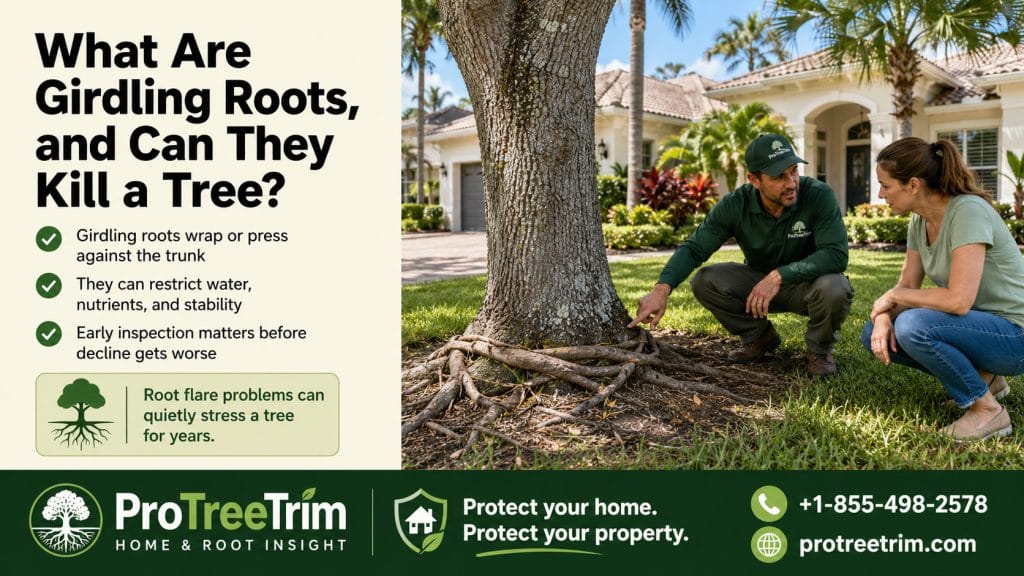
Girdling roots are roots that grow around, across, or tightly against the base of a tree instead of spreading outward naturally. Over time, they can press against the trunk, root flare, or other main roots. This pressure may restrict movement of water and nutrients, weaken the tree, hide decay, or contribute to long-term decline.
A tree with girdling roots may look normal for years. Then the canopy slowly thins, leaves get smaller, branches die back, or the tree becomes less stable. The problem is often hidden under soil, mulch, turf, or a raised landscape bed.
The key homeowner question is simple: can you see the root flare, and are roots circling or pressing against the trunk?
What Girdling Roots Look Like
Girdling roots are not always obvious. Sometimes they are visible at the surface. Other times, they are hidden just below soil or mulch.
They may look like:
- a root wrapping around the trunk base
- a root crossing over the root flare
- a large root pressing tightly against the trunk
- roots growing in a circle near the base
- a trunk that goes straight into the ground like a pole
- one side of the trunk looking flattened or compressed
- a tree base buried under mulch or soil
- poor flare development at ground level
A healthy tree base should usually widen as it meets the roots. If the trunk disappears into the ground without a visible flare, there may be a planting-depth or root-flare problem.
The Root Flare Is the First Clue
The root flare is where the trunk widens into the main roots. It should be visible. When the flare is buried, hidden, or missing, girdling roots become more likely or harder to detect.
A hidden root flare may happen because:
| Cause | Why it matters |
|---|---|
| Tree planted too deep | Roots may grow incorrectly near the trunk |
| Mulch piled against trunk | Root flare and bark problems get hidden |
| Soil added over roots | Roots may lose oxygen and grow poorly |
| Raised bed built around tree | Trunk base stays buried and moist |
| Nursery root defects | Circling roots may have started in the container |
| Sod installed too high | Root flare may be covered |
| Repeated landscaping changes | Grade may slowly rise around the tree |
If the root flare is not visible, do not ignore it. That does not automatically mean the tree is doomed, but it is worth checking.
Why Girdling Roots Happen
Girdling roots often begin early in a tree’s life. A tree may have been grown in a container too long, planted too deep, installed with roots circling in the planting hole, or buried later by mulch and soil.
Common causes include:
- container-grown roots circling in the pot
- planting hole too narrow
- tree planted too deep
- root ball not corrected at planting
- compacted soil around the tree
- mulch volcanoes
- raised beds around the trunk
- poor drainage or oxygen-starved soil
- roots forced to grow in limited space
- hardscape restricting root spread
The problem may start small and become serious only after the tree grows larger.
Can Girdling Roots Kill a Tree?
Yes, girdling roots can contribute to serious decline and may eventually kill a tree, especially when they press tightly against the trunk or main roots over many years. They can restrict flow, create stress, weaken root function, and make the tree less able to handle drought, storms, pests, disease, or construction damage.
But not every visible crossing root is an emergency.
The seriousness depends on:
- tree age
- root size
- how tightly the root presses against the trunk
- whether the root flare is buried
- canopy condition
- trunk compression
- soil drainage
- species
- whether decay or instability is present
- whether the tree is near a target like a house, driveway, or walkway
A small root crossing near the surface is different from a large root embedded against the trunk of a mature shade tree.
Warning Signs Above Ground
Because girdling roots are often hidden, the canopy may show the first warning signs.
Look for:
- thinning canopy
- smaller leaves than normal
- early leaf drop
- branch dieback
- dead top
- one-sided canopy decline
- slow growth
- stress shoots near the base
- leaf scorch during heat
- poor response after watering
- repeated deadwood
These symptoms can have many causes, but if they appear with a buried root flare or roots circling the trunk, girdling roots should be considered.
A Healthy-Looking Tree Can Still Have Girdling Roots
One difficult thing about girdling roots is timing. A tree may look fine while the roots are still small. As the trunk and roots expand, the pressure increases. Symptoms may appear slowly.
This is why homeowners sometimes say:
- “The tree looked healthy last year.”
- “Only one side is thinning.”
- “The leaves are smaller every season.”
- “It drops leaves earlier than nearby trees.”
- “There are dead branches at the top.”
- “The trunk looks squeezed at the base.”
- “The tree never really grew well after planting.”
A tree does not need to look dead for girdling roots to matter.
Girdling Roots and Tree Stability
Girdling roots are usually discussed as a tree-health problem, but they can also relate to stability. If main roots do not spread properly, or if decay develops near the base, the tree may be less secure over time.
Be more cautious when girdling-root concerns appear with:
| Warning sign | Why it matters |
|---|---|
| New lean | Root or soil support may be changing |
| Soil lifting near base | Stability concern |
| Mushrooms near root flare | Decay may be involved |
| Trunk crack | Structural issue may exist |
| Hollow or soft base | Strength may be reduced |
| Major dead limbs | Tree decline may be advanced |
| Root cutting nearby | Support may already be weakened |
| Tree near house or driveway | Consequences are higher |
A root-flare problem on a tree in open lawn is one issue. The same problem on a tree leaning toward a house is more urgent.
Girdling Roots Are Common After Poor Planting
Many girdling-root problems trace back to planting. If the tree was planted too deep or with circling roots, the defect may have been built into the tree from the start.
Poor planting clues include:
- trunk looks like a telephone pole entering soil
- root flare is buried
- mulch covers the trunk base
- tree has not grown well
- tree rocks or leans after storms
- roots circle close to the trunk
- tree was planted from a container
- landscape bed was raised after planting
The best time to prevent girdling roots is before or during planting. The second-best time is early, while the tree is still young.
Mulch Volcanoes Can Hide the Problem
A mulch volcano is mulch piled high against the trunk. It looks tidy to some homeowners, but it can hide the root flare, hold moisture against bark, encourage roots to grow into mulch, and cover early warning signs.
Mulch should be:
- wide
- shallow
- pulled away from the trunk
- not stacked against bark
- not covering the root flare
- refreshed lightly, not piled deeper every year
If you have to dig through mulch to find the trunk flare, the tree base may be too buried.
Raised Beds Around Trees Can Make It Worse
A raised bed around an established tree may look like landscaping, but it can bury the root flare and main roots. This can create oxygen problems and hide girdling roots.
Avoid raised beds that:
- add several inches of soil over roots
- cover the trunk base
- trap moisture against bark
- use retaining blocks tight to the trunk
- require cutting roots for edging
- bury visible surface roots
- hide mushrooms, cracks, or decay
A tree should not be treated like a post in the middle of a planter.
Can Girdling Roots Be Fixed?
Sometimes, especially when the tree is young and the roots are small. Small girdling roots may be removed or corrected with less risk. Larger roots on mature trees are much more complicated.
Correction depends on:
- root size
- tree species
- tree age
- how deeply the root is embedded
- whether the root is structural
- tree health
- canopy condition
- decay presence
- location near targets
- whether removal would create more harm
Do not cut a large girdling root casually. It may be causing a problem, but it may also now be part of the tree’s support or water movement.
Young Trees Have the Best Chance
Young trees are easier to correct because roots are smaller and defects are less advanced. If a young tree has circling roots near the surface, early correction may improve future growth.
For young trees, useful steps may include:
- exposing the root flare carefully
- removing excess mulch
- checking for circling roots
- correcting small roots where appropriate
- avoiding deep soil around the trunk
- watering properly during establishment
- protecting the trunk from mower damage
- monitoring growth over time
Small corrections early can prevent larger problems later.
Mature Trees Need Caution
A mature tree with girdling roots needs a careful decision. Large roots may be embedded against the trunk. Cutting them may create wounds, destabilize the tree, or stress a tree that is already declining.
For mature trees, ask:
- Is the canopy declining?
- Is the trunk compressed?
- Is the root flare buried?
- Are mushrooms present?
- Is the tree leaning?
- Is the root large?
- Is the tree near a house, driveway, or walkway?
- Would root removal create a wound or stability concern?
- Is removal more realistic than correction?
Mature girdling-root work is not a simple DIY project.
Root Collar Excavation May Help Diagnosis
Root collar excavation means carefully removing soil or mulch from around the base of the tree to expose the root flare and main roots. This can help identify buried root flare, girdling roots, decay, and planting-depth problems.
It may be useful when:
- the root flare is not visible
- trunk base is buried
- mulch has been piled for years
- canopy is thinning without clear cause
- roots seem to circle the trunk
- tree was planted too deep
- mushrooms or soft areas are near the base
- a high-value tree needs diagnosis
The goal is not to damage roots. The goal is to see what is actually happening at the base.
Do Not Dig Aggressively With a Shovel
The base of the tree is sensitive. Aggressive digging can cut roots, wound bark, or expose roots too harshly. If you are only removing loose mulch, that is one thing. Digging into soil and roots is another.
Avoid:
- chopping around the trunk with a shovel
- cutting visible roots randomly
- scraping bark at the base
- removing soil deeply all at once
- tearing roots out by hand
- pressure washing the trunk base
- leaving exposed roots to dry out
If the tree is mature or valuable, get help before excavation.
Do Not Cut Roots Just Because They Circle
A circling root may be harmful, but cutting it is not always safe. The decision depends on root size, position, and tree condition.
Cutting may be more reasonable when:
- the root is small
- the tree is young
- the root is clearly pressing against the trunk
- the tree is otherwise healthy
- the cut can be made cleanly
- the root is not a major structural support
Cutting is riskier when:
- the root is large
- the tree is mature
- several roots circle the trunk
- decay is present
- the tree is leaning
- canopy is already declining
- the tree is near important property areas
A bad root cut can create a second problem.
Girdling Roots and Sidewalk or Driveway Damage
Girdling roots usually happen close to the tree base, but they can be part of a broader root-conflict pattern. If a tree was planted in a tight space near hardscape, roots may have grown poorly in several ways.
Watch for:
- sidewalk lifting
- driveway cracking
- paver movement
- exposed roots
- root flare buried under hardscape edge
- tree too close to concrete
- roots circling because outward growth was limited
- drainage collecting near the tree base
A tree with root flare problems and hardscape conflict may need a larger site decision.
Girdling Roots and Foundation Concerns
Homeowners often worry about roots near foundations. Girdling roots are usually a tree-base problem, not a foundation-attack problem. However, a tree with girdling roots near a house can still create concerns if it is declining, leaning, or dropping limbs.
Near a foundation, check:
- root flare visibility
- tree lean
- branches over roof
- driveway or walkway lifting
- drainage around the house
- dead limbs
- trunk defects
- history of root cutting or construction
The foundation concern and the tree-health concern should be evaluated separately but together.
Girdling Roots on Maples, Oaks, Pines, and Ornamentals
Many tree types can develop girdling roots, but the issue is often noticed on planted landscape trees, especially those that began in containers or were planted too deep.
Homeowners may see problems on:
- maples
- oaks
- elms
- pines
- magnolias
- ornamental trees
- street trees
- front-yard shade trees
- trees planted in small cutouts
- trees surrounded by hardscape
The species matters, but planting depth and root flare visibility often matter more.
Palms Are Different
Palms do not develop woody branch-like root flares in the same way many shade trees do. They can still suffer from planting-depth problems, trunk damage, poor drainage, and root-zone stress, but girdling-root language usually applies more to branching trees.
For palms, watch for:
- planting too deep
- soil piled against trunk
- poor drainage
- trunk wounds
- crown health problems
- leaning
- root disturbance during construction
Do not apply the exact same girdling-root correction logic to palms.
When Girdling Roots Are Less Urgent
A girdling-root concern may be less urgent when:
- the tree is young
- roots are small
- canopy is healthy
- trunk is not compressed
- root flare can be exposed safely
- no lean is present
- no decay signs are visible
- tree is not near major targets
In that case, careful correction or monitoring may be possible.
When Girdling Roots Are Serious
Girdling roots deserve faster attention when the tree shows decline or structural warning signs.
Be more concerned when:
| Serious sign | Why it matters |
|---|---|
| Canopy thinning | Root function may be restricted |
| Top dieback | Decline may be advanced |
| Trunk compression | Root pressure may be significant |
| Large root embedded in trunk | Correction may be difficult |
| Mushrooms near base | Decay concern |
| New lean | Stability concern |
| Large dead limbs | Property risk increases |
| Tree near house or driveway | Consequences are higher |
A declining mature tree with girdling roots near a target should not be ignored.
What Homeowners Should Photograph
Take photos of:
- full tree from several angles
- trunk base and root flare
- mulch depth
- any visible circling roots
- canopy thinning
- dead limbs
- trunk compression or cracks
- mushrooms near the base
- nearby driveway, sidewalk, or house
- changes over time
Photos help track whether symptoms are getting worse.
What to Do First
A practical first response:
- Look for the root flare.
- Pull mulch away from the trunk if it is piled high.
- Do not cut roots immediately.
- Check canopy health.
- Look for trunk compression, lean, decay, or mushrooms.
- Avoid adding soil or raised beds around the tree.
- Photograph the base and canopy.
- Get help if the tree is mature, declining, or near structures.
The safest first step is to expose and understand, not cut.
Final Homeowner Takeaway
Girdling roots are roots that circle or press against the trunk or root flare instead of spreading outward normally. They often begin with poor planting, container root defects, deep planting, mulch volcanoes, raised beds, or restricted root space.
Small girdling roots on young trees may be correctable. Large girdling roots on mature trees are more serious and should not be cut casually. If the tree has canopy thinning, trunk compression, mushrooms, lean, or large dead limbs, the problem deserves closer attention.
If you are unsure whether your tree has girdling roots, a buried root flare, planting-depth problems, or a root-related decline issue, ProTreeTrim can help connect homeowners with local tree service support. Call +1-855-498-2578 or visit protreetrim.com.
FAQs
What are girdling roots?
Girdling roots are roots that circle, cross, or press against the trunk or root flare instead of growing outward normally.
Can girdling roots kill a tree?
Yes, they can contribute to long-term decline and may eventually kill a tree, especially if they restrict the trunk or main roots.
How do I know if my tree has girdling roots?
Look for a missing root flare, roots circling the trunk, trunk compression, canopy thinning, smaller leaves, or dead branches.
Should I cut a girdling root myself?
Do not cut large roots casually. Small roots on young trees may be correctable, but mature trees or large roots need careful evaluation.
ProTreeTrim™ can help you take the next step.
If you are dealing with a damaged tree, fallen branch, stump, root issue, palm concern, or storm cleanup question in Florida, call ProTreeTrim for tree service support.