
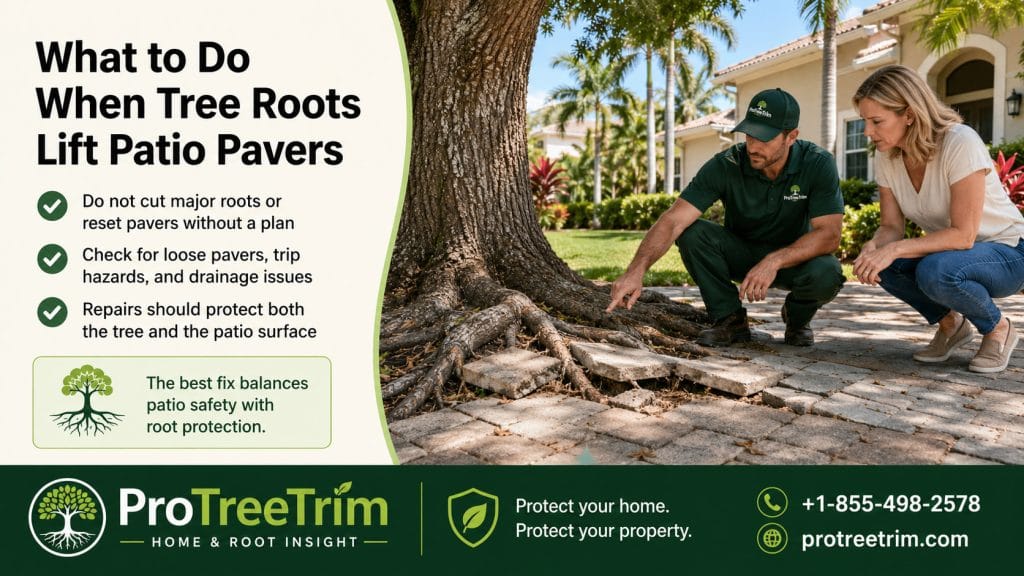
Tree roots lifting patio pavers can create uneven surfaces, trip hazards, drainage problems, and frustrating repair decisions. The patio may look messy, chairs may wobble, water may collect in low spots, and individual pavers may rise or separate.
But before pulling up pavers or cutting roots, slow down. The roots may be important to the tree’s health and stability. A paver repair that damages major roots can create a larger tree problem later.
Why Tree Roots Lift Pavers
Tree roots usually grow where oxygen, moisture, and space are available. Many important roots grow close to the soil surface. If a patio, walkway, or pool deck was installed near an existing tree, roots may continue to thicken below or beside the pavers.
Paver lifting is more likely when:
- the tree is close to the patio
- roots are already near the surface
- pavers were installed over existing roots
- the base material is compacted around roots
- water collects near the patio edge
- the tree is large for the space
- the patio blocks natural soil moisture movement
- roots have limited open soil elsewhere
The tree is not trying to ruin the patio. It is growing in the space it has.
Do Not Cut Roots First
Cutting roots may seem like the fastest way to flatten the patio. But large roots may support the tree, feed the canopy, and help anchor the tree during wind and wet soil.
Root cutting is more risky when roots are:
| Root situation | Why caution matters |
|---|---|
| Large roots close to the trunk | Tree health and stability may be affected |
| Multiple roots under pavers | Cutting several roots can add major stress |
| Roots on the side of a lean | Stability concerns may increase |
| Mature shade tree roots | Older trees rely on established roots |
| Roots near a house or pool cage | Consequences are higher if tree declines |
| Roots already damaged by construction | Additional cuts may worsen decline |
| Tree canopy is thinning | Tree may already be stressed |
A flat patio is not worth creating an unstable tree.
First Check the Tree’s Location
The closer the tree is to the paver area, the more carefully the repair should be handled. A root lifting pavers ten or fifteen feet away may be a different issue from a root directly beside the trunk.
Ask:
- How close is the trunk to the lifted pavers?
- Are roots visible above the surface?
- Are the roots large or small?
- Is the tree leaning?
- Is the canopy healthy?
- Are there dead limbs above the patio?
- Is the patio near the house, pool cage, or fence?
- Has this area been repaired before?
The repair decision should include the whole tree, not only the uneven pavers.
Pavers Are Adjustable, but Roots Still Matter
One advantage of pavers is that they can often be lifted and reset more easily than poured concrete. That may make root-sensitive repair more possible. But removing pavers still involves digging, base material, compaction, and possible root exposure.
Paver repair can harm roots if workers:
- cut roots to make the base flat
- remove soil around major roots
- leave roots exposed to dry out
- compact base material heavily over roots
- raise or lower grade around the trunk
- pile sand or gravel against the root flare
- use equipment that compacts the root zone
A paver patio can be repaired carefully, but it should not be treated like root-free ground.
Minor Lifting May Be Managed Differently Than Severe Lifting
Not every lifted paver area requires the same response.
Minor lifting may be manageable with careful resetting, small grade adjustments, or expanding a nearby tree bed. Severe lifting may suggest that the tree and patio are no longer compatible in that location.
| Severity | Possible response |
|---|---|
| One or two slightly raised pavers | Resetting may be possible |
| Repeated lifting in the same area | Root growth or base conflict is continuing |
| Large roots visible between pavers | Root-sensitive repair is needed |
| Pavers lifted near trunk | Cutting roots may be risky |
| Patio surface badly uneven | Redesign or removal discussion may be needed |
| Tree also has dead limbs or lean | Tree evaluation should come first |
The bigger the conflict, the less likely a simple reset will last.
Do Not Bury Roots Under a Thicker Base
A common repair mistake is adding more sand, gravel, or base material over roots to level the surface. That can bury roots, reduce oxygen, change drainage, and create more root-zone stress.
Avoid:
- raising grade deeply over major roots
- burying the root flare
- packing gravel against the trunk
- adding thick sand layers over visible roots
- trapping roots under plastic or fabric
- building a raised patio edge against the tree
Roots need air and water. A patio repair should not suffocate them.
Landscape Fabric Can Create Problems
Landscape fabric is sometimes used under pavers, gravel, or planting beds. Around tree roots, it can become a long-term problem. Roots may grow into it, water may move unevenly, and future repair becomes harder.
Fabric around roots can:
- trap roots near the surface
- interfere with soil improvement
- complicate future paver repairs
- become tangled with roots
- hide root problems
- reduce natural soil exchange
If major roots are already involved, adding fabric may make the next repair more difficult.
Drainage Often Makes the Problem Worse
Patio paver problems often overlap with drainage. Water may pool in low spots, run toward the tree, wash out base material, or keep roots in a moist zone near the patio edge.
Check for:
- water pooling after rain
- pavers sinking beside raised roots
- erosion around patio edges
- downspouts emptying near the patio
- soil washing away from roots
- paver joints staying wet
- mulch or soil piled against the trunk
- drainage flowing toward the house
If drainage is not corrected, reset pavers may shift again.
Pool Deck Pavers Need Extra Caution
Tree roots near pool deck pavers can create a special mix of concerns: uneven walking surfaces, screen enclosure clearance, leaf and seed debris, drainage toward the pool, and root damage risk.
Before repairing pool-area pavers, check:
- whether roots are lifting pavers near the pool edge
- whether branches or palm fronds touch the pool cage
- whether roots are near screen enclosure supports
- whether water drains toward or away from the pool
- whether excavation could damage major roots
- whether the tree is too close to the pool area
A tree near a pool may create both root and canopy maintenance issues.
Patio Roots Near the House
If pavers are lifting near the house, patio door, foundation-side walkway, or exterior wall, homeowners may worry about root damage to the home. The visible issue may be the pavers, but drainage and tree placement should also be checked.
Look at:
- water flow toward the house
- distance from trunk to wall
- roots under patio or walkway sections
- branches touching roof or gutters
- patio slope after paver movement
- soil moisture near the foundation
- whether repairs require digging close to the trunk
Do not cut major roots near the house without considering tree stability.
Expanding the Tree Bed May Help
If roots are lifting pavers near the edge of a patio, one possible solution is to remove a small section of pavers and expand the tree bed. This can reduce hardscape conflict and protect roots from future damage.
This may work when:
- the lifted area is near the patio edge
- the tree is healthy and worth preserving
- the patio can lose some square footage
- roots are large and should not be cut
- the new bed can be mulched shallowly
- drainage can still be managed
- the design still works for furniture and access
Sometimes the best repair is giving the tree more open soil.
Resetting Pavers Around Roots
In some cases, pavers may be reset around roots with minimal cutting. This must be done carefully, and it may not create a perfectly flat surface if large roots remain. But it may reduce trip hazards while preserving the tree.
A root-sensitive paver reset should aim to:
- avoid cutting major roots
- avoid deep excavation near the trunk
- keep roots from drying out
- preserve the root flare
- correct drainage where possible
- use only necessary base material
- avoid compacting directly over major roots
- monitor the area after repair
The goal is a safer surface without sacrificing tree stability.
When Root Cutting May Be Considered
Root cutting may be considered in limited cases, but it should not be the default. The closer the root is to the trunk and the larger the root is, the more risk there may be.
Root cutting is more concerning when:
- the root is large
- the root is close to the trunk
- several roots would be cut
- the tree is mature
- the tree leans
- the canopy is already thin
- the tree is near a house, pool cage, or patio seating
- soil is wet or unstable
If major roots must be cut to repair the patio, tree removal may need to be part of the decision.
When Tree Removal May Be More Realistic
Sometimes the tree and patio simply no longer fit together. If the tree is too close, the pavers keep lifting, major roots are involved, and the patio is important to daily use, removal may be the more practical long-term option.
Removal may need discussion when:
- roots lift a large patio section
- roots are very close to the trunk
- pavers have been repaired repeatedly
- the tree is declining
- the tree leans toward the house or patio
- large dead limbs are over the seating area
- trunk decay or mushrooms are present
- the tree is too large for the space
- cutting roots would create stability concerns
A healthy tree may be worth designing around. A declining tree damaging a patio may not be.
Do Not Ignore Branches Above the Patio
If roots are lifting the patio, also look up. A tree creating root conflicts may also have branches over the same area where people sit, walk, grill, or gather.
Check for:
- dead limbs above the patio
- cracked branches
- low branches over seating
- palm fronds hanging over pool cages
- seed pods or fruit drop
- limbs touching the roof
- branches over outdoor kitchens or grills
The patio is a target area. Branch safety matters there too.
What Homeowners Should Photograph
Before paver repair or root decisions, take photos of:
- full tree and patio together
- lifted pavers close up
- visible roots
- distance from trunk to patio
- trunk base and root flare
- canopy over the patio
- any dead branches
- drainage after rain
- paver joints and low spots
- nearby pool cage, fence, or house
Photos help compare conditions before and after repair.
What to Do First
A practical first response:
- Do not cut roots immediately.
- Photograph the lifted pavers and the tree.
- Check tree health and lean.
- Look for drainage problems.
- Decide whether the patio can be adjusted around roots.
- Avoid burying roots under deep base material.
- Consider expanding the tree bed if the conflict is at the edge.
- Get help before cutting large roots or removing pavers near the trunk.
The best repair solves the surface issue without creating a tree hazard.
Final Homeowner Takeaway
Tree roots lifting patio pavers can be a repair problem, a drainage problem, and a tree placement problem all at once. Pavers are more adjustable than concrete, but root damage is still a serious concern.
Avoid cutting major roots without evaluation. Avoid burying roots under deep sand, gravel, or soil. Consider root-sensitive paver resetting, drainage correction, expanded tree beds, or redesign where possible. If the tree is too close, declining, or repeatedly damaging the patio, removal may be the more practical long-term decision.
If you are unsure whether patio roots should be protected, repaired around, pruned, or whether the tree should be removed, ProTreeTrim can help connect homeowners with local tree service support. Call +1-855-498-2578 or visit protreetrim.com.
FAQs
Can tree roots lift patio pavers?
Yes. Surface roots can thicken under or beside pavers and cause lifting, uneven joints, or raised patio sections.
Can I cut roots under patio pavers?
Do not cut large roots without evaluation. Cutting roots close to the trunk can harm the tree or affect stability.
Can pavers be reset without cutting tree roots?
Sometimes. Pavers may be adjusted around roots, but the repair should avoid deep excavation, heavy compaction, and root damage.
Should I remove a tree that is lifting my patio pavers?
Not always. Removal may be considered when the conflict is severe, repeated repairs fail, the tree is declining, or major roots must be cut for repair.
ProTreeTrim™ can help you take the next step.
If you are dealing with a damaged tree, fallen branch, stump, root issue, palm concern, or storm cleanup question in Florida, call ProTreeTrim for tree service support.