White pine trees are known for their soft-looking needles, graceful branching, and tall evergreen form. They can be beautiful shade and screening trees, but homeowners often do not know they have one until needles start browning, branches drop, cones appear, or the tree begins crowding a roof, driveway, fence, or utility area.
Identifying a white pine starts with a few clues: needle bundles, cone shape, bark, branch pattern, and the tree’s overall form.
Start With the Needles
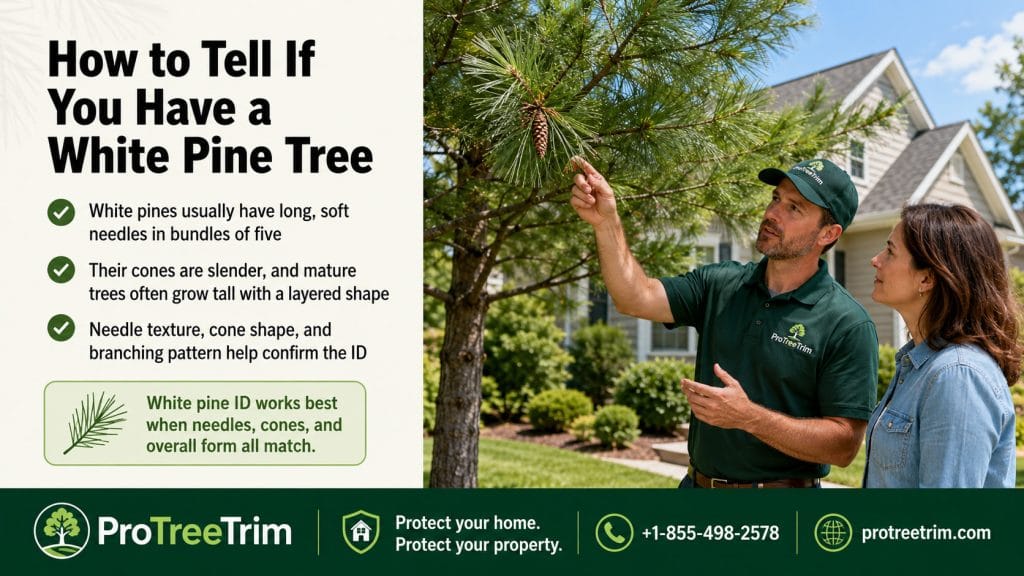
The easiest clue is the needles. White pine needles are usually soft, flexible, and grouped in bundles of five. This is one of the most useful identification details for homeowners.
Many pine species have needles in bundles of two, three, or five. If you can safely reach a low branch from the ground, look at how many needles are attached together at the base.
| Feature | White pine clue |
|---|---|
| Needle bundles | Usually five needles per bundle |
| Needle feel | Soft and flexible, not stiff and sharp |
| Needle color | Often blue-green to soft green |
| Needle length | Longer than many small ornamental evergreens |
| Branch look | Light, feathery, layered appearance |
| Cones | Long, narrow cones on mature trees |
Do not climb or cut branches just to check. Fallen needles, low reachable twigs, or clear photos are usually enough for a first look.
Look at the Overall Shape
A young white pine may have a more defined, upright evergreen shape. Mature trees often become tall, layered, and somewhat open. The branches may look softer and less rigid than many other pines.
From a distance, a white pine may appear graceful rather than dense. Older trees can develop a broad canopy, long limbs, and a tall trunk.
A white pine may stand:
- in a front yard as a feature tree
- along a property line as a screen
- near a driveway or side yard
- at the edge of a wooded lot
- near older homes and larger landscapes
- in groups or windbreak-style plantings
The tree’s shape helps, but needles are usually the stronger clue.
Check the Cones
Mature white pines often produce long, narrow cones. These cones may hang from branches and later drop to the ground. Homeowners may notice them in lawn, mulch beds, gutters, driveways, or near walkways.
Cones are normal. They do not mean the tree is unhealthy.
Cones become a practical issue when they collect in high-use areas:
- driveways
- sidewalks
- patios
- roof valleys
- gutters
- pool decks
- front entries
- mowing areas
If cones are dropping onto cars, walkways, or gutters, the concern is usually cleanup and placement, not tree health by itself.
Bark Changes With Age
Young white pines often have smoother bark. Mature trees develop darker, rougher, more furrowed bark. Bark alone is not enough to identify the tree, but it can support the other clues.
Look for:
- smoother bark on younger trunks
- darker, rougher bark on older trunks
- vertical ridges as the tree matures
- layered branch structure above
- soft needle bundles on branch tips
If bark is peeling deeply, splitting, oozing, or paired with dead branches, that is a health concern rather than a simple identification feature.
Do Not Confuse White Pine With Other Evergreens
Homeowners often confuse white pine with spruce, fir, cedar, juniper, or other pine species. The needle arrangement helps separate them.
A simple homeowner check:
| Tree type | Basic clue |
|---|---|
| White pine | Soft needles usually in bundles of five |
| Other pines | Needles may be in bundles of two or three |
| Spruce | Needles often attach singly and feel sharper |
| Fir | Needles attach singly and may feel flatter |
| Juniper/cedar-like trees | Scale-like or prickly foliage, not long pine needles |
If the tree has long, soft needles in groups of five, white pine becomes much more likely.
Why Identification Matters
Knowing you have a white pine helps you make better decisions about care, pruning, risk, and placement. White pines can become large. A tree that looked manageable when planted may later crowd a roofline, block a driveway, shade a lawn heavily, or drop cones and needles where cleanup is constant.
Identification matters when deciding:
- whether browning needles are seasonal or stress-related
- whether low limbs should be removed
- whether the tree is too close to a house
- whether branches are over a driveway or walkway
- whether storm damage needs attention
- whether roots or shade are affecting nearby landscaping
- whether removal is more practical than repeated pruning
A white pine can be valuable, but it still has to fit the site.
Normal Needle Drop Can Look Alarming
Evergreens still shed older needles. A white pine may drop older interior needles, especially seasonally. This can make the inside of the tree look brown while the outer branch tips remain green.
That can be normal.
Normal needle shedding is more likely when:
- browning is mostly on older interior needles
- branch tips remain green
- the tree still has full outer growth
- the change is seasonal
- nearby white pines show similar behavior
- there are no major dead limbs
- the trunk and root area look stable
The tree may make a mess without being in serious trouble.
When Browning Needles Are More Concerning
Needle browning deserves more attention when it affects entire branch tips, one side of the tree, the top of the tree, or large sections of the canopy.
Look closer if you see:
| Symptom | Why it matters |
|---|---|
| Entire branch browning | Branch injury, pest, disease, or root stress may be involved |
| Top thinning or dying | More serious decline may be possible |
| One-sided browning | Root, sun, wind, or site damage may matter |
| Brown needles plus cankers or wounds | Branch health should be checked |
| Sawdust-like material | Insect or decay concern may exist |
| Mushrooms near base | Root or decay concern deserves attention |
| New lean | Stability should be checked |
| Branches dying over driveway or roof | Property risk increases |
Do not judge the tree only by color. Look at the pattern and location.
White Pines Can Drop Branches
White pines can develop long limbs, and mature trees may shed branches during storms, wind, snow in colder regions, or after stress. In warm storm-prone areas, wind and saturated soil may be the bigger concern.
A branch over open lawn is different from a branch over a driveway, roof, patio, pool cage, walkway, or neighbor’s property.
Pay closer attention when white pine limbs hang over:
- parking areas
- front walkways
- roofs
- gutters
- fences
- outdoor seating
- play areas
- utility lines
- neighbor-facing yards
A healthy white pine still needs monitoring when large limbs are over targets.
White Pines Near Houses Need Space
White pines can become much larger than homeowners expect. A young evergreen may look perfect near a corner of the house or fence line. Years later, the canopy may touch siding, block windows, drop needles into gutters, or create roofline cleanup.
A white pine may be poorly placed if it is:
- too close to the house
- under utility lines
- crowding a driveway
- blocking a walkway
- growing into a fence
- shading out lawn or beds completely
- dropping cones into gutters or drains
- difficult to access for pruning or removal
A tree can be healthy and still be in the wrong place.
Should You Prune a White Pine?
Pruning should be selective and purposeful. White pines should not be topped or cut hard just to make them smaller. Removing the wrong branches can create poor shape, stress, and long-term structure problems.
Pruning may make sense for:
- dead branches
- storm-damaged limbs
- branches touching rooflines
- limbs blocking driveways or walkways
- broken hanging branches
- branches rubbing structures
- clearance around utility-safe areas
- lower branches that create access problems
Avoid pruning simply because the tree looks too full. If the tree is fundamentally too large for the site, repeated cutting may not be the right long-term answer.
Watch for Root and Soil Stress
White pine health is not only about needles and branches. Root conditions matter. Soil compaction, poor drainage, construction, trenching, heavy mulch, grade changes, or repeated parking under the canopy can all stress roots.
Look around the base:
- Is the root flare visible?
- Is mulch piled against the trunk?
- Does water collect around the tree?
- Has soil been added over roots?
- Were pavers, driveway work, or trenching done nearby?
- Are roots exposed or cut?
- Is the tree leaning more than before?
- Is the ground soft after rain?
Canopy problems often begin below ground.
Cones and Needles Can Create Maintenance Issues
White pines can drop needles, cones, small twigs, and branch debris. This may be acceptable in a naturalized yard but frustrating near hardscape.
Debris matters more near:
- gutters
- roof valleys
- patio drains
- pool areas
- sidewalks
- driveways
- front entries
- AC units
- paver joints
If the tree is healthy, the answer may be better cleanup. If debris comes with dead branches, cracks, or canopy decline, the tree needs closer attention.
When a White Pine May Need Removal
Removal is not needed just because the tree drops needles or cones. But removal may be reasonable if the tree is declining, badly placed, storm-damaged, or creating repeated property conflicts.
Removal may deserve discussion when the tree has:
- large dead limbs
- major trunk wounds
- severe lean
- root damage
- repeated large branch drop
- branches over roof or driveway
- major canopy decline
- conflict with utility lines
- poor placement near structures
- decay signs near the base
A valuable tree in the right place may be worth preserving. A declining tree in the wrong place may not be.
What Homeowners Should Photograph
To identify and evaluate a possible white pine, take photos of:
- full tree from a distance
- close-up needle bundles
- cones if present
- bark on the trunk
- branch tips
- any brown or dead sections
- trunk base and root flare
- nearby roof, driveway, fence, or walkway
- any wounds, mushrooms, or sawdust-like material
Photos help separate normal evergreen shedding from a more serious tree condition issue.
Final Homeowner Takeaway
You may have a white pine if the tree has soft needles usually grouped in bundles of five, long narrow cones, layered evergreen branches, and mature furrowed bark. Once you identify it, look at placement and condition.
A white pine can be a beautiful, valuable tree. It can also become too large for tight spaces, drop debris into gutters and driveways, or need attention when branches brown, crack, or die back.
If you are unsure whether you have a white pine or whether your pine is showing signs of stress, branch decline, or poor placement, ProTreeTrim can help connect homeowners with local tree service support. Call +1-855-498-2578 or visit protreetrim.com.
FAQs
How can I tell if I have a white pine tree?
Look for soft, flexible needles usually grouped in bundles of five, long narrow cones, and a graceful layered evergreen shape.
Do white pine trees drop needles?
Yes. White pines naturally shed older interior needles, which can look alarming but may be normal if branch tips remain green.
Are brown needles on white pine always bad?
No. Interior seasonal needle drop can be normal. Browning on branch tips, one side, the top, or large sections deserves closer attention.
Should white pine trees be topped?
No. Topping can damage structure and appearance. Pruning should be selective and focused on dead, damaged, or conflicting branches.
ProTreeTrim™ can help you take the next step.
If you are dealing with a damaged tree, fallen branch, stump, root issue, palm concern, or storm cleanup question in Florida, call ProTreeTrim for tree service support.