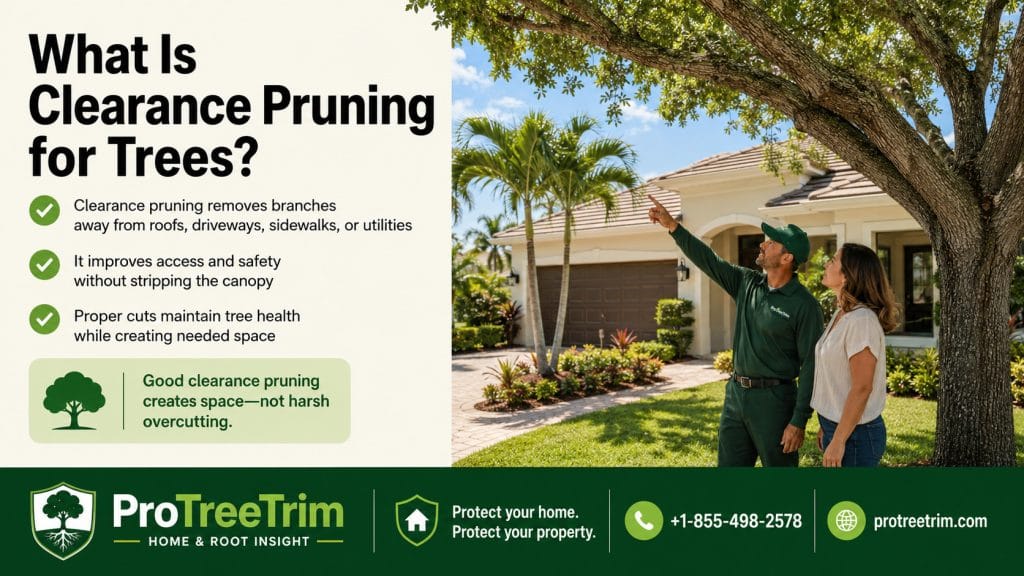
Clearance pruning is tree pruning done to create safe and practical space between branches and property features. Homeowners often need clearance pruning when branches touch a roof, hang over a driveway, block a walkway, rub a fence, crowd a pool cage, or interfere with daily yard use.
Good clearance pruning solves a specific problem without cutting more of the tree than necessary. Poor clearance pruning can leave a tree flat-sided, unbalanced, over-lifted, or stressed.
Clearance Pruning Has a Practical Goal
Clearance pruning is not general shaping. It should answer a clear property question: what needs space from what?
It may be used to clear branches away from:
- roofs
- gutters
- siding
- driveways
- sidewalks
- patios
- pool cages
- fences
- gates
- service paths
- outdoor seating areas
The goal is not to make the tree smaller everywhere. The goal is to remove or reduce the branches causing the conflict.
Roof Clearance Is One of the Most Common Reasons
Branches touching a roof can rub shingles, drop debris into gutters, scrape fascia, or give wildlife easier roof access. Clearance pruning can help, but it should be selective.
A good roof-clearance plan may include:
| Roof issue | Better pruning response |
|---|---|
| Branch touching shingles | Create modest clearance |
| Limb rubbing gutter | Remove or reduce that limb |
| Dead branch over roof | Remove deadwood |
| Twigs dropping into roof valley | Improve clearance where practical |
| Canopy pressing into siding | Selectively reduce contact |
| Large limb over roof | Evaluate structure before cutting |
The tree should not be cut flat on the house side unless there is no better option.
Driveway Clearance Should Protect Vehicles and People
Branches over driveways can scratch vehicles, block visibility, or drop deadwood where people park. Clearance pruning may involve removing low limbs, reducing overextended branches, or removing deadwood above parking areas.
Driveway pruning should focus on:
- branches that hit vehicles
- deadwood above parking spots
- limbs blocking garage access
- branches reducing driveway visibility
- storm-damaged limbs over parked cars
- low branches that force people to duck
This is often crown raising, but it should still be balanced. Removing every lower branch can over-lift the tree.
Walkway and Entry Clearance Matters
Branches over sidewalks, front entries, and garden paths can create daily inconvenience. A branch that brushes people every time they pass is a reasonable pruning target.
Clearance pruning may be useful near:
- front doors
- public sidewalks
- side-yard walkways
- gates
- mailboxes
- rental property access paths
- outdoor seating areas
- service entrances
Small clearance cuts made early are usually better than waiting until large branches become a bigger problem.
Pool Cage and Patio Clearance Needs Care
Trees near pool cages and patios create special issues. Branches may rest on screens, drop debris into pools, or interfere with outdoor furniture and seating.
Clearance pruning may help when:
- branches touch screen panels
- fronds or limbs rest on cage frames
- seed pods drop over pool decks
- branches hang low over seating areas
- deadwood is above patios
- leaves collect heavily in drains or gutters
But pruning cannot solve every poolside tree problem. If the tree is too close, too messy, or too large for the area, placement may be the real issue.
Clearance Pruning Is Not Topping
Clearance pruning should not remove the top of the tree or cut major limbs to stubs. Topping damages structure and often creates weak regrowth.
A good clearance plan sounds like:
- “Clear branches touching the roofline.”
- “Remove deadwood over the driveway.”
- “Lift selected low branches over the walkway.”
- “Reduce the limb pressing into the pool cage.”
- “Preserve the natural canopy.”
A bad plan sounds like:
- “Cut it way back.”
- “Take the top off.”
- “Make it much smaller.”
- “Cut the whole side flat.”
- “Remove most of the canopy.”
Clearance pruning should be precise, not aggressive.
Do Not Remove Too Much Live Canopy
A common mistake is removing too many live branches to create more space than needed. This can stress the tree and make it look unbalanced.
Over-clearance may cause:
- thin canopy
- exposed bark
- weak regrowth
- poor tree shape
- reduced shade
- over-lifted lower canopy
- large unnecessary wounds
- more future pruning needs
The best clearance pruning solves the conflict with the fewest reasonable cuts.
Clearance Pruning Near Fences and Property Lines
Branches growing into fences or neighboring yards can create tension. Pruning may be needed for access, repairs, visibility, or neighbor concerns.
Fence-line pruning should consider:
- branch ownership and local rules
- whether the branch is healthy or dead
- whether the tree will become unbalanced
- whether cutting creates large wounds
- whether the fence can be repaired without root damage
- whether the tree is already leaning or stressed
Do not cut heavily only because a branch crosses a boundary. The work should still protect tree structure.
Utility Clearance Is Different
Branches near utility lines should not be handled like ordinary clearance pruning. This is a safety issue. Homeowners should not use ladders, pole saws, ropes, or hand tools near power lines.
If branches are near wires:
- do not climb the tree
- do not pull branches off lines
- do not cut limbs touching wires
- contact the utility or qualified help
- keep people away after storm damage
- treat all line conflicts seriously
Clearance pruning near utilities requires proper safety procedures.
Young Trees Can Be Trained for Future Clearance
Young trees near driveways, sidewalks, and homes can often be guided gradually. This is better than waiting until branches are large.
Young-tree clearance planning may include:
- removing small branches growing toward the roof
- gradually raising low limbs over walkways
- correcting crossing branches
- reducing competing leaders
- preserving temporary lower branches when useful
- staging clearance over several years
Young trees should not be stripped too early. Clearance should develop with the tree.
Mature Trees Need More Conservative Decisions
Mature trees may require larger cuts for clearance. That means more caution. A large healthy limb should not be removed unless the reason is strong.
Before removing a mature limb for clearance, ask:
- Is the limb touching a structure?
- Is it dead, cracked, or rubbing?
- Is there a smaller reduction cut that works?
- Will removal unbalance the tree?
- Is the tree already stressed?
- Is the branch over a high-use area?
- Would removal create a large wound?
- Is the tree too close to the structure overall?
Sometimes pruning can solve the issue. Sometimes the tree’s location is the real problem.
Palms Need Palm-Specific Clearance
Palm clearance usually involves dead fronds, broken fronds, seed pods, or fronds touching roofs and pool cages. It should not involve stripping healthy green fronds.
Good palm clearance may include:
- removing dead fronds over walkways
- removing seed pods over pool decks
- clearing fronds resting on screen enclosures
- removing broken storm fronds
- clearing roof contact
- preserving healthy green crown
A palm should not be hurricane-cut just for clearance.
When Clearance Pruning Should Wait
Clearance pruning may be better delayed when the issue is minor and the tree is stressed.
Waiting may be better when:
- the tree is newly planted
- the canopy is already thin
- the tree is drought-stressed
- roots were recently damaged
- the work would remove large healthy limbs
- the conflict is only cosmetic
- the tree was recently over-pruned
- no branch is touching or threatening anything
If there is no urgent conflict, careful planning is better than quick cutting.
When Clearance Pruning Should Not Wait
Some clearance problems should be handled sooner.
Act sooner when:
| Situation | Why action may be needed |
|---|---|
| Branch touches roof | Can damage shingles or gutters |
| Dead limb over driveway | People and vehicles are exposed |
| Limb blocks walkway | Access and safety issue |
| Branch rests on pool cage | Screen damage possible |
| Broken limb hangs over patio | Falling-branch risk |
| Branch rubs siding | Repeated property damage |
| Limb blocks service access | Practical maintenance issue |
The pruning should solve the problem without turning into unnecessary canopy removal.
What Homeowners Should Ask Before Clearance Pruning
Before approving the work, ask:
- What exactly needs clearance?
- Which branches will be removed or reduced?
- Are any branches dead, broken, or cracked?
- How much live canopy will be removed?
- Will the tree still look natural?
- Are large cuts required?
- Can the work be staged?
- Are utility lines involved?
- Is the tree too close to the structure overall?
A good clearance plan should be clear and limited.
Final Homeowner Takeaway
Clearance pruning creates space between tree branches and property features like roofs, gutters, driveways, walkways, fences, patios, and pool cages. It is useful when there is a real conflict, but it should be selective.
The best clearance pruning removes or reduces the specific branches causing the issue while preserving the tree’s natural structure. Avoid topping, flat-sided cutting, over-lifting, and removing large healthy limbs without a clear reason.
If you are unsure whether your tree needs roof clearance, driveway clearance, pool cage clearance, or a broader pruning plan, ProTreeTrim can help connect homeowners with local tree service support. Call +1-855-498-2578 or visit protreetrim.com.
FAQs
What is clearance pruning?
Clearance pruning removes or reduces branches to create space from roofs, driveways, walkways, fences, pool cages, and other property features.
Is clearance pruning bad for trees?
Not when done carefully. It can be harmful if too much live canopy is removed or if the tree is topped.
How far should branches be from a roof?
Enough to prevent rubbing, debris buildup, and repeated contact. The right distance depends on the tree, roofline, branch size, and growth pattern.
Can I prune branches near power lines for clearance?
No. Branches near power lines should be handled by the utility or qualified professionals with proper safety procedures.
ProTreeTrim™ can help you take the next step.
If you are dealing with a damaged tree, fallen branch, stump, root issue, palm concern, or storm cleanup question in Florida, call ProTreeTrim for tree service support.