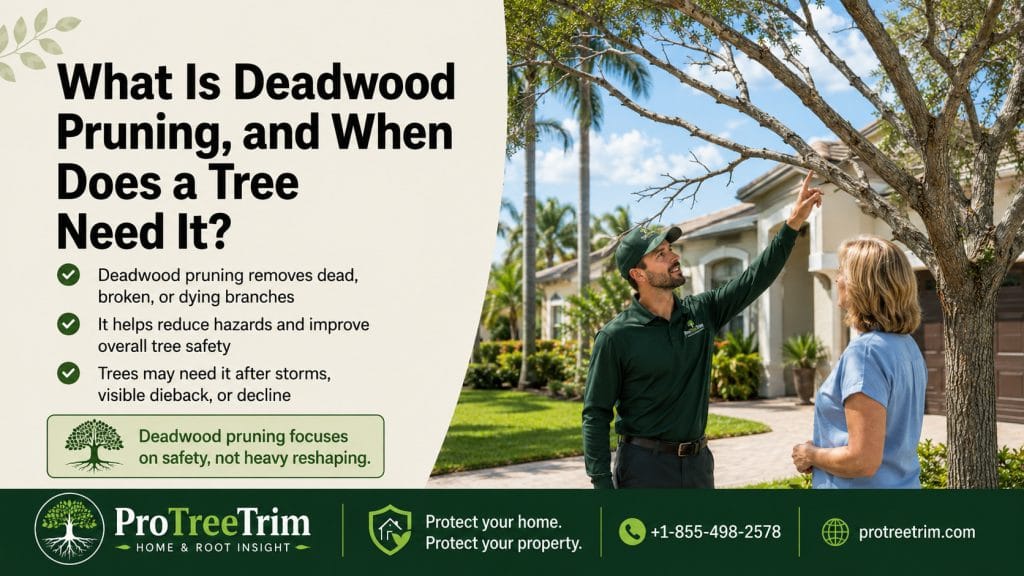
Deadwood pruning means removing dead branches from a tree. It is one of the most practical forms of tree pruning because it focuses on branches that no longer help the tree and may eventually break, fall, or create property concerns.
Deadwood pruning is not about making a tree smaller. It is not the same as topping, heavy thinning, or shaping. The goal is simple: remove dead, broken, or clearly non-living branches while preserving healthy structure.
Dead Branches Are Not Always an Emergency
A dead branch in a tree does not automatically mean the whole tree is dying. Trees naturally shed small branches over time, especially inside shaded canopies or after stress. A few small dead twigs may be normal.
But dead branches become more important when they are large, high, cracked, hanging, or located over something valuable.
| Deadwood situation | Why it matters |
|---|---|
| Small dead twigs inside canopy | Often less urgent |
| Large dead branch over driveway | Vehicles and people may be exposed |
| Dead limb over roof | Property damage risk increases |
| Hanging dead branch | Can fall unpredictably |
| Dead branch over pool cage | Screen and frame damage possible |
| Deadwood after storm damage | Tree structure may need inspection |
| Widespread dead branches | Tree health may be declining |
The question is not just whether a branch is dead. It is where the dead branch is and what it could hit.
How to Tell If a Branch Is Dead
Dead branches often look different from living branches. They may have no leaves during the growing season, brittle twigs, peeling bark, cracks, fungal growth, or old dry wood.
Signs of deadwood may include:
- no leaves when the rest of the tree has leafed out
- brittle small twigs
- bark peeling from the branch
- dry, gray, or sunken wood
- cracks along the limb
- no buds on branch tips
- broken hanging sections
- fungal growth on the branch
- repeated twig drop below the limb
A branch that leafs out late may not be dead. A branch that remains bare while the rest of the tree is active deserves a closer look.
Deadwood Pruning Is Different From Heavy Thinning
Deadwood pruning removes dead material. Crown thinning removes selected live branches to reduce canopy density. These are not the same job.
Deadwood pruning is usually more conservative because it does not remove healthy live canopy unless there is another reason.
| Pruning type | Main purpose |
|---|---|
| Deadwood pruning | Remove dead branches |
| Crown cleaning | Remove dead, broken, diseased, or damaged branches |
| Crown thinning | Reduce live canopy density selectively |
| Crown raising | Remove lower branches for clearance |
| Crown reduction | Carefully reduce height or spread where appropriate |
| Topping | Harmful cutting of major limbs to stubs |
Many homeowners who ask to “thin out” a tree may actually need deadwood pruning first.
Why Deadwood Should Be Removed
Dead branches eventually decay and weaken. Small dead branches may fall as twigs. Larger dead limbs may become a more serious concern, especially during wind, rain, or storms.
Deadwood removal can help:
- reduce falling-branch concerns
- improve roof and driveway safety
- clean up storm-damaged trees
- improve curb appeal
- make future inspections easier
- reduce debris over patios and pool areas
- remove branches that attract pests or decay organisms
- clarify whether the rest of the tree is healthy
Removing deadwood does not make every tree safe, but it can reduce obvious branch-level risk.
Deadwood Over Targets Matters Most
A target is anything a branch could hit if it falls. Deadwood over open lawn may be less urgent than deadwood over daily-use areas.
High-priority target areas include:
- houses
- driveways
- parked vehicles
- sidewalks
- patios
- pool cages
- fences
- outdoor seating
- play areas
- utility areas
- neighbor property
A dead branch high over a driveway deserves more urgency than a small dead branch over an unused corner of the yard.
Deadwood After Storms
Storms can break, crack, or partially detach limbs. Sometimes a branch is not fully dead yet, but it is damaged enough to become a hazard. Storm-damaged deadwood should be handled carefully.
After storms, look for:
| Storm sign | Why it matters |
|---|---|
| Hanging branches | May fall without warning |
| Cracked limbs | Can fail later under weight or wind |
| Broken branch stubs | May need proper pruning cuts |
| Dead limbs caught in canopy | Can drop later |
| Branches resting on roof | Property damage may continue |
| Split branch unions | Structural concern may exist |
| New lean or root movement | Bigger tree issue may be present |
Storm cleanup should focus first on making the tree and property safer, not cutting more than necessary.
Deadwood Can Reveal Larger Tree Health Problems
Deadwood pruning can remove dead branches, but it does not solve every reason branches died. If dead branches are widespread, clustered at the top, or increasing over time, the tree may have a broader health issue.
Possible causes include:
- drought stress
- poor drainage
- root damage
- soil compaction
- construction injury
- pest activity
- disease pressure
- trunk decay
- storm damage
- old age or natural decline
- over-pruning in the past
If deadwood keeps returning quickly, the tree needs more than a cleanup cut.
Top Dieback Is More Concerning
Dead branches near the top of a tree can be a warning sign. Top dieback may point to root stress, drought, pests, disease, lightning, or severe decline.
Pay closer attention if the top of the tree has:
- multiple dead limbs
- thinning canopy
- small or sparse leaves
- bark peeling on upper branches
- dead branch tips across the crown
- brown needles on pine or evergreen tips
- repeated large twig drop
Top dieback over a home, driveway, or walkway deserves a closer inspection.
Deadwood on Oaks
Large oaks can naturally carry some deadwood, especially inside older shaded canopies. But dead oak limbs can be heavy. When they hang over roofs, driveways, pool cages, or patios, removal may be important.
Oak deadwood pruning should be selective. The goal is not to remove large healthy limbs or strip the canopy. It is to remove dead branches that create risk or indicate decline.
With oaks, also check for:
- large dead limbs
- cracks near branch unions
- mushrooms near the base
- hollow areas
- root damage
- branches over rooflines
- one-sided canopy decline
Deadwood may be only one symptom.
Deadwood on Pines and Evergreens
Dead branches on pines and evergreens can be harder for homeowners to interpret. Interior needle drop may be normal, but fully dead branches, brown tops, and brittle limbs are more concerning.
For pines and evergreens, look at:
- whether branch tips are green
- whether browning is interior or outer growth
- whether the top is dead
- whether bark is peeling
- whether there are holes or sawdust-like material
- whether the branch is brittle
- whether nearby branches are also dying
A dead evergreen branch may not refill with new growth. If many branches are dead, removal or replacement may need discussion.
Dead Palm Fronds Are a Different Case
Palm deadwood is usually discussed as dead frond removal rather than branch pruning. Dead palm fronds can hang over walkways, driveways, pool cages, patios, and roofs.
Palm cleanup may include:
- fully dead fronds
- broken hanging fronds
- seed pods over high-use areas
- fronds touching roofs or screens
- storm-damaged material
But palms should not be stripped of healthy green fronds. Removing dead fronds is good maintenance. Hurricane-cutting the palm is not.
Deadwood Near Roofs and Gutters
Dead branches above a roof can break and damage shingles, gutters, fascia, skylights, or pool screens. Even smaller deadwood can collect in roof valleys and drainage areas.
Roof-related deadwood pruning should focus on:
- dead limbs directly over the roof
- branches touching shingles
- limbs rubbing gutters
- dead twigs collecting in roof valleys
- storm-broken branches
- branches that could fall onto solar panels or skylights
The goal is targeted clearance and risk reduction, not cutting the whole side of the tree flat.
Deadwood Near Driveways and Walkways
Deadwood near driveways and walkways matters because people and vehicles pass underneath. A limb that falls in an unused yard area is one issue. A limb that falls where someone parks or walks daily is another.
Deadwood pruning should be prioritized near:
- front entries
- sidewalks
- driveway parking spots
- garage approaches
- gates
- patios
- outdoor seating
- mailboxes
- rental property access paths
Daily-use areas deserve more attention.
Do Not Remove Deadwood by Climbing Without Proper Equipment
Deadwood can be brittle and unpredictable. Branches may snap under weight, break differently than expected, or fall into other limbs. Ladder work under dead branches is especially risky.
Avoid DIY deadwood removal when:
- branches are high
- limbs are large
- branches hang over roofs or driveways
- power lines are nearby
- the tree is leaning
- the branch is cracked or suspended
- a chainsaw would be required
- the branch is over a pool cage or fence
Small reachable dead twigs are one thing. Large dead limbs are different.
Do Not Leave Large Dead Stubs
If a dead branch is pruned, the cut should be made properly. Leaving a long dead stub can create future decay and poor wound closure. Cutting flush against the trunk can damage the branch collar.
A proper cut should:
- avoid tearing bark
- avoid cutting into the trunk
- avoid leaving a long dead stub
- preserve the branch collar
- be appropriate for the branch size
- use the right technique for heavy limbs
Deadwood pruning still requires good pruning technique.
Deadwood Pruning Before Storm Season
Before storm season, deadwood pruning can be one of the most useful tree-care steps. Removing dead, broken, or hanging branches may reduce obvious branch-fall concerns.
A pre-storm deadwood check should include:
| What to check | Why it matters |
|---|---|
| Dead limbs over roof | Property damage risk |
| Deadwood over driveway | Vehicle and person exposure |
| Hanging storm-damaged branches | Unpredictable falling risk |
| Dead palm fronds | Falling debris or screen damage |
| Cracked limbs | May fail under wind |
| Dead top | More serious tree decline possible |
| Dead branches near utility areas | Safety and access concerns |
Storm prep should not mean over-pruning. It should mean removing obvious weak or dead material.
Deadwood Pruning Before Selling a Home
Dead branches can make a property look neglected and may raise buyer concerns. If a tree has obvious deadwood over a driveway, walkway, roof, or front yard, addressing it before listing can improve both appearance and confidence.
Before selling, consider:
- removing dead limbs over front entry
- clearing dead branches above driveway
- trimming dead palm fronds
- documenting completed tree work
- cleaning debris from roof and gutters
- photographing before and after
- avoiding aggressive last-minute topping
A clean, natural tree looks better than an over-cut tree.
When Deadwood Pruning Is Not Enough
Deadwood pruning removes dead branches. It does not fix a severely declining, unstable, hollow, split, or root-damaged tree.
More evaluation may be needed when the tree has:
- trunk cracks
- vertical splits
- mushrooms near the base
- new lean
- soil lifting near roots
- large cavities
- many dead limbs
- top dieback
- major storm damage
- repeated large branch drop
In these cases, pruning may reduce some risk, but removal or deeper evaluation may be the real decision.
How Often Should Deadwood Be Removed?
There is no fixed schedule for every tree. Deadwood should be removed when it becomes noticeable, large enough to matter, or located over important targets.
A tree near a driveway, roof, pool cage, or walkway may need more frequent inspection than a tree in open lawn.
Good times to check for deadwood:
- before storm season
- after storms
- during spring leaf-out
- after drought
- before listing a home
- before exterior work or roof work
- when branches start dropping frequently
Inspection can happen more often than pruning.
What Homeowners Should Photograph
Photos help track deadwood and explain the scope clearly.
Take photos of:
- full tree from several angles
- dead branches close up
- branches over roof or driveway
- hanging limbs
- trunk base and root flare
- cracks, mushrooms, or cavities
- storm-damaged branches
- before-and-after cleanup
- areas below the branch
Photos can also help document storm damage or property concerns.
What a Good Deadwood Pruning Scope Sounds Like
A good scope:
- “Remove dead branches over the driveway.”
- “Remove hanging storm-damaged limb.”
- “Clear deadwood above the pool cage.”
- “Remove dead palm fronds and seed pods over patio.”
- “Clean dead branches from the lower canopy only.”
- “Preserve healthy live canopy.”
A poor scope:
- “Cut it way back.”
- “Thin it out a lot.”
- “Remove everything dead and most of the inside.”
- “Top it so branches stop falling.”
- “Make the tree smaller while you’re there.”
Deadwood pruning should be specific and conservative.
Final Homeowner Takeaway
Deadwood pruning removes dead branches before they fall, spread decay concerns, or create property issues. It is one of the most practical pruning services because it focuses on branches that no longer help the tree.
Small dead twigs may not be urgent. Large dead limbs over roofs, driveways, walkways, patios, pool cages, fences, or parking areas deserve more attention. If deadwood is widespread or paired with trunk cracks, mushrooms, root movement, or canopy decline, the tree may need a deeper review.
If you are unsure whether your tree needs deadwood pruning, storm cleanup, roof clearance, or removal evaluation, ProTreeTrim can help connect homeowners with local tree service support. Call +1-855-498-2578 or visit protreetrim.com.
FAQs
What is deadwood pruning?
Deadwood pruning is the removal of dead branches from a tree to improve safety, appearance, and tree maintenance.
Does deadwood mean the whole tree is dying?
Not always. A tree can have some dead branches and still be healthy. Widespread deadwood or top dieback is more concerning.
Can dead branches be removed any time of year?
Yes, dead or hazardous branches can usually be removed when they create risk or property concerns.
Should I remove dead branches myself?
Only small, reachable branches may be safe for homeowners. Large, high, hanging, or utility-adjacent dead branches should be handled professionally.
ProTreeTrim™ can help you take the next step.
If you are dealing with a damaged tree, fallen branch, stump, root issue, palm concern, or storm cleanup question in Florida, call ProTreeTrim for tree service support.