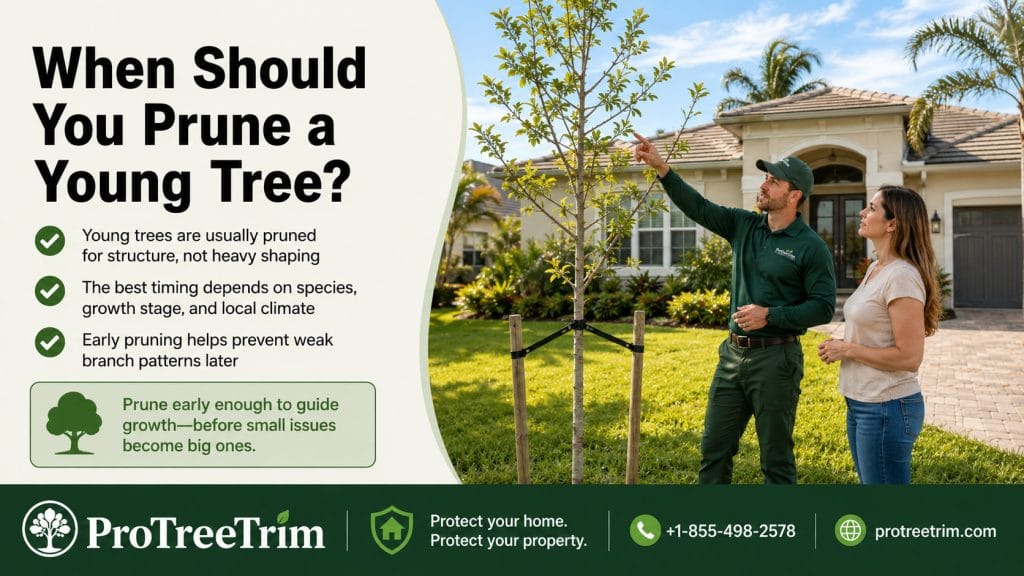
Young trees should be pruned carefully and gradually. The goal is not to make them look perfect right away. The goal is to guide strong structure, remove obvious problems early, and avoid large corrective cuts later.
A young tree may need light pruning when branches are broken, crossing, rubbing, competing for the main leader, growing toward the house, or likely to block future driveway or walkway clearance. But heavy pruning too soon can slow growth, weaken the tree, and remove leaf area the young tree needs to build roots.
Young Tree Pruning Is About the Future
A young tree may look small now, but the branch pattern it develops early can affect it for decades. Poor branch spacing, weak unions, crossing branches, and competing stems may become larger problems as the tree grows.
Young tree pruning can help prevent:
- weak branch attachments
- rubbing branches
- crossing branches
- competing leaders
- low limbs that later block access
- branches growing toward the roof
- future large pruning wounds
- storm-vulnerable structure
A small cut today can prevent a large cut years later.
Do Not Prune a Young Tree Too Heavily
Young trees need leaves. Leaves produce energy that supports root growth, trunk development, and canopy expansion. Removing too much live growth can slow establishment.
A young tree should not be stripped, topped, or shaped into an unnatural form.
| Bad young-tree pruning habit | Why it can hurt |
|---|---|
| Removing too many lower branches | Can slow trunk development |
| Cutting the top off | Damages structure and leader growth |
| Removing too much live canopy | Reduces energy production |
| Shaping it like a shrub | Creates poor tree form |
| Cutting for symmetry only | May remove useful branches |
| Pruning immediately after planting too hard | Adds stress during establishment |
Young tree pruning should be light, staged, and purposeful.
The First Year: Focus on Damage, Not Shape
During the first year after planting, the tree is adjusting to its new site. Roots are establishing, watering is being balanced, and the tree may already be under transplant stress.
In the first year, pruning should usually be limited to:
- broken branches
- dead branches
- damaged branches
- branches torn during planting
- branches that are clearly rubbing
- small defects that should not wait
Avoid major shaping in the first year unless there is a strong reason. The tree needs time to settle in.
After Establishment, Start Structural Pruning
Once the tree is establishing and growing, light structural pruning can begin. This usually means guiding the tree’s future form rather than making dramatic cuts.
Structural pruning may include:
- selecting or protecting a main leader
- reducing competing leaders
- removing small crossing branches
- correcting rubbing branches
- improving branch spacing
- managing low limbs gradually
- removing branches growing back into the canopy
The earlier this work is done, the smaller the cuts usually are.
Competing Leaders Should Be Watched Early
A competing leader is a second upright stem that tries to become another main trunk. On some trees, this can create a weak structure later, especially if two stems form a tight V shape.
Not every young tree needs one central leader, depending on species and natural form. But many shade trees benefit from a clear, strong structure.
Watch for:
| Sign | Why it matters |
|---|---|
| Two upright stems of similar size | Future split risk may increase |
| Tight V-shaped union | Included bark may develop |
| One leader growing toward the house | Future clearance issue |
| Both leaders pulling apart | Storm weakness may develop |
| One leader cracked or damaged | Correction may be needed |
Correcting competing leaders early is usually easier than fixing a mature split later.
Remove Crossing and Rubbing Branches While Small
Crossing branches may seem harmless when they are young and flexible. Over time, they can rub bark, create wounds, and interfere with stronger branches.
Young trees are the best time to fix this.
Remove or reduce branches that:
- rub another branch
- cross through the center
- grow back toward the trunk
- crowd a stronger limb
- create narrow branch spacing
- point toward a future roofline conflict
Small rubbing branches are easy to correct. Large rubbing branches are harder and create bigger wounds.
Low Branches Should Be Removed Gradually
Homeowners often want a young tree to look like a mature shade tree right away, with a clean trunk and canopy high above the ground. That can be a mistake.
Some lower branches can help a young tree build trunk strength and protect bark from sun exposure. Removing all lower branches too soon may slow development.
A better approach is gradual crown raising.
Low branches may be removed over time if they will eventually interfere with:
- sidewalks
- driveways
- patios
- mowing
- front entries
- fences
- windows
- street visibility
- rooflines
The goal is future clearance, not instant maturity.
Do Not Top a Young Tree
Topping a young tree is one of the worst mistakes. Cutting the top off can destroy the natural leader, trigger weak sprouts, and create poor long-term structure.
Do not top a young tree because:
- it looks too tall
- you want it bushier
- it is growing fast
- it may one day hit the roof
- you want it to stay small
- you think it will make it stronger
If a young tree is already too large for the space, the problem may be placement. Topping is not a good solution.
Prune for Clearance Before the Branches Become Large
If a young tree is near a driveway, sidewalk, patio, or house, plan clearance early. This does not mean stripping the tree. It means identifying which branches may become future conflicts and removing or reducing them while they are still small.
Early clearance planning helps avoid large future cuts near:
- rooflines
- gutters
- driveways
- sidewalks
- pool cages
- fences
- front doors
- service paths
- neighbor boundaries
A small branch growing toward the roof is easy to correct now. A large limb touching the roof later is more difficult.
Newly Planted Trees Need Correct Site Care First
Before pruning a young tree heavily, make sure the basics are right.
Check:
- root flare is visible
- mulch is not touching the trunk
- watering is consistent but not excessive
- soil drains properly
- trunk is protected from mowers and trimmers
- stakes and ties are not too tight
- the tree is not planted too deep
- the tree is not already showing transplant shock
A young tree struggling from planting problems may not need more pruning. It may need better site care.
Do Not Prune to Fix Every Cosmetic Issue
Young trees often look uneven, thin, or awkward for a while. That does not always mean they need heavy pruning. Many young trees grow through awkward phases as roots and canopy develop.
Avoid pruning only because:
- one side looks fuller
- the tree is not symmetrical
- the canopy looks sparse
- the branches look messy
- the tree does not yet look mature
- you want an instant finished shape
Good young tree pruning is about future structure, not perfect appearance today.
When Young Tree Pruning Should Wait
Waiting may be better when the young tree is stressed or newly planted.
Delay non-urgent pruning when:
- the tree was planted very recently
- leaves are wilting
- the tree is in transplant shock
- soil is too wet or too dry
- the canopy is already thin
- roots were damaged
- the tree was just heavily pruned
- summer heat or drought is severe
Remove broken or hazardous branches when needed, but avoid cosmetic cuts during stress.
When Young Tree Pruning Should Not Wait
Some issues are easier and safer to correct early.
Act sooner when:
| Issue | Why earlier pruning helps |
|---|---|
| Broken branch | Prevents tearing and poor wound development |
| Crossing branch | Stops rubbing before bark damage grows |
| Competing leader | Reduces future split risk |
| Branch growing toward roof | Prevents future large clearance cut |
| Low branch blocking walkway | Easier to remove while small |
| Weak branch angle | Can be corrected before limb becomes heavy |
| Storm-damaged young branch | Helps guide recovery structure |
Early, small, thoughtful cuts are the advantage of young tree pruning.
How Often Should a Young Tree Be Checked?
Young trees do not usually need heavy annual pruning, but they should be inspected regularly. A light check every year and structural pruning every few years may be useful depending on the species, growth rate, and location.
Good times to inspect:
- after planting
- after storms
- during spring growth
- before storm season
- after drought or flooding
- when branches begin crossing
- when the tree approaches a roof, walkway, or driveway
Inspection does not always mean cutting. It means watching structure develop.
Young Oaks, Maples, and Shade Trees
Young shade trees often benefit from structural pruning because they can become large. Early branch spacing and leader development matter.
For young shade trees, watch for:
- co-dominant stems
- weak V-shaped unions
- low branches over future walkways
- branches growing toward homes
- crossing or rubbing limbs
- storm-damaged branches
- poor spacing along the trunk
Good early decisions can reduce future risk and cost.
Young Palms Are Different
Palms are not pruned like branching shade trees. A young palm should not be stripped of green fronds to shape it. Palm care focuses more on planting depth, watering, drainage, crown health, and removing only dead or damaged fronds when appropriate.
For young palms, avoid:
- removing healthy green fronds
- cutting into the trunk
- shaving the trunk
- pulling off tight boots
- damaging the crown
- over-fertilizing during stress
A young palm needs establishment, not structural pruning like an oak or maple.
Young Crape Myrtles and Ornamentals
Young ornamental trees can be ruined by repeated hard cutting. Crape myrtles are a common example. Cutting them back to stubs every year can create ugly knobs, weak shoots, and poor form.
For young ornamentals, focus on:
- choosing the right trunk structure
- removing crossing branches
- preserving natural form
- avoiding topping
- removing base suckers when needed
- keeping branches away from walkways and walls
- avoiding repeated hard cuts
Ornamental does not mean disposable. Structure still matters.
What Homeowners Should Ask Before Pruning a Young Tree
Before cutting, ask:
- Is this branch dead, broken, crossing, or rubbing?
- Is it competing with the main leader?
- Will it become a future clearance problem?
- Is the tree newly planted or stressed?
- How much live canopy will be removed?
- Can this correction be staged over time?
- Will the tree still look natural?
- Is this cut for structure or just appearance?
If there is no clear reason, do not cut.
What a Good Young Tree Pruning Scope Sounds Like
A good scope:
- “Remove the broken branch from planting damage.”
- “Reduce the competing leader while the tree is young.”
- “Remove small crossing branches.”
- “Preserve temporary lower branches for now.”
- “Stage future driveway clearance over time.”
- “Do not top the tree.”
- “Preserve natural structure.”
A poor scope:
- “Cut it into shape.”
- “Make it look mature.”
- “Remove all lower branches.”
- “Top it so it stays small.”
- “Thin out most of the inside.”
- “Cut it back hard.”
Young trees need guidance, not heavy shaping.
Final Homeowner Takeaway
Young trees should be pruned lightly, gradually, and with a long-term purpose. The best time to prune is when there is something specific to correct: broken branches, crossing limbs, rubbing branches, competing leaders, weak branch angles, or future clearance problems.
Do not over-prune a newly planted tree. Do not top it. Do not remove too much live canopy. A young tree needs leaves, roots, and time to establish. Good early pruning should help the tree become stronger—not make it look artificially finished.
If you are unsure whether your young tree needs pruning now, should wait, or has planting problems that need attention first, ProTreeTrim can help connect homeowners with local tree service support. Call +1-855-498-2578 or visit protreetrim.com.
FAQs
When should a young tree be pruned?
A young tree should be pruned when there is a clear reason, such as broken branches, crossing limbs, rubbing branches, competing leaders, or future clearance issues.
Should you prune a tree right after planting?
Only lightly. Remove broken, dead, or damaged branches, but avoid heavy shaping while the tree is establishing.
Can pruning too much hurt a young tree?
Yes. Removing too much live canopy can slow root growth, stress the tree, and weaken development.
Should lower branches be removed from young trees?
Sometimes, but gradually. Some lower branches can help trunk development and should not all be removed too early.
ProTreeTrim™ can help you take the next step.
If you are dealing with a damaged tree, fallen branch, stump, root issue, palm concern, or storm cleanup question in Florida, call ProTreeTrim for tree service support.