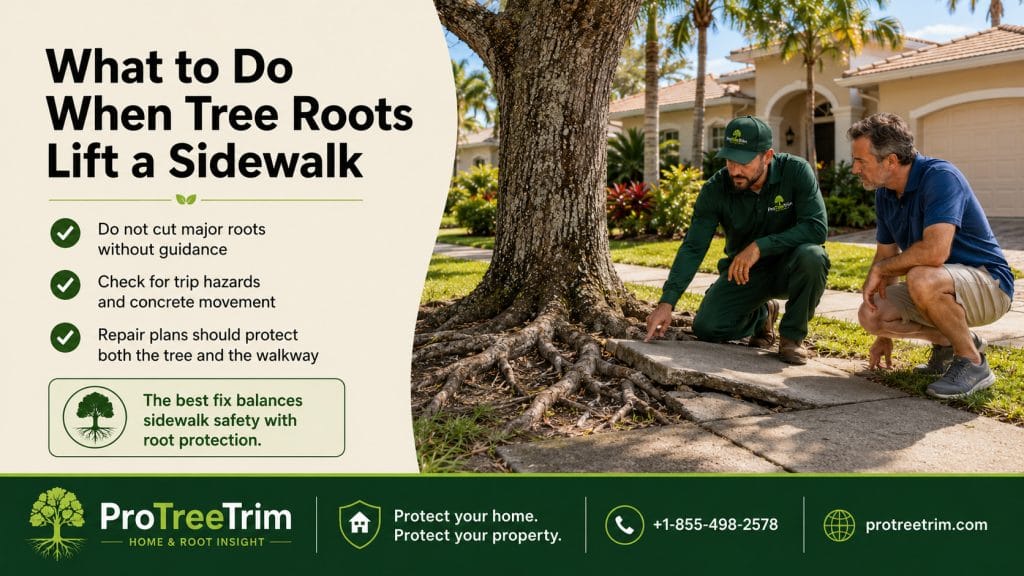
Tree roots lifting a sidewalk can create an uneven surface, a trip hazard, drainage problems, and a difficult decision for homeowners. The sidewalk may need repair, but cutting the roots that lifted it can harm or destabilize the tree.
The safest first step is not to cut the roots. It is to understand how large the roots are, how close they are to the trunk, how healthy the tree is, and whether the sidewalk can be repaired without damaging major roots.
Why Tree Roots Lift Sidewalks
Tree roots often grow in the upper layers of soil where oxygen, moisture, and nutrients are available. When a tree is planted close to a sidewalk, roots may grow under or beside the concrete. Over time, roots can thicken and lift panels.
Sidewalk lifting is more likely when:
- the tree is close to the sidewalk
- soil is compacted
- the planting strip is narrow
- roots have limited space
- drainage patterns push roots toward the sidewalk
- the tree species develops strong surface roots
- concrete was poured too close to existing roots
- the tree has matured beyond the original planting space
The tree may not be “attacking” the sidewalk. It may simply be growing in a space that no longer fits it.
Do Not Cut Roots Without Understanding the Risk
Cutting roots can injure the tree. Large roots may be important for water, nutrients, and stability. If roots are cut too close to the trunk, the tree may decline or become less stable in wind and saturated soil.
Root cutting is more risky when:
| Root situation | Why caution matters |
|---|---|
| Root is large | It may be important for support and health |
| Root is close to trunk | Stability and tree function may be affected |
| Multiple roots need cutting | Cumulative stress increases |
| Tree already leans | Root loss may worsen stability |
| Canopy is thinning | Tree may already be stressed |
| Tree is near house or driveway | Consequences are higher |
| Soil is wet or unstable | Root support matters more |
| Tree is mature | Larger trees depend on established roots |
A sidewalk repair should not create a future tree-failure problem.
First Check How Close the Tree Is
Distance matters. A root lifting a sidewalk several feet from the trunk is different from a root directly beside the trunk. The closer the conflict is to the trunk, the more careful the decision needs to be.
Ask:
- How far is the trunk from the sidewalk?
- Are roots lifting one panel or several?
- Are the largest roots directly under the concrete?
- Is the tree leaning toward the sidewalk or house?
- Is the root flare visible?
- Are there signs of root or trunk decay?
- Is the canopy healthy?
A small young tree near a sidewalk creates a different decision than a mature shade tree with large roots under multiple panels.
Sidewalk Repair Options May Avoid Root Cutting
In some cases, the sidewalk can be adjusted without removing major roots. The best option depends on local rules, sidewalk ownership, accessibility requirements, tree value, and the severity of the lift.
Possible approaches may include:
- grinding or beveling a raised edge
- replacing a panel with a modified grade
- rerouting the walkway slightly
- using flexible materials in private paths
- bridging over roots where appropriate
- expanding the tree bed
- removing and replacing the tree if conflict is severe
Not every option fits every property. Public sidewalks may have city or HOA rules, while private garden paths may allow more flexibility.
Grinding a Raised Edge May Be a Temporary Fix
If one sidewalk edge is slightly raised, grinding or beveling may reduce the trip hazard without disturbing roots. This can be useful when the lift is minor.
But grinding does not solve the root conflict. If roots continue growing, the sidewalk may lift again.
Grinding is usually more reasonable when:
- the lift is small
- the tree is healthy
- roots are large and should not be cut
- the sidewalk is still mostly stable
- a temporary safety improvement is needed
- full replacement would damage major roots
It may not be enough when panels are badly lifted, cracked, or unstable.
Replacing Concrete Can Damage Roots
Replacing a sidewalk panel sounds simple, but excavation can expose or cut roots. Heavy equipment, digging, and soil compaction can stress the tree.
Before replacing concrete, check:
- whether major roots are directly below the panel
- whether excavation will cut roots close to the trunk
- whether machinery will compact soil under the canopy
- whether the new panel will sit on the same roots
- whether the grade can be adjusted safely
- whether the tree is worth preserving long term
A repair that cuts roots today may create tree decline months later.
Rerouting a Walkway May Be Better
For private walkways, rerouting may be a good option when the tree is valuable and the root conflict is severe. Moving the path away from the root flare and major roots may protect both the tree and the walking surface.
Rerouting may make sense when:
- the tree is healthy and valuable
- roots are large and close to the trunk
- the walkway is private, not municipal
- space is available
- repeated concrete repairs have failed
- the tree provides important shade
- removal is not preferred
A path can move more easily than a mature tree can rebuild major roots.
Flexible Surfaces May Help in Private Areas
In some private yard situations, flexible walking surfaces may work better than rigid concrete near roots. These may include mulch paths, stepping stones set carefully, gravel in limited contexts, or other permeable materials.
The goal is to reduce trip hazards while avoiding root cutting and allowing water and air to reach the root zone.
Flexible options are more realistic for:
- garden paths
- side-yard walkways
- informal access paths
- low-traffic private areas
- areas under mature shade trees
- places where concrete is not required
They may not be appropriate for public sidewalks, front entries, accessibility routes, or high-traffic areas.
Do Not Pile Soil Over Roots to Level the Sidewalk
Adding soil over roots may seem like a simple way to smooth the area, but deep soil can suffocate roots and bury the root flare. Roots need oxygen. Burying them can create long-term stress.
Avoid:
- adding several inches of soil over roots
- burying the trunk base
- building a raised bed against the tree
- packing soil tightly around exposed roots
- covering roots to force grass growth
- hiding the problem under rocks
If the sidewalk is lifted, the solution should address the hardscape conflict, not bury the tree.
Sidewalk Lifting Can Signal Poor Planting Space
Sometimes the problem is not the root alone. The tree may have been planted in a narrow strip that was never large enough for its mature size.
This is common near:
- streets
- narrow front yards
- parking strips
- small sidewalk cutouts
- driveway edges
- townhouse landscapes
- compacted urban soil
- older neighborhoods with mature trees
A tree in a cramped space may keep creating conflict no matter how many times the sidewalk is repaired.
Check the Tree’s Health Before Deciding
A healthy, valuable tree may be worth designing around. A declining tree with major root conflict may not be.
Look for:
- full canopy
- normal leaf size
- no major dead limbs
- stable trunk
- visible root flare
- no mushrooms near the base
- no new lean
- no severe trunk cracks
- no large cavities
If the tree is already declining, sidewalk repair may be only one part of a larger decision.
Warning Signs the Tree Needs Closer Evaluation
Root conflicts become more serious when the tree also shows signs of decline or instability.
Be more cautious if you see:
| Warning sign | Why it matters |
|---|---|
| New lean | Stability may be changing |
| Soil lifting near roots | Root movement may be occurring |
| Large dead limbs | Tree health may be declining |
| Mushrooms near base | Decay or moisture concern |
| Trunk crack or cavity | Structural concern |
| One-sided canopy thinning | Root or trunk stress may be involved |
| Recent root cutting | Tree may be weakened |
| Roots lifting multiple panels | Conflict may be severe |
A sidewalk problem can also be a tree-risk clue.
Sidewalk Roots Near Driveways
If roots are lifting a sidewalk near a driveway, the issue may affect both walking and vehicle access. Driveway edges, curb cuts, garage approaches, and front walkways often overlap.
This matters because:
- vehicles may worsen soil compaction
- roots may extend under both sidewalk and driveway
- repairs may require more excavation
- water runoff may follow hardscape edges
- the tree may be trapped between concrete surfaces
- future access may become harder
A tree boxed in by concrete often has fewer good options.
Sidewalk Roots Near the House
If the sidewalk is close to the house, homeowners may worry that roots are also affecting the foundation. Roots and foundations are a more complex topic, but the immediate issue is usually the visible hardscape lift.
Still, check:
- drainage near the house
- cracks in nearby concrete
- soil movement
- distance from trunk to foundation
- roofline branch contact
- roots under patios or entry walks
- whether the tree is too large for the site
Do not cut major roots near a house without considering tree stability and drainage.
Who Is Responsible for the Sidewalk?
Sidewalk responsibility varies by location. In some areas, homeowners are responsible for maintaining sidewalk panels. In others, the city, HOA, or community association may have rules. Public sidewalks may also need accessibility-compliant repair.
Before starting work, check:
- local sidewalk repair rules
- HOA requirements
- whether permits are needed
- whether city-approved materials are required
- whether tree removal approval is needed
- who owns or manages the tree
- whether the tree is protected
Do not assume a sidewalk can be removed, rerouted, or replaced without checking local requirements.
When Root Pruning May Be Discussed
Root pruning may be discussed in some sidewalk repair cases, but it should be approached carefully. Cutting roots is not the same as trimming branches. Root cuts can affect tree health and stability.
Root pruning is more risky when:
- the root is large
- the cut is close to the trunk
- several roots would be removed
- the tree is mature
- the tree leans
- the soil is wet or unstable
- canopy decline is already present
- the tree is near structures or people
If major roots must be cut to repair the sidewalk, tree removal may need to be part of the conversation.
When Tree Removal May Be the Better Long-Term Decision
No one wants to remove a healthy shade tree just because of one sidewalk crack. But sometimes the conflict is too severe or the tree is no longer compatible with the site.
Removal may need discussion when:
- roots lift multiple sidewalk panels
- the tree is too close to hardscape
- root cutting would be severe
- the tree is declining
- the tree is leaning
- trunk or root decay is present
- repeated repairs have failed
- pedestrian safety is a major issue
- the tree species is too large for the strip
In some cases, replacing the tree with a better-suited species in a better location is the more responsible choice.
What Homeowners Should Photograph
Before repairs, take photos of:
- full tree and sidewalk together
- lifted sidewalk panels
- exposed roots
- distance from trunk to sidewalk
- trunk base and root flare
- canopy condition
- dead limbs or lean
- nearby driveway or house
- drainage paths
- cracks before repair
Photos help with contractors, city/HOA questions, and future comparison.
What to Do First
A practical first response:
- Mark or avoid the trip hazard if needed.
- Photograph the lifted sidewalk and tree.
- Do not cut roots immediately.
- Check tree health and lean.
- Identify whether the sidewalk is public or private.
- Ask whether repair can avoid major root cutting.
- Consider rerouting or flexible surfaces where allowed.
- Get help before cutting large roots or removing concrete near the trunk.
The right decision protects both people and the tree when possible.
Final Homeowner Takeaway
Tree roots lifting a sidewalk can be a safety issue, but cutting roots without evaluation can create a tree-health or stability problem. The best solution depends on root size, trunk distance, tree health, sidewalk rules, and repair options.
Minor lifts may be managed with surface correction. Severe lifts may require panel replacement, path rerouting, root-sensitive repair, or tree removal if the conflict is too great. Do not treat the sidewalk and tree as separate problems. They are connected.
If you are unsure whether roots should be protected, pruned, repaired around, or whether the tree should be removed, ProTreeTrim can help connect homeowners with local tree service support. Call +1-855-498-2578 or visit protreetrim.com.
FAQs
Can tree roots lifting a sidewalk be cut?
Sometimes root cutting is discussed, but cutting large roots can harm or destabilize the tree, especially close to the trunk.
Can a sidewalk be repaired without removing tree roots?
Sometimes. Minor grinding, grade adjustment, rerouting, or flexible private paths may reduce the need for root cutting.
Are sidewalk-lifting roots a sign the tree is dangerous?
Not always. But if root lifting appears with leaning, soil movement, dead limbs, trunk cracks, or canopy decline, the tree should be evaluated more carefully.
Should I remove a tree that is lifting the sidewalk?
Not always. Removal may be considered when the conflict is severe, repeated repairs fail, root cutting would be major, or the tree is declining or poorly placed.
ProTreeTrim™ can help you take the next step.
If you are dealing with a damaged tree, fallen branch, stump, root issue, palm concern, or storm cleanup question in Florida, call ProTreeTrim for tree service support.