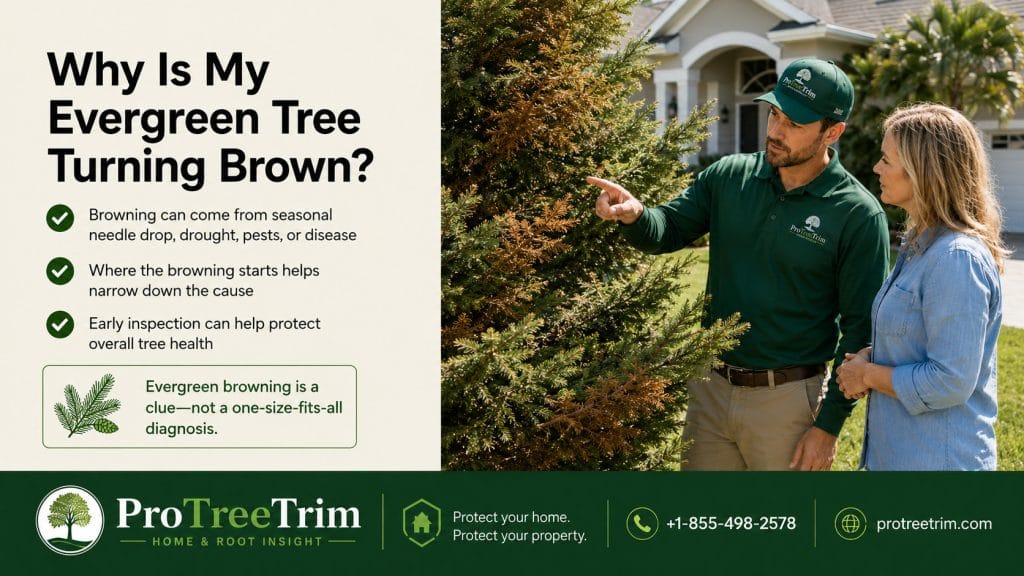
An evergreen tree turning brown can be confusing because “evergreen” sounds like it should stay green all year. But evergreens still shed older foliage, react to stress, and show damage when roots, water, pests, weather, or planting conditions are not right.
Some browning is normal. Some browning is a warning sign. The difference depends on where the browning appears, how quickly it spreads, and whether the branch tips are still alive.
Start With the Browning Pattern
Before assuming the tree is dying, look at the pattern.
Interior browning may be normal older foliage shedding. Browning at the tips, top, one side, or entire branches is more concerning. A whole evergreen fading quickly deserves more attention than a few brown needles tucked inside the canopy.
| Browning pattern | What it may suggest |
|---|---|
| Interior needles or foliage turning brown | Often normal seasonal shedding |
| Branch tips turning brown | Stress, pests, disease, or root trouble may be involved |
| One side turning brown | Sun, wind, irrigation, root damage, or construction stress may matter |
| Top of tree turning brown | More serious decline may be possible |
| Lower branches browning | Shade, age, crowding, or site stress may contribute |
| Whole tree fading quickly | Root, water, pest, or severe stress concern |
| Brown plus holes, webbing, or sawdust | Pest activity may need closer attention |
The pattern tells you where to look next.
Interior Browning Can Be Normal
Evergreens do not keep every needle or scale forever. Older interior foliage naturally ages, turns yellow or brown, and drops. This can look alarming, especially when a tree sheds heavily in one season.
Normal interior shedding is more likely when:
- browning is mostly inside the canopy
- outer branch tips remain green
- the tree still looks full from a distance
- nearby evergreens show similar shedding
- the trunk and root area look stable
- there are no large dead branches
- the change appears seasonal
If the outside of the tree remains green and healthy, the browning may simply be normal renewal.
Brown Branch Tips Are More Concerning
Branch-tip browning is different. On many evergreens, dead branch tips may not fill back in the way homeowners hope. Tip browning can point to water stress, root damage, pests, disease, weather injury, or poor planting conditions.
Look closer when:
- new growth is browning
- tips are dry and brittle
- browning spreads from branch to branch
- the top is affected
- the tree is young or newly planted
- the tree is part of a privacy screen
- branches are over a driveway, walkway, patio, or roof
A few brown interior needles may be routine. Brown active growth is more important.
Water Stress Is One of the First Things to Check
Evergreens can turn brown from too little water or too much water.
Dry soil can cause needles or foliage to brown, especially during hot weather, drought, or after planting. But soggy soil can also make evergreens brown because roots need oxygen. A tree with wet, stressed roots may look dry above ground.
Before watering more, check the soil.
Ask:
- Is the soil dry several inches down?
- Does water sit around the tree after rain?
- Is irrigation hitting only one side?
- Is the tree in a low spot?
- Did a downspout or grading change water flow?
- Is mulch piled against the trunk?
- Are roots exposed, buried, or cut?
- Is the tree surrounded by pavers, concrete, or compacted soil?
Do not assume brown foliage always means the tree needs more water.
Newly Planted Evergreens Need Extra Attention
A newly planted evergreen that turns brown may be struggling with transplant shock, planting depth, poor watering, root ball issues, or drainage.
New trees often fail because water is not reaching the root ball correctly. The surrounding soil may be wet while the root ball is dry, or the planting hole may hold water like a bowl.
Check for:
| New planting issue | Why it matters |
|---|---|
| Root flare buried | Tree may be planted too deep |
| Root ball drying out | Tree may brown even if nearby soil is damp |
| Planting hole holding water | Roots may lack oxygen |
| Mulch touching trunk | Moisture and decay problems may be hidden |
| Stakes or ties too tight | Trunk movement and growth may be restricted |
| Reflected heat from pavement | Young roots and foliage may stress faster |
| Poor drainage | Browning may worsen after rain |
A new evergreen should be evaluated as a planting and establishment issue, not only a foliage issue.
Root Damage Can Show Up Later
Evergreen browning often begins below ground. Roots may be damaged weeks or months before the canopy shows symptoms.
Think about recent yard work.
Root stress may follow:
- driveway repair
- sidewalk replacement
- patio or paver installation
- irrigation trenching
- fence work
- grading changes
- soil added over roots
- heavy equipment under the canopy
- repeated parking near the tree
- stump grinding or digging nearby
If browning began after construction or landscaping, the tree may be reacting to root-zone disturbance.
Pests May Be Involved
Some evergreen browning is caused or worsened by pests. The symptoms may include webbing, tiny insects, scale-like bumps, chewed foliage, holes in bark, resin, or sawdust-like material.
Look closely before treating.
Possible pest clues include:
- fine webbing
- small bags or cases hanging from branches
- tiny insects on needles or stems
- sticky residue
- white fuzzy material
- bark holes
- sawdust-like material
- branches dying from the tips inward
- foliage being chewed or stripped
Do not spray randomly before identifying the issue. The wrong treatment may waste time and ignore the real stress.
Disease and Site Stress Can Look Similar
Evergreen disease problems, root stress, drought, overwatering, and pest damage can all look similar from the ground. They may cause browning tips, thinning, dead branches, or patchy decline.
That is why the site matters.
Check whether the tree is:
- planted too close to the house
- crowded by other trees
- in compacted soil
- sitting in a wet area
- exposed to strong reflected heat
- planted under utility lines
- surrounded by hardscape
- part of an overcrowded privacy row
- repeatedly pruned or sheared
Sometimes the tree is not “diseased” first. It is stressed by where and how it is growing.
Privacy Rows Often Brown From Crowding
Evergreens are commonly planted as privacy screens. They may look good when young, then become crowded as they grow. Lower branches may brown from shade, roots may compete, and irrigation may not reach all trees evenly.
In a privacy row, ask:
- Are trees planted too close together?
- Is one tree getting less water?
- Is one side facing more heat or wind?
- Are lower branches shaded out?
- Is the fence line compacted?
- Are roots competing in a narrow bed?
- Is one tree declining faster than the others?
- Are pests spreading through the row?
A privacy screen problem may be a spacing and site problem, not only a pest problem.
Brown Lower Branches May Not Recover
Lower evergreen branches can brown because of shade, age, crowding, or stress. Once a branch is fully dead and bare, it may not fill back in.
This matters when homeowners rely on evergreens for screening. If the lower half of a privacy tree becomes bare, pruning may not restore the original dense look.
Before cutting, check whether the branch is truly dead or just shedding older interior foliage. A dead lower branch may be removed, but removing many lower branches can change the tree’s appearance permanently.
Do Not Top an Evergreen to “Save” It
A browning evergreen does not usually benefit from being topped or cut back hard. Many evergreens do not regrow well from old bare wood. Heavy cutting can leave permanent gaps or a distorted shape.
Avoid:
- topping the tree
- cutting into bare old wood without a reason
- shearing large trees during stress
- removing too much green growth
- cutting every brown area without diagnosis
- pruning just because interior needles are shedding
Pruning should focus on dead, broken, hazardous, or structure-conflicting branches.
When Pruning Makes Sense
Pruning may make sense when branches are clearly dead, broken, cracked, rubbing, or blocking access. It may also be needed when branches touch a roof, driveway, walkway, fence, or utility area.
Good reasons to prune include:
- dead branches over walkways
- broken storm limbs
- branches rubbing siding or gutters
- limbs blocking a driveway
- dead lower branches that create access issues
- branches near service areas
- cracked or hanging limbs
Pruning should not be used to hide a health problem without understanding it.
Check the Base of the Tree
Walk around the trunk and root area. Many important clues are at ground level.
Look for:
| Base sign | Why it matters |
|---|---|
| Mulch piled against trunk | Moisture and decay problems may be hidden |
| Root flare not visible | Tree may be buried or planted too deep |
| Mushrooms near base | Decay or moisture concern may exist |
| Bark wounds | Mower, trimmer, or construction damage |
| Resin or oozing | Injury or pest response may be possible |
| Sawdust-like material | Insect or decay activity may be present |
| Standing water | Root stress may be involved |
| New lean | Stability concern |
The tree’s foliage may be brown because the root or trunk area is stressed.
Brown Evergreens Near Structures Need Faster Decisions
A browning evergreen in open lawn can often be monitored more calmly. A browning evergreen near a house, driveway, walkway, pool cage, fence, utility line, or neighbor’s property deserves more caution.
Location matters because dead branches or a declining tree may affect property.
Pay closer attention when the tree is near:
- rooflines
- driveways
- patios
- walkways
- fences
- pool areas
- utility lines
- AC units
- neighbor yards
- children’s play areas
A declining evergreen in a high-use area should not be ignored.
What Homeowners Should Photograph
Photos help you track whether the evergreen is stable, improving, or getting worse.
Take photos of:
- the full tree from several angles
- brown areas close up
- branch tips
- interior versus outer foliage
- trunk base and root flare
- any holes, resin, wounds, or mushrooms
- soil and mulch conditions
- nearby driveway, patio, fence, or construction work
- branches over structures or walkways
Good photos are useful if you ask for help later.
What to Do First
Before assuming the tree is dead, work through a simple check:
- Is browning inside the canopy or at branch tips?
- Are outer tips still green?
- Is the soil too dry or too wet?
- Was the tree recently planted?
- Did construction or digging happen nearby?
- Are pests, webbing, bags, holes, or sawdust visible?
- Are dead branches over important areas?
- Is the trunk base healthy and visible?
- Is the tree leaning or unstable?
This helps separate normal shedding from a serious problem.
Final Homeowner Takeaway
An evergreen turning brown is not always dying. Interior browning can be normal seasonal shedding. Browning at the tips, top, one side, or entire branches deserves more attention.
Start with the pattern. Then check water, drainage, roots, pests, planting depth, recent yard work, and whether the tree is near structures or high-use areas. Avoid panic pruning or random treatment until you understand what is causing the browning.
If you are unsure whether your evergreen is shedding normally or showing signs of decline, ProTreeTrim can help connect homeowners with local tree service support. Call +1-855-498-2578 or visit protreetrim.com.
FAQs
Is it normal for evergreens to turn brown inside?
Yes. Older interior needles or foliage can brown and drop naturally while outer growth remains green.
Why are the tips of my evergreen turning brown?
Brown tips may point to drought, overwatering, root damage, pests, disease, weather stress, or branch decline.
Can a brown evergreen recover?
Sometimes, if the branches are still alive and the cause is corrected. Fully dead bare branches often do not refill.
Should I prune brown branches off an evergreen?
Dead or hazardous branches may be removed, but do not top or heavily cut an evergreen just because some foliage is brown.
ProTreeTrim™ can help you take the next step.
If you are dealing with a damaged tree, fallen branch, stump, root issue, palm concern, or storm cleanup question in Florida, call ProTreeTrim for tree service support.