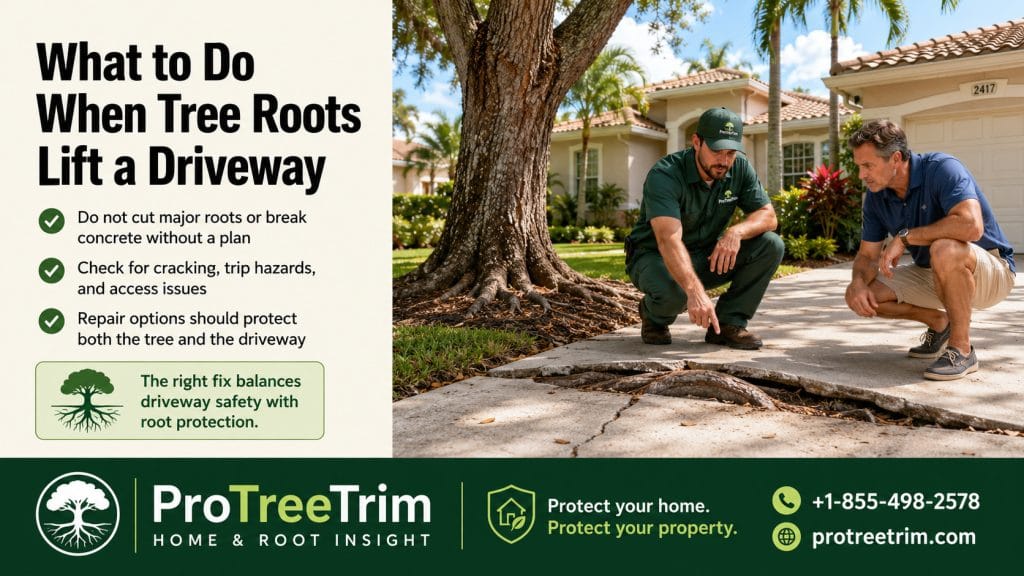
Tree roots lifting a driveway can create cracks, raised edges, uneven pavers, drainage problems, and daily frustration. It can also create a difficult decision: should you repair the driveway, cut the roots, remove the tree, or work around the root system?
The first rule is simple: do not cut large roots just because they are lifting the driveway. Those roots may be important to the tree’s health and stability.
Why Tree Roots Lift Driveways
Most important tree roots grow relatively close to the soil surface because that is where oxygen, water, and nutrients are available. When a tree is planted too close to a driveway, roots may grow under or beside the surface. As those roots thicken, they can lift concrete, asphalt, pavers, or driveway edges.
Driveway root problems are more likely when:
- the tree is close to the driveway
- the driveway was built near existing roots
- soil is compacted
- roots have limited space
- the tree is large for the planting area
- water runs toward the driveway edge
- pavers or concrete trap roots below the surface
- previous repairs cut or disturbed roots
The tree is not trying to damage the driveway. It is growing where space, oxygen, and moisture are available.
First, Look at the Tree and the Driveway Together
A driveway crack is not only a concrete problem. It may also be a tree-root and tree-stability problem. Before repairing the surface, look at both the driveway and the tree.
Check:
| What to check | Why it matters |
|---|---|
| Distance from trunk to driveway | Closer roots are usually more sensitive |
| Root size | Large roots may be important for stability |
| Tree lean | Root cutting can worsen stability concerns |
| Canopy health | A stressed tree may not tolerate root damage |
| Driveway material | Concrete, asphalt, and pavers respond differently |
| Drainage | Water may be encouraging root growth or soil movement |
| Previous root cuts | The tree may already be weakened |
| Nearby structures | House, garage, sidewalk, and utilities affect decisions |
Do not treat the driveway and tree as separate issues. They are connected.
Cutting Roots Can Be Risky
Cutting roots may seem like the fastest way to flatten a driveway, but it can harm the tree. Large roots provide water, nutrients, and structural support. Cutting them can lead to canopy decline, dead branches, instability, or long-term stress.
Root cutting is especially risky when roots are:
- large
- close to the trunk
- on the side supporting a lean
- connected to a mature shade tree
- already damaged by construction
- under multiple driveway sections
- near a house, garage, or walkway
- part of a tree with thinning canopy
If several major roots would need to be cut, tree removal may need to be discussed before driveway repair begins.
Concrete Driveways Can Crack and Lift
Concrete slabs can crack when roots push against them or when soil shifts around roots. Sometimes one slab edge lifts. Sometimes cracking spreads across multiple sections.
Concrete repair questions include:
- Can the slab be lifted or adjusted without cutting roots?
- Can a section be replaced with a modified grade?
- Are roots directly under the slab?
- Will excavation damage major roots?
- Will the same roots lift the new concrete later?
- Is the tree too close for long-term repair success?
Replacing concrete without addressing the root conflict may only create a temporary fix.
Asphalt Driveways May Show Humps or Cracks
Asphalt can sometimes flex more than concrete, but roots may still create humps, cracking, drainage problems, or uneven vehicle access.
With asphalt, check whether:
- roots are lifting one area or a long strip
- water pools near the raised area
- the edge is crumbling near roots
- resurfacing would only hide the problem
- excavation would cut major roots
- the tree is still growing into the driveway zone
A surface patch may look clean briefly but fail again if roots continue thickening below.
Paver Driveways Can Be More Adjustable, but Roots Still Matter
Paver driveways may sometimes be lifted and reset more flexibly than poured concrete. That can be an advantage. However, digging under pavers can still expose or damage roots.
Paver repair should consider:
- whether pavers can be reset around roots
- whether base material is compacted over roots
- whether roots are lifting multiple sections
- whether drainage under the pavers is poor
- whether cutting roots would destabilize the tree
- whether the tree is too close to the driveway
Pavers can be easier to adjust, but they do not make root problems disappear.
Do Not Just Add Material Over the Raised Area
Adding more asphalt, concrete, gravel, or soil over a lifted area may hide the uneven surface temporarily. It can also create drainage problems, bury roots, or raise the driveway grade in a way that causes new issues.
Avoid quick fixes that:
- bury the root flare
- trap water against the tree
- add heavy material over major roots
- redirect runoff toward the garage or house
- create a steeper driveway edge
- cover the problem without solving it
A smooth surface is not always a safe long-term repair.
Driveway Roots Near the Garage Need Extra Attention
If roots are lifting the driveway close to the garage, front entry, or house foundation area, the decision becomes more sensitive. Vehicle access, drainage, garage door clearance, and home repairs may all be affected.
Check:
- whether water flows toward the garage
- whether the lifted area affects vehicle entry
- whether roots are near the foundation-side walkway
- whether the tree leans toward the house
- whether branches also touch the roof
- whether repeated driveway repairs have failed
A tree that conflicts with both the driveway and the house may be a long-term placement problem.
A Healthy Tree May Be Worth Designing Around
If the tree is healthy, valuable, well-placed otherwise, and providing shade, it may be worth exploring driveway repair options that avoid major root cutting.
Possible approaches may include:
- adjusting the driveway grade where practical
- replacing a section without cutting major roots
- using pavers or flexible design in limited private areas
- expanding the tree bed away from the driveway edge
- routing water away from the root conflict zone
- avoiding heavy equipment over roots
- monitoring the tree after repair
Not every property has these options, but the tree should not be sacrificed automatically for a minor surface lift.
A Declining Tree Changes the Decision
If the tree is already declining, driveway repair should be approached differently. It may not make sense to protect roots from a tree that is unsafe, mostly dead, leaning, or structurally compromised.
Look for:
- large dead limbs
- top dieback
- thinning canopy
- mushrooms near the base
- trunk cracks
- cavities
- new lean
- soil lifting near roots
- bark peeling with decline
- repeated large branch drop
If the tree is declining and damaging the driveway, removal may be more practical than repairing around it.
When Tree Removal May Be the Better Long-Term Option
Removal may need discussion when the root-driveway conflict is severe, repeated, or impossible to repair without cutting major roots.
Removal may be more realistic when:
| Situation | Why removal may need discussion |
|---|---|
| Large roots lift several driveway sections | Repair may keep failing |
| Tree is very close to driveway | Long-term space conflict |
| Major roots must be cut for repair | Tree health and stability risk |
| Tree is leaning toward house or driveway | Consequences are higher |
| Canopy is declining | Tree may not justify root-sensitive repair |
| Trunk has decay or cracks | Structural concern |
| Driveway access is unsafe | Daily use issue |
| Tree is too large for the site | Future conflict likely |
Removal is not always the first answer, but it should not be ignored when the conflict is severe.
Do Not Ignore Drainage
Driveway root problems often overlap with drainage. Water may collect along driveway edges, run toward the tree, or erode soil near roots. Poor drainage can also weaken pavement and encourage roots to grow near moisture.
Check for:
- water pooling after rain
- runoff from the roof or downspouts
- driveway slope toward the tree
- soil washing away near roots
- soggy areas at the driveway edge
- pavers settling around roots
- erosion exposing roots
Repairing the surface without fixing drainage may allow the problem to return.
What About Root Barriers?
Root barriers are sometimes suggested near driveways, but they are not magic. They must be planned carefully and are usually more useful before major conflicts develop. Installing a barrier near an established tree may require trenching, which can cut roots and create stress.
Before considering a root barrier, ask:
- How close is the tree to the driveway?
- Would installation cut major roots?
- Is the tree young or mature?
- Is the root conflict already severe?
- Is the tree healthy enough?
- Would removal be more realistic?
A root barrier cannot turn a poor planting location into a perfect one.
Driveway Repair Can Damage Roots Even Without Cutting Them
Roots can be harmed by more than direct cutting. Heavy equipment, soil compaction, grade changes, and excavation can also stress the tree.
During driveway work, root stress can come from:
- machinery parked under the canopy
- soil compacted over roots
- roots exposed and left to dry
- grade lowered or raised around roots
- trenching near the trunk
- concrete washout near soil
- paver base compacted over major roots
A careful repair plan should protect the root zone as much as possible.
Should You Grind Down the Raised Area?
For minor concrete lips or small trip points, grinding may reduce the hazard without cutting roots. But it is usually a temporary or limited fix. If roots continue to grow, the area may lift again.
Grinding may make sense when:
- the lift is small
- the tree is healthy
- the root should not be cut
- the driveway remains structurally usable
- the goal is short-term safety improvement
- replacement would damage major roots
It may not work when the driveway is badly cracked, deeply lifted, or unstable.
Driveway Roots and Insurance or Home Sale Concerns
Driveway lifting can matter during home sale preparation or property documentation. Buyers may notice uneven concrete, visible roots, or tree limbs over the driveway. Insurance or inspection concerns may also arise when a tree appears unstable or poorly maintained.
Before selling a home, consider documenting:
- current driveway condition
- tree condition
- any pruning or removal work
- repair estimates
- photos before and after repair
- whether branches over driveway were addressed
- whether roots were cut or protected
A clear maintenance record can help explain what was done and why.
What Homeowners Should Photograph
Before any root cutting, driveway repair, or tree removal decision, take photos.
Photograph:
- full tree and driveway together
- raised driveway sections
- cracks or lifted pavers
- visible roots
- distance from trunk to driveway
- trunk base and root flare
- canopy condition
- any lean
- branches over driveway or garage
- drainage after rain
Photos help contractors understand the full situation and help track whether the problem is getting worse.
What to Do First
A practical first response:
- Avoid cutting roots immediately.
- Photograph the driveway and tree together.
- Check whether the tree is healthy or declining.
- Identify whether concrete, asphalt, or pavers are involved.
- Look for drainage problems.
- Ask whether repair can avoid major root cutting.
- Consider whether the tree is too close to the driveway long term.
- Get help before cutting large roots or removing hardscape near the trunk.
The best decision protects people, property, and tree stability whenever possible.
Final Homeowner Takeaway
Tree roots lifting a driveway can be a surface problem, a root-zone problem, and a long-term tree placement problem at the same time. Cutting the roots may flatten the driveway, but it can also stress or destabilize the tree.
Minor lifting may be repairable without major root damage. Severe lifting, repeated cracking, driveway access problems, or large roots close to the trunk may require a bigger decision. In some cases, the driveway can be adjusted. In others, tree removal and replacement may be the safer long-term option.
If you are unsure whether driveway roots should be protected, repaired around, pruned, or whether the tree should be removed, ProTreeTrim can help connect homeowners with local tree service support. Call +1-855-498-2578 or visit protreetrim.com.
FAQs
Can I cut tree roots that are lifting my driveway?
Do not cut large roots without evaluation. Cutting major roots can harm the tree or affect stability, especially close to the trunk.
Can a driveway be repaired without removing tree roots?
Sometimes. Minor grinding, careful section replacement, paver adjustment, drainage correction, or design changes may reduce root damage.
Will roots lift the driveway again after repair?
They can, especially if the same large roots remain active and the tree is close to the driveway.
Should I remove a tree that is damaging my driveway?
Not always. Removal may be considered when the conflict is severe, roots are close to the trunk, repairs keep failing, or the tree is declining or poorly placed.
ProTreeTrim™ can help you take the next step.
If you are dealing with a damaged tree, fallen branch, stump, root issue, palm concern, or storm cleanup question in Florida, call ProTreeTrim for tree service support.