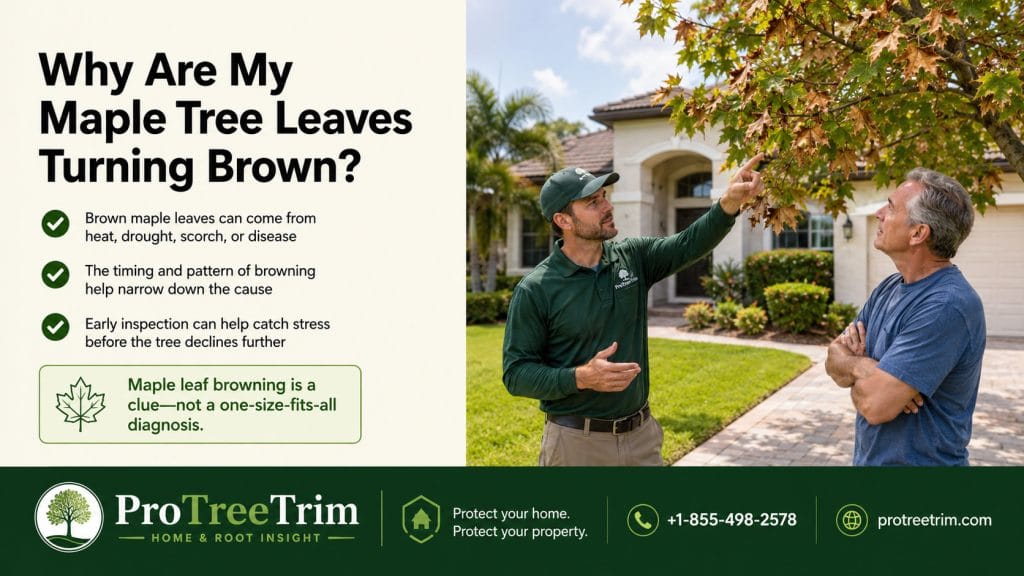
Maple tree leaves can turn brown for many reasons. Sometimes the problem is heat, drought, or normal seasonal stress. Other times, browning can point to leaf scorch, poor watering, compacted soil, root damage, girdling roots, pests, fungal leaf spots, construction injury, or broader decline.
The most useful question is not simply “Why are the leaves brown?” It is where the browning appears, how fast it spread, and whether the maple has other warning signs.
Start With the Browning Pattern
The pattern gives the first clue. Brown edges across many leaves may suggest water or heat stress. Brown spots may point toward a leaf issue. One brown branch may mean localized branch damage. One side of the tree browning may suggest root, irrigation, sun, or construction stress.
| Browning pattern | What it may suggest |
|---|---|
| Brown leaf edges | Heat, drought, root stress, or leaf scorch may be involved |
| Brown spots or blotches | Leaf spot or weather-related disease may be possible |
| One branch turning brown | Branch injury, pests, or localized decline |
| One side of tree browning | Root damage, sun exposure, irrigation, or soil change |
| Top of canopy browning | More serious stress may be possible |
| Leaves browning after construction | Root-zone damage may be part of the story |
| Brown leaves plus dead limbs | Tree condition needs closer attention |
One brown leaf does not tell the whole story. Look at the canopy, trunk, roots, and recent yard changes together.
Brown Edges Often Point to Stress
Maple leaves with brown edges or crispy margins often make homeowners think the tree is “burning up.” Sometimes that is close to the truth. Hot weather, dry soil, reflected heat from pavement, poor root space, or drought stress can all show up as browning along the leaf edges.
This may be more noticeable on maples planted near:
- driveways
- sidewalks
- patios
- streets
- compacted lawns
- hot walls
- parking areas
- newly built hardscape
- dry slopes
A maple in open, healthy soil may handle summer better than one squeezed between pavement, lawn competition, and reflected heat.
Too Much Water Can Also Cause Trouble
Brown leaves do not always mean the tree needs more water. Too much water or poor drainage can also stress roots. When roots sit in saturated soil for too long, they may not get enough oxygen. The canopy may then show browning, yellowing, thinning, or early leaf drop.
Check the ground before changing irrigation.
Ask:
- Does soil stay wet for days after rain?
- Is the tree in a low spot?
- Does a downspout empty near the root zone?
- Is irrigation running too often?
- Did a patio, driveway, or grading project change runoff?
- Is mulch piled against the trunk?
- Are mushrooms appearing near the base?
- Is the root flare buried?
A maple can look dry above ground while struggling with wet soil below ground.
Maples Can Be Sensitive to Root-Zone Stress
Many maple problems begin below the surface. Roots need oxygen, moisture, and space. When the root zone is compacted, cut, buried, or disturbed, the leaves may show stress later.
Think about what has changed around the tree.
Recent root-zone stress may include:
- driveway repair
- sidewalk replacement
- trenching for utilities
- irrigation installation
- fence work
- patio or paver installation
- soil added over roots
- heavy equipment parked under the canopy
- repeated mowing or foot traffic
- grade changes near the trunk
If browning started after yard work, the leaves may be reacting to root disturbance rather than a leaf-only problem.
Girdling Roots Can Be a Hidden Issue
Maples can sometimes develop roots that circle around the trunk or press against the base. These are often called girdling roots. They may restrict normal root and trunk development over time.
Homeowners may not notice them until the tree shows stress.
Possible clues include:
| Clue | Why it matters |
|---|---|
| Root flare is not visible | Trunk base may be buried or restricted |
| Trunk goes straight into the ground like a pole | Normal flare may be missing |
| Surface roots circle the trunk | Root pattern may be problematic |
| One side of canopy declines | Root restriction may be uneven |
| Leaves brown repeatedly in summer | Chronic stress may be involved |
| Tree was planted too deep | Root and trunk-base problems may develop |
Do not cut major roots casually. If a girdling-root issue is suspected, the tree should be evaluated carefully.
Brown Spots Are Different From Brown Edges
Brown spots, blotches, or dark patches on maple leaves may come from leaf spot problems, weather conditions, or other stress. These can look alarming, especially when leaves drop early.
In many cases, leaf spotting is less serious than root damage or trunk decay, especially if the tree is mature and otherwise full. But heavy spotting paired with canopy thinning, dead branches, or repeated decline deserves closer attention.
Do not prune large limbs just because spotted leaves look ugly. First check whether the tree is otherwise healthy.
A practical first response:
- photograph the affected leaves
- compare different parts of the canopy
- check whether new growth looks healthy
- clean up heavy fallen leaves if practical
- avoid heavy pruning during stress
- look for trunk, root, or branch warning signs
The leaf spot may be a symptom, not the full problem.
One Brown Branch Needs a Local Check
If one branch turns brown while the rest of the maple looks normal, the issue may be localized. The branch may be cracked, shaded out, wounded, pest-affected, or dying back from a specific injury.
Look from the ground for:
- cracks where the branch joins the trunk
- bark peeling on that branch
- holes or sawdust-like material
- dead twigs beyond one point
- old pruning wounds
- rubbing branches
- storm damage
- leaves browning only past a certain spot
A dead branch over open lawn may be less urgent. A dead branch over a driveway, roof, patio, sidewalk, or fence should be handled sooner.
Maples Near Hardscape Often Struggle More
Maples planted near sidewalks, streets, patios, driveways, and parking areas may face more stress. The soil may be compacted. Water may run off instead of soaking in. Roots may have limited space. Heat from pavement may increase leaf stress.
This does not mean every maple near hardscape is doomed. It means browning leaves in that setting should make you inspect the site, not just the canopy.
Check for:
- lifted sidewalk panels
- exposed roots
- compacted bare soil
- cracked driveway edges
- mulch piled against trunk
- irrigation missing the root zone
- pavers trapping heat
- standing water after rain
- root cuts from past repair work
The leaf problem may be connected to where the tree was planted.
Pests Can Contribute to Browning
Some pest activity can cause browning, curling, spotting, or dieback. The signs may be subtle at first.
Look for:
- sticky residue
- tiny insects on leaf undersides
- webbing
- holes in leaves
- sawdust-like material near trunk or branches
- bark holes
- leaf distortion
- branch-tip dieback
Pests are not always the main cause. A stressed maple may also be more vulnerable to pest pressure. Treating pests while ignoring root stress may not solve the problem.
Do Not Rush to Fertilize
Brown leaves do not automatically mean the maple needs fertilizer. If the issue is heat, drought, root damage, poor drainage, or trunk restriction, fertilizer may not help.
Fertilizing a stressed tree without understanding the cause can waste money and sometimes add stress.
Before fertilizing, ask:
- Is the soil too dry or too wet?
- Is the root flare visible?
- Has construction happened nearby?
- Are roots cut, buried, or compacted?
- Are pests present?
- Is the browning seasonal or worsening?
- Are branches dying too?
A tree with root or structural problems needs diagnosis first, not random feeding.
Do Not Over-Prune a Stressed Maple
A maple with brown leaves does not automatically need pruning. Removing healthy canopy can stress the tree further. Pruning should focus on dead, broken, cracked, rubbing, or hazardous branches.
Pruning may make sense when there are:
- dead limbs
- storm-damaged branches
- branches touching the roof
- limbs over a driveway or walkway
- cracked branches
- broken hanging limbs
- clearance issues
Avoid:
- topping the maple
- stripping the canopy
- cutting large healthy limbs for appearance
- pruning only because leaves look brown
- making heavy cuts during obvious stress
The goal is to help the tree, not make it look temporarily cleaner.
When Brown Maple Leaves Are Less Concerning
Browning may be less concerning when:
- only a few leaves are affected
- the canopy remains full
- new growth looks healthy
- browning follows a short heat or dry period
- nearby maples show similar symptoms
- no dead limbs are present
- the trunk base looks stable
- the tree is not near high-risk targets
In this case, observation, soil checks, and basic cleanup may be enough.
When to Take It More Seriously
Brown maple leaves deserve closer attention when they come with other warning signs.
Be more cautious if you see:
| Warning sign | Why it matters |
|---|---|
| Large dead limbs | Branch-fall concern may exist |
| One-sided canopy decline | Root or trunk stress may be involved |
| Top thinning | More serious decline may be possible |
| Mushrooms near the base | Decay or moisture issue may exist |
| Trunk cracks or cavities | Structural questions may arise |
| Root flare buried | Long-term root/trunk stress possible |
| Soil lifting or new lean | Stability concern |
| Recent construction | Root damage may be likely |
| Branches over structures | Consequences are higher |
The leaves may be the first visible clue, but the risk may be in the branches, trunk, or roots.
What Homeowners Should Photograph
Photos help you compare the tree over time and explain the issue clearly.
Take photos of:
- the full maple from multiple angles
- close-up brown leaves
- affected branches
- trunk base and root flare
- visible surface roots
- any mushrooms, cracks, wounds, or cavities
- nearby driveway, sidewalk, patio, or construction work
- branches over roof, driveway, patio, or walkway
- soil and mulch around the base
Good photos can show whether the issue is spreading or stable.
What to Do First
Before assuming the maple is dying, work through this checklist:
- Check the browning pattern.
- Look at soil moisture.
- Inspect the root flare.
- Think about recent yard work.
- Look for dead branches.
- Check for pests or webbing.
- Avoid heavy pruning.
- Do not fertilize blindly.
- Monitor whether new growth appears.
- Get help if structural or root warning signs are present.
This keeps the response practical instead of reactive.
Final Homeowner Takeaway
Maple leaves can turn brown from heat, drought, too much water, leaf scorch, leaf spots, root damage, compacted soil, pests, construction stress, or branch decline. The color alone is not enough to diagnose the tree.
Start with the pattern. Brown leaf edges across the canopy often point to stress. One brown branch may be localized damage. Brown leaves with dead limbs, root flare problems, mushrooms, cracks, or recent construction deserve a closer look.
If you are unsure whether your maple’s brown leaves are seasonal stress or a sign of a larger tree problem, ProTreeTrim can help connect homeowners with local tree service support. Call +1-855-498-2578 or visit protreetrim.com.
FAQs
Are brown maple leaves always a sign the tree is dying?
No. Brown leaves can come from heat, drought, seasonal stress, or leaf spots. Worry more when browning comes with dead limbs, trunk cracks, root issues, or canopy thinning.
Why are the edges of my maple leaves turning brown?
Brown edges often suggest heat, drought, root stress, poor watering, or leaf scorch, but the soil and root zone should be checked too.
Can too much water turn maple leaves brown?
Yes. Poor drainage or saturated soil can stress roots and show up as browning, yellowing, thinning, or early leaf drop.
Should I prune a maple tree with brown leaves?
Not just because leaves are brown. Prune only dead, broken, cracked, hazardous, or structure-conflicting branches.
ProTreeTrim™ can help you take the next step.
If you are dealing with a damaged tree, fallen branch, stump, root issue, palm concern, or storm cleanup question in Florida, call ProTreeTrim for tree service support.