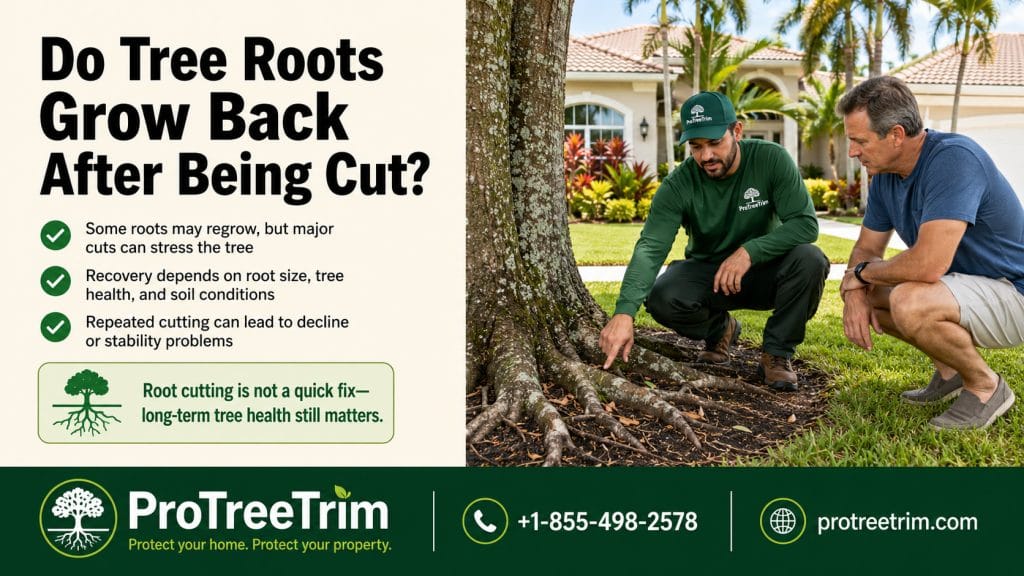
Tree roots can sometimes grow back after being cut, but the answer depends on the tree, the root, and the situation. Small roots may regrow more easily than large structural roots. Roots from a living tree may continue growing if the tree is healthy. Roots from a removed tree may eventually decline, but some species can send up sprouts from remaining roots or stumps.
The important question is not only “Will the root grow back?”
It is “Why was the root cut, and what does that mean for the tree’s health, stability, or future yard problems?”
Small Roots and Large Roots Behave Differently
Not all roots have the same job. Fine roots absorb water and nutrients. Larger roots help move resources and support the tree. Big roots close to the trunk can also help anchor the tree.
| Root type | What may happen after cutting |
|---|---|
| Fine absorbing roots | May regrow if tree is healthy and soil conditions are good |
| Small surface roots | May regrow, branch, or be replaced by new roots |
| Large structural roots | May not “regrow” in the same way and cutting can be risky |
| Roots close to trunk | Cutting may affect stability or health |
| Roots from a removed stump | May decline, but some species can sprout |
| Roots under hardscape | May continue causing conflict if tree remains alive |
A small root cut is not the same as cutting a major root near the trunk.
Roots From a Living Tree May Continue Growing
If the tree is still alive, its root system may continue to grow. A cut root may produce new smaller roots near the cut area, or the tree may redirect growth through other roots.
This is more likely when:
- the tree is healthy
- the root cut is not too close to the trunk
- only a small root was cut
- soil moisture is balanced
- roots were not left exposed to dry out
- the tree is not already stressed
- the canopy remains strong
But regrowth does not mean the cut was harmless. The tree may still lose stored energy, stability, or absorbing capacity.
Large Roots May Not Replace Themselves Quickly
A large root that is cut does not simply grow back to full size right away. It may produce smaller new roots near the cut, but the original structural function may be reduced for a long time.
This matters when large roots are cut near:
- driveways
- sidewalks
- patios
- pool decks
- house foundations
- fences
- retaining walls
- septic areas
- utility trenches
A large root may be annoying because it lifts hardscape, but it may also be helping hold the tree.
Cutting Roots Can Cause Delayed Symptoms
A tree may look fine right after roots are cut. Decline can show up later because the canopy still has stored moisture and energy for a while.
Delayed symptoms may include:
- browning leaves
- early leaf drop
- thinning canopy
- smaller leaves
- branch dieback
- dead top
- increased deadwood
- stress shoots
- reduced growth
- pest or disease pressure
Root damage is often invisible at first. The tree’s response may take time.
Roots Cut Under Sidewalks May Keep Causing Problems
If a living tree’s roots lifted a sidewalk, cutting one root may not end the conflict. Other roots may continue growing. The same root area may also produce new smaller roots if conditions remain favorable.
Sidewalk root conflicts often return when:
- the tree remains close to the sidewalk
- the planting strip is narrow
- soil is compacted
- roots have limited space
- concrete is replaced in the same position
- drainage still encourages root growth there
- major roots were left under the panels
The long-term issue may be tree placement, not one root.
Roots Cut Under Driveways May Return or Shift
Driveway repairs often involve root decisions. If a tree remains alive beside the driveway, roots may continue growing under or along the driveway edge. Cutting roots may temporarily help the surface, but the conflict can return if the tree is still too close.
Driveway root problems are more likely to return when:
- the tree is large and healthy
- the driveway is close to the trunk
- roots already lifted multiple sections
- the new repair uses the same grade
- drainage is not corrected
- soil remains compacted
- the tree has limited open soil elsewhere
A driveway repair should plan for future root growth, not only today’s crack.
Paver Roots May Be Easier to Work Around
Pavers can sometimes be reset around roots more easily than concrete or asphalt. That may reduce the need for major root cutting. But if the tree remains alive and the paver area is close, roots may continue thickening.
Paver repairs may fail again if:
- large roots remain just below the base
- pavers are reset tightly over roots
- base material is compacted over the root zone
- drainage keeps water near the roots
- the tree bed is too small
- roots are cut and then stressed
- the patio is too close to the trunk
Sometimes expanding the tree bed is better than repeatedly resetting the same pavers.
Stump Roots Are Different From Living Tree Roots
If a tree has been removed and the stump remains, the roots are no longer supported by a full canopy. Many roots will eventually decline and decay. However, some tree species can send up new shoots from the stump or remaining roots.
This is why homeowners sometimes see sprouts after a tree is cut down.
Root or stump sprouts may appear when:
- the stump was not ground or treated properly
- the species is prone to suckering
- roots still have stored energy
- the stump remains alive
- the tree was cut but not fully killed
- nearby roots are still active
A removed tree does not always stop growing immediately.
Can Roots Regrow After Stump Grinding?
After stump grinding, most of the visible stump is removed below grade, but roots often remain in the soil. Those roots usually decay over time. In many cases, they do not continue growing because the tree no longer has a living trunk and canopy.
However, some species may still produce sprouts from remaining root tissue if enough living material remains.
After stump grinding, homeowners may notice:
- small sprouts near the old stump area
- mushrooms as roots decay
- soil settling over the stump hole
- soft spots as wood breaks down
- roots remaining under lawn or pavers
- new growth from nearby related roots
Stump grinding reduces regrowth risk, but it does not instantly remove every root underground.
Root Sprouts Are Not the Same as Healthy Tree Regrowth
Root sprouts, also called suckers, may grow from roots or the base of a removed or stressed tree. They can look like the tree is coming back. But they are usually not the same as a healthy, well-placed replacement tree.
Root sprouts may be:
- weakly attached
- fast-growing
- poorly placed
- growing from leftover root energy
- difficult to mow around
- likely to return after cutting
- connected to a root system you wanted gone
Repeatedly mowing or cutting suckers may reduce them over time, but some species can be persistent.
Cutting a Root May Trigger More Small Roots
In some situations, cutting a root can stimulate smaller root growth near the cut if the tree remains healthy. That does not mean cutting roots is a good way to control them.
Root pruning can sometimes redirect growth, but it is not a simple homeowner fix for hardscape conflicts.
Root cutting can also:
- stress the tree
- create decay entry points
- reduce stability
- encourage uneven root response
- fail to stop the hardscape problem
- cause canopy decline
- lead to more repair decisions later
Cutting roots to “stop them growing” is often not reliable.
Roots Grow Toward Favorable Conditions
Roots grow where they find oxygen, moisture, and space. If those conditions remain near a sidewalk, driveway, patio, pipe, or drainage path, roots may continue growing in that direction.
Root conflicts may keep returning when:
- irrigation leaks near hardscape
- soil is compacted elsewhere
- drainage collects near a structure
- roots are trapped in a narrow strip
- pavement covers most of the root zone
- the tree is too close to the hardscape
- the species is vigorous
To reduce future conflicts, the site conditions need to change—not just the root.
Can Cutting Roots Stop Sidewalk or Driveway Damage?
Sometimes it may reduce the immediate problem, but it is not always a lasting solution. If the tree is alive, other roots may continue growing. If major roots are cut, the tree may be harmed. If the tree is too close, the conflict may return.
Better long-term options may include:
- adjusting the hardscape
- rerouting a walkway
- resetting pavers around roots
- expanding a tree bed
- improving drainage
- choosing flexible materials in private areas
- removing and replacing the tree if conflict is severe
- planting a better-suited tree farther away
Root cutting alone is often too simple for a complex problem.
Root Regrowth Depends on Tree Health
A healthy tree has a better chance of producing new roots after minor root loss. A stressed tree may not recover well.
Root recovery is weaker when the tree has:
| Stress factor | Why it matters |
|---|---|
| Drought stress | Tree may struggle to replace lost roots |
| Poor drainage | Roots may decay or lack oxygen |
| Compacted soil | New root growth may be limited |
| Construction damage | Root system may already be reduced |
| Canopy thinning | Tree has fewer resources |
| Trunk decay | Overall tree condition may be poor |
| Recent transplant shock | Roots are already stressed |
| Pest or disease pressure | Recovery capacity may be lower |
A root cut that a healthy young tree survives may be too much for a mature stressed tree.
Root Regrowth Depends on Species
Some trees are more likely to send up suckers, sprouts, or vigorous root growth than others. Species, climate, soil, and tree condition all matter.
Homeowners may see more root or stump sprouting from some fast-growing or suckering trees. Other trees may decline quietly after root damage instead of sprouting.
Because species response varies, do not assume every tree will behave the same way after roots are cut.
Do Not Keep Cutting the Same Roots Repeatedly
Repeated root cutting can weaken a tree over time. A homeowner may cut roots to fix pavers, then cut again for a driveway edge, then cut again for irrigation or landscaping. Each cut adds stress.
Repeated cuts can lead to:
- reduced anchoring
- canopy decline
- dead branches
- decay in root wounds
- root imbalance
- poor storm stability
- long-term tree decline
If roots keep returning to the same conflict area, the design may need to change.
What If Roots Were Cut During Construction?
Roots are often cut accidentally during trenching, fence installation, driveway work, irrigation repair, paver installation, or grading. The tree may not show symptoms right away.
After construction root damage, monitor:
- leaf browning
- early leaf drop
- branch dieback
- canopy thinning
- new lean
- soil lifting
- cracks in trunk
- mushrooms near base
- increased deadwood
If symptoms appear after digging, root damage may be part of the cause.
What to Do After Roots Are Cut
If roots were already cut, focus on reducing additional stress.
Practical steps include:
- avoid cutting more roots
- keep soil moisture balanced
- avoid overwatering
- avoid piling soil over roots
- keep mulch away from the trunk
- reduce mower damage
- avoid heavy equipment over the root zone
- monitor canopy changes
- photograph the tree over time
Do not panic-prune the canopy just because roots were cut. Heavy pruning may add stress.
Should You Fertilize After Root Cutting?
Fertilizer is not usually the first answer after root damage. The tree needs stable moisture, oxygen, healthy soil conditions, and time. Fertilizer cannot fix severed structural roots or compacted soil.
Before fertilizing, check:
- soil moisture
- drainage
- root flare visibility
- mulch depth
- canopy condition
- whether roots were large or small
- whether the tree is leaning
- whether construction stress is ongoing
A stressed root system should not be pushed blindly.
When Tree Removal May Be More Practical
If roots are cut or need to be cut because of hardscape repair, the tree may become a bigger risk. In severe cases, removal may be more practical than leaving a weakened tree in place.
Removal may need discussion when:
- major roots were cut close to the trunk
- several roots must be removed
- the tree is leaning
- the tree is already declining
- roots are damaging important hardscape repeatedly
- the tree is too close to the house or driveway
- trunk decay is present
- large dead limbs are over targets
- future repairs would require more root cutting
A tree that cannot keep its roots and cannot fit the site may not be a good long-term candidate.
What Homeowners Should Photograph
Before and after root work, take photos of:
- full tree
- roots being cut or exposed
- distance from roots to trunk
- trunk base and root flare
- canopy condition
- hardscape damage
- any lean
- dead branches
- soil or drainage conditions
- construction or repair area
Photos help track whether the tree changes over time.
What to Do First
A practical first response:
- Identify whether the tree is alive or removed.
- Check whether the root is small or large.
- Measure how close the root is to the trunk.
- Avoid cutting major roots casually.
- Look for hardscape or drainage causes.
- Expect some roots to regrow if the tree remains alive.
- Watch for suckers after stump work.
- Get help if roots are close to the trunk, large, or tied to property damage.
Root regrowth is less important than root function and tree stability.
Final Homeowner Takeaway
Tree roots may grow back after being cut, especially small roots from a healthy living tree. But large structural roots do not simply replace themselves quickly, and cutting them can affect tree health or stability. Roots from removed trees often decay over time, but some species can send up sprouts from remaining roots or stumps.
If roots are damaging a sidewalk, driveway, patio, pavers, or utility area, do not focus only on whether they will grow back. Focus on why they are there, whether the tree is stable, and whether the site design needs to change.
If you are unsure whether roots will regrow, whether root cutting was safe, or whether stump grinding, hardscape repair, or removal is the better decision, ProTreeTrim can help connect homeowners with local tree service support. Call +1-855-498-2578 or visit protreetrim.com.
FAQs
Do tree roots grow back after being cut?
Small roots may regrow or be replaced if the tree is healthy. Large roots may not return to their original size or function quickly.
Will roots keep growing after a tree is cut down?
Many roots decline after tree removal, but some species can send up suckers or sprouts from remaining roots or stumps.
Can roots regrow after stump grinding?
Usually remaining roots decay over time, but some trees may still produce sprouts if living root tissue remains.
Does cutting roots stop driveway or sidewalk damage?
Not always. Roots may regrow, other roots may continue growing, and cutting major roots can harm or destabilize the tree.
ProTreeTrim™ can help you take the next step.
If you are dealing with a damaged tree, fallen branch, stump, root issue, palm concern, or storm cleanup question in Florida, call ProTreeTrim for tree service support.