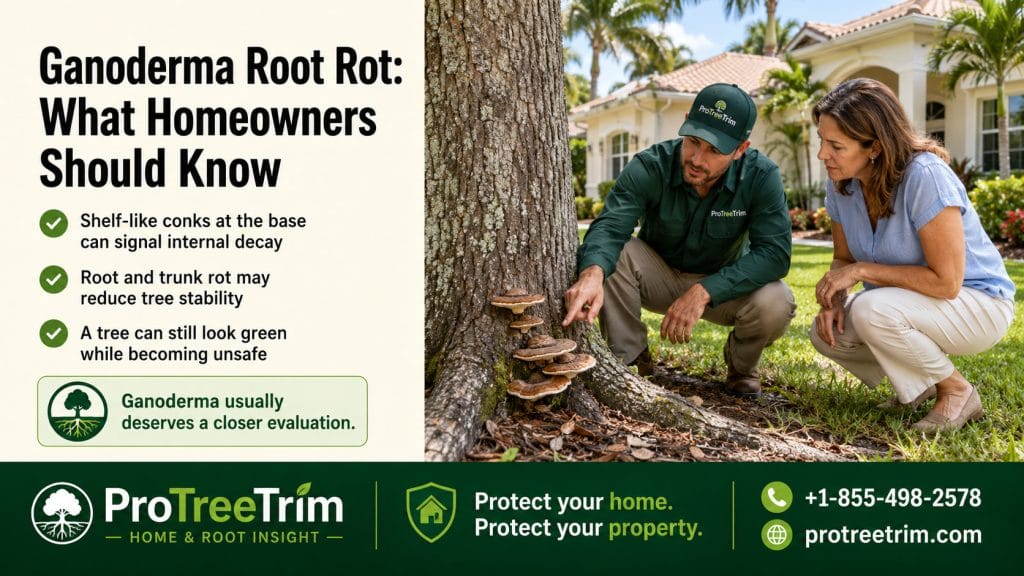
Ganoderma root rot is a serious fungal decay problem that can affect the lower trunk, root flare, and major roots of trees and palms. Homeowners usually notice it when a shelf-like fungus, conk, or mushroom appears near the base of the tree.
The difficult part is that a tree with Ganoderma-related decay may still have green leaves for a while. The canopy can look acceptable even when the lower trunk or root system is losing strength.
The most important homeowner takeaway is this: a conk or fungal growth at the base of a tree should not be ignored, especially if the tree is near a house, driveway, walkway, patio, pool cage, or street.
What Is Ganoderma Root Rot?
Ganoderma refers to a group of fungi that decay wood. In trees and palms, Ganoderma can be associated with decay in the lower trunk, root flare, and major roots. The visible sign is often a hard or shelf-like fungal structure called a conk.
Homeowners may describe it as:
- a mushroom at the base of the tree
- a shelf fungus on the trunk
- a hard brown growth near the root flare
- a white-edged bracket fungus
- a woody-looking mushroom
- a growth that returns in the same spot
- fungus on a palm trunk base
- mushrooms around exposed roots
Not every mushroom near a tree is Ganoderma. But any persistent fungal growth directly attached to the trunk, root flare, or large roots deserves attention.
Why Ganoderma Is Different From Mushrooms in Mulch
Mushrooms in mulch are often just breaking down wood chips or organic matter. That is usually less concerning if they are away from the trunk and the tree looks healthy.
Ganoderma-type growth at the tree base is different because it may be connected to decay inside the tree’s structural wood.
| Fungus location | Level of concern |
|---|---|
| In mulch away from trunk | Often lower concern |
| In old stump grindings | Common during decay |
| On old buried roots from removed tree | Often decay of leftover wood |
| On exposed roots of living tree | More concerning |
| At root flare | More concerning |
| Attached to trunk base | Serious concern |
| On palm trunk base | Serious concern |
| With lean or canopy decline | Higher urgency |
Location matters. A mushroom in mulch is not the same as a conk growing from the tree itself.
What a Ganoderma Conk May Look Like
A conk can vary in shape and color, but homeowners often notice that it looks firmer and more shelf-like than a soft lawn mushroom. It may grow from the lower trunk or near the soil line.
It may appear:
- shelf-like
- woody or hard
- brown, tan, reddish-brown, or white-edged
- flat or bracket-shaped
- attached to the lower trunk
- near the root flare
- on one side of the tree base
- recurring after wet weather
- larger over time
Do not rely on appearance alone for a final diagnosis. But do take clear photos and note exactly where it is growing.
Why It Matters for Tree Stability
Ganoderma-related decay can affect the wood that helps support the tree. If decay develops in the lower trunk or main roots, the tree may become structurally weaker even before the canopy looks dead.
This is why Ganoderma is not just a cosmetic fungus issue.
It may affect:
- root strength
- lower trunk strength
- anchoring
- storm stability
- resistance to wind
- ability to support heavy canopy
- safety near homes and hardscape
A tree with lower-trunk decay can fail even if some leaves are still green.
The Canopy May Look Healthy at First
One of the most dangerous misunderstandings is assuming the tree is safe because it still has leaves. Trees can sometimes maintain a green canopy while decay is progressing at the base.
A homeowner may say:
- “The tree still looks alive.”
- “Only the mushroom is new.”
- “The leaves look mostly fine.”
- “It has not dropped many branches.”
- “It survived the last storm.”
- “It has been like this for a while.”
Those details matter, but they do not rule out structural decay.
Warning Signs to Look For
Ganoderma concern increases when fungal growth appears with other symptoms.
Look for:
| Warning sign | Why it matters |
|---|---|
| Conk at trunk base | Lower-trunk decay may be present |
| Mushrooms at root flare | Root or buttress decay possible |
| New lean | Stability may be changing |
| Soil lifting | Root plate movement concern |
| Large dead limbs | Tree decline may be broader |
| Canopy thinning | Root/trunk function may be reduced |
| Soft wood at base | Decay may be advanced |
| Trunk crack | Structural issue may exist |
| Hollow sound | Internal decay possible |
| Tree near house or driveway | Consequences are higher |
The more warning signs present, the less comfortable a “wait and see” approach becomes.
Ganoderma on Palms
Ganoderma is especially concerning on palms because palm trunks do not respond to wounds the same way many branching trees do. A palm with serious lower trunk decay may not show obvious problems until stability is compromised.
Homeowners should be cautious when a palm has:
- conk near the lower trunk
- soft trunk tissue
- crown decline
- leaning
- loose or unstable base
- fungal growth near soil line
- trunk damage from equipment
- poor drainage around the base
- fronds declining along with base symptoms
Do not remove the conk and assume the palm is fixed. The visible growth is only a sign of the problem.
Ganoderma on Oaks and Large Shade Trees
Large shade trees, including oaks and other mature trees, can become serious risk concerns when decay is located near the base. A mature tree has heavy limbs and a large canopy. If the lower trunk or major roots are compromised, the consequences can be significant.
Be especially careful when the tree is near:
- rooflines
- bedrooms
- driveways
- sidewalks
- patios
- pool cages
- fences
- outdoor seating
- neighbor property
- service lines
A mature tree with a conk at the base should be evaluated as a structural question, not only a tree-health question.
Can Ganoderma Be Treated?
For homeowners, the practical answer is difficult: once structural wood decay is present, there is usually no simple spray, fertilizer, or surface treatment that restores the lost wood strength.
That does not mean every tree with a mushroom must be removed immediately. But it does mean the decision should focus on condition, location, and risk rather than hoping a product will “cure” the tree.
Be cautious of any solution that promises to:
- make the conk disappear and solve the issue
- reverse internal decay quickly
- restore trunk strength with fertilizer
- fix root rot with surface spraying
- make a structurally weak tree safe without inspection
A decay problem needs evaluation, not cosmetic treatment.
Should You Remove the Conk?
You can remove a conk for appearance or to keep children and pets away from it, but removing it does not remove the decay inside the tree. The fungus may still be active in the wood.
If you remove it, photograph it first.
Take photos of:
- the conk close up
- where it attaches
- the full tree
- the trunk base
- canopy condition
- any lean
- nearby targets such as house, driveway, patio, or sidewalk
The photo may be useful when discussing the tree later.
Do Not Cover the Problem With Mulch or Soil
If a fungal growth appears near the tree base, do not hide it under mulch, soil, rocks, or a raised bed. Covering the area can trap moisture and make inspection harder.
Avoid:
- piling mulch against the trunk
- adding soil over the root flare
- building a raised bed around the tree
- covering the conk location with rocks
- hiding soft wood or cracks
- installing landscape fabric over root-zone problems
A visible problem is easier to monitor than a buried one.
Drainage Can Make Root Problems Worse
Ganoderma is not simply caused by one wet day, but poor drainage and saturated soil can stress roots and create conditions where decay issues become harder to manage.
Check whether:
- water pools near the trunk
- downspouts empty toward the tree
- irrigation wets the trunk base
- mulch stays constantly damp
- soil is compacted
- the tree sits in a low spot
- grading sends water toward roots
- roots are buried under wet soil
Improving drainage may help surrounding tree health, but it will not rebuild decayed wood already lost.
Root Damage Can Increase Risk
Trees already weakened by root cutting, construction, trenching, driveway repair, paver installation, grading, or soil compaction may have less ability to handle decay.
Ganoderma-related concern is higher when the tree also has a history of:
- trenching near roots
- driveway or sidewalk root cutting
- patio work near the trunk
- irrigation repair through root zones
- heavy equipment over roots
- soil added around the base
- storm damage
- repeated over-pruning
A tree with both root damage and base decay deserves extra caution.
Can a Tree With Ganoderma Fall?
A tree with serious lower trunk or root decay can fail, especially during wind, heavy rain, saturated soil, or storms. Whether a specific tree is likely to fall depends on species, size, decay location, canopy weight, lean, root condition, and nearby targets.
Act faster when the tree:
- leans toward a house
- has soil lifting near roots
- has a large conk at the base
- has dead limbs over targets
- has a thinning canopy
- has soft or hollow trunk areas
- stands in wet soil
- is close to people or property
The risk is not the mushroom alone. It is the mushroom plus structure, location, and condition.
When Monitoring May Be Reasonable
Monitoring may be reasonable only when the fungal growth appears to be in mulch, old stump material, or buried roots from a removed tree—not attached to the living trunk or root flare—and the nearby living tree looks healthy.
Monitoring may fit when:
- the growth is away from the trunk
- the root flare is visible
- the canopy is full
- no lean is present
- no large dead limbs exist
- the tree is not near major targets
- the fungus appears in old stump grindings
- there are no signs of soft wood or trunk cracking
Even then, take photos and watch whether it returns closer to the tree.
When to Act Quickly
Do not wait if Ganoderma-like growth appears with structural warning signs.
Act sooner when:
| Situation | Why it matters |
|---|---|
| Conk attached to trunk base | Decay may involve structural wood |
| Tree is leaning | Stability concern |
| Soil is lifting | Root movement possible |
| Large limbs are dead | Tree decline and target risk |
| Tree is near house | Consequences are high |
| Tree is near driveway or walkway | People and vehicles are exposed |
| Trunk feels soft | Advanced decay concern |
| Palm has conk near base | Serious palm stability concern |
A tree near a target should not be guessed about.
Removal May Be the Safer Decision
If a tree has confirmed or strongly suspected lower-trunk or root decay and stands near a target, removal may be the safer long-term decision. This is especially true if the tree is leaning, declining, hollow, cracking, or dropping large limbs.
Removal may need discussion when:
- conk is attached to the trunk or root flare
- decay appears advanced
- tree is close to the house
- tree leans toward a target
- canopy is thinning
- large limbs are dead
- roots have been cut before
- soil is unstable or saturated
- the tree is a palm with trunk-base fungal growth
A tree does not need to be completely dead to become a removal candidate.
What About Stump Grinding After Removal?
If a tree is removed because of Ganoderma or root decay, stump grinding may still be useful for lawn restoration, trip hazard reduction, curb appeal, and replanting plans. But the old root system may continue decaying underground.
After grinding, homeowners may see:
- mushrooms in the old stump area
- soil settling
- soft spots
- wood chips mixed with soil
- old roots during digging
- uneven grass growth
This can be normal as old wood breaks down. It is different from a conk on a living tree.
Should You Replant in the Same Spot?
Replanting directly where a tree with root or trunk decay was removed may not be ideal. Old roots, fungal activity, poor drainage, buried wood, and the original site problem may still be present.
Before replanting, consider:
- moving the new tree away from the old stump area
- improving drainage
- removing excess wood chips
- replacing soil where needed
- choosing a better-suited species
- avoiding planting too close to hardscape
- keeping the root flare visible
- giving the new tree enough mature space
A new tree should not inherit the old tree’s problem location.
What Homeowners Should Photograph
Take photos of:
- the conk close up
- where it attaches
- full tree from several angles
- trunk base and root flare
- canopy condition
- dead limbs
- any lean
- soil lifting or wet areas
- nearby house, driveway, patio, or sidewalk
- changes over time
Photos help determine whether the situation is stable or worsening.
What to Do First
A practical first response:
- Do not panic, but do not ignore it.
- Photograph the fungus before removing it.
- Note whether it is attached to trunk, roots, mulch, or old stump material.
- Check the canopy for thinning or dead limbs.
- Look for lean, soil lifting, trunk cracks, or soft wood.
- Pull mulch away from the trunk if it is piled high.
- Avoid covering the area with soil or rocks.
- Get help if the growth is attached to a living tree or palm.
The goal is to identify whether this is harmless decay nearby or decay affecting the tree itself.
Final Homeowner Takeaway
Ganoderma root rot can be serious because it may affect roots and lower trunk wood that help support the tree. A tree or palm may still look alive while decay is developing at the base.
Mushrooms in mulch are often less concerning. A conk or fungal growth attached to the trunk, root flare, or major roots is more serious—especially near a house, driveway, walkway, patio, pool cage, or street.
If you are unsure whether a conk, mushroom, or fungal growth near your tree is harmless decay or a warning sign of structural root rot, ProTreeTrim can help connect homeowners with local tree service support. Call +1-855-498-2578 or visit protreetrim.com.
FAQs
Is Ganoderma root rot dangerous?
It can be. If decay affects the lower trunk or major roots, the tree’s stability may be reduced.
Can a tree survive Ganoderma?
Some trees may remain standing for a time, but structural decay cannot be reversed easily. Risk depends on tree condition, decay location, and nearby targets.
Should I remove a Ganoderma conk?
You can remove it for appearance, but it does not remove the internal decay. Photograph it first and check the tree carefully.
Does Ganoderma mean the tree must be removed?
Not always, but removal may be the safer decision if the tree is near structures, leaning, declining, or showing signs of lower-trunk/root decay.
ProTreeTrim™ can help you take the next step.
If you are dealing with a damaged tree, fallen branch, stump, root issue, palm concern, or storm cleanup question in Florida, call ProTreeTrim for tree service support.