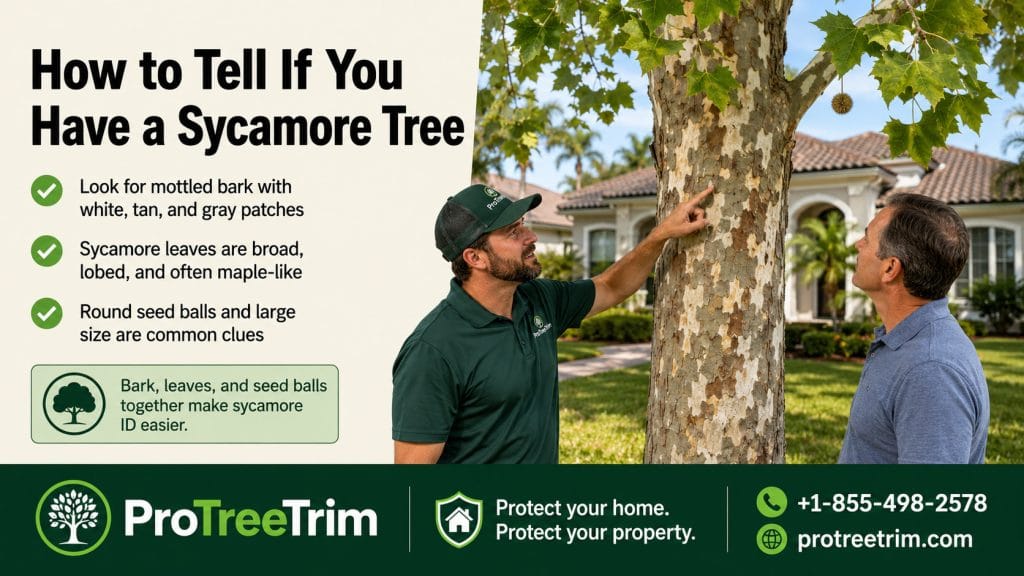
A sycamore tree is often easy to recognize once you know what to look for. Large maple-like leaves, round seed balls, broad shade, and patchy peeling bark are some of the biggest clues. Mature sycamores can become impressive yard trees, but they can also create cleanup, root, branch, and placement questions when they grow near homes, sidewalks, driveways, patios, or utility areas.
Identifying a sycamore is useful because homeowners sometimes confuse normal bark shedding with disease or mistake seasonal leaf problems for serious decline.
Start With the Bark
The bark is one of the strongest sycamore clues. Mature sycamores often have bark that peels or flakes away in patches, revealing lighter inner bark underneath. The trunk may look mottled, with shades of cream, tan, gray, greenish-gray, brown, or white.
This peeling bark can worry homeowners, but on sycamores it is often normal.
| Bark clue | What it may suggest |
|---|---|
| Patchy peeling bark | Common sycamore feature |
| Light-colored trunk sections | Often visible on mature sycamores |
| Mottled camouflage-like pattern | Strong identification clue |
| Bark shedding in flakes | Often normal, especially as trunk expands |
| Soft, wet, or foul-smelling bark | Not normal; check tree condition |
| Bark loss plus dead limbs | More than normal shedding may be involved |
Peeling bark by itself does not mean the tree is dying. But peeling bark with decay, cracks, mushrooms, or dead branches deserves more attention.
Look at the Leaves
Sycamore leaves are large, broad, and often shaped somewhat like maple leaves. They usually have pointed lobes and can be wider than many common yard leaves.
During the growing season, leaves are one of the easiest identification clues.
Look for:
- large broad leaves
- lobed shape
- pointed tips
- wide leaf surface
- coarse texture
- leaves that create heavy shade
- large fallen leaves in the yard
Because the leaves are large, sycamores can create noticeable fall cleanup. Leaves may collect in gutters, patios, pool areas, drainage corners, and along fence lines.
Check for Round Seed Balls
Sycamores often produce round seed balls that hang from stems and later drop. These balls can look like small brown ornaments, fuzzy seed clusters, or round pods.
Homeowners may notice them on the ground before they notice them in the tree.
Seed balls may collect on:
- lawns
- sidewalks
- driveways
- patios
- roof valleys
- gutters
- pool decks
- garden beds
- fence lines
The seed balls are usually normal. The main issue is cleanup and where they fall.
Sycamores Can Become Very Large
A young sycamore may look manageable, but mature sycamores can become large shade trees with broad canopies and substantial roots. That size is part of their appeal, but it also makes placement important.
A sycamore near open space may be a beautiful shade tree. A sycamore squeezed near a sidewalk, driveway, pool deck, roofline, or small front yard can become more complicated.
A mature sycamore may affect:
| Property area | Why it matters |
|---|---|
| Sidewalks | Roots and leaf litter can create maintenance issues |
| Driveways | Large roots, shade, and debris may become concerns |
| Rooflines | Leaves, twigs, and branches may collect in gutters |
| Patios | Shade and debris can both increase |
| Pool areas | Leaves and seed balls may create cleanup |
| Fences | Branch spread and roots may complicate repair |
| Utilities | Mature size may create clearance issues |
The tree may be healthy and still too large for the wrong location.
Do Not Confuse Normal Bark Shedding With Trouble
Sycamore bark naturally sheds as the tree grows. The outer bark flakes off, and the trunk may look patchy or almost painted. This is often one of the reasons people love sycamores.
Normal bark shedding is more likely when:
- the tree canopy is full
- new growth appears healthy
- bark underneath looks firm
- there is no foul smell
- there are no large soft areas
- branches are not dying heavily
- the tree is not leaning suddenly
Bark shedding becomes more concerning when it appears with trunk wounds, deep cracks, cavities, mushrooms, sawdust-like material, or dead limbs.
Sycamore Leaf Problems Can Look Dramatic
Sycamore leaves may develop spots, browning, curling, or early drop in some seasons. Because the leaves are large, symptoms can look dramatic even when the tree is not in immediate danger.
Leaf issues may be influenced by:
- wet spring weather
- drought stress
- heat
- root disturbance
- soil compaction
- leaf spot problems
- poor drainage
- construction near roots
If the tree has a full canopy and recovers with new growth, the issue may be seasonal. If the canopy thins year after year or large limbs die back, look closer.
Watch for Dead Branches
Large sycamores can develop deadwood, especially as they age or experience stress. Dead branches are more important when they hang over daily-use areas.
Pay attention to dead limbs over:
- driveways
- sidewalks
- roofs
- patios
- pool cages
- fences
- parked vehicles
- outdoor seating areas
- neighbor property
A dead branch in open lawn may be less urgent. A dead branch over a driveway or roof deserves faster attention.
Roots Can Become a Yard Issue
Sycamore roots can be substantial. Roots may become visible near the surface, compete with lawn, lift nearby hardscape, or complicate planting beds. This does not mean every sycamore is a problem. It means the planting space matters.
Be more cautious when sycamores grow close to:
- sidewalks
- driveways
- patios
- pool decks
- retaining walls
- septic areas
- narrow planting strips
- foundation-side beds
- irrigation lines
Do not cut large surface roots casually. Major root cutting can stress the tree or affect stability.
Sycamores Near Homes Need Monitoring
A mature sycamore near a home can provide shade, but it may also create roof and gutter cleanup. Large leaves, twigs, seed balls, and bark flakes can collect in roof valleys and gutters.
Check roofline areas if:
- branches touch shingles or gutters
- gutters overflow during rain
- roof valleys collect leaves
- large limbs hang over the house
- bark or twigs gather on flat roof sections
- squirrels or wildlife use branches to access the roof
The tree may not need removal, but roofline clearance and cleanup may matter.
What If the Tree Has Peeling Bark and Brown Leaves?
Peeling bark plus brown leaves can worry homeowners. The bark may be normal, while the leaves may reflect seasonal stress. But if both appear with dead limbs, trunk cracks, or root problems, the tree deserves more attention.
Look at the whole tree:
- Is new growth appearing?
- Are only older leaves affected?
- Are large limbs dead?
- Is one side declining?
- Is the trunk soft or hollow?
- Are mushrooms growing near the base?
- Was construction done near roots?
- Is water collecting around the trunk?
Do not diagnose the tree from one symptom.
Sycamore Cleanup Can Be Significant
Even a healthy sycamore can be messy. Large leaves, bark flakes, twigs, and seed balls may require seasonal cleanup.
Cleanup matters more near:
- pools
- patios
- driveways
- roof gutters
- sidewalks
- AC units
- outdoor kitchens
- front entries
- drainage grates
A sycamore in open lawn may feel manageable. A sycamore over a pool deck or roof may become a routine maintenance commitment.
Should You Prune a Sycamore?
Pruning should have a clear reason. A sycamore should not be topped or cut back hard just because it is large. Poor pruning can create weak regrowth, large wounds, and long-term structure problems.
Good reasons to prune may include:
- dead branches
- broken storm limbs
- branches touching the roof
- limbs over a driveway or walkway
- cracked or hanging branches
- rubbing branches
- clearance for structures
- branches affecting utility-safe areas
Avoid pruning only to reduce leaf drop or seed balls. That usually does not solve the cleanup issue and may harm the tree.
When a Sycamore May Be in Trouble
A sycamore may need closer attention if normal features are paired with decline or structural concerns.
Watch for:
| Warning sign | Why it matters |
|---|---|
| Large dead limbs | Branch-fall concern |
| One-sided canopy decline | Root or trunk issue may be involved |
| Trunk cracks or cavities | Structural concern may exist |
| Mushrooms near base | Decay or moisture concern |
| Sawdust-like material | Insect or decay activity may be possible |
| New lean | Stability concern |
| Soil lifting near roots | Root movement may matter |
| Branches over structures | Consequences are higher |
Normal peeling bark is one thing. Peeling bark plus major structural symptoms is different.
What Homeowners Should Photograph
If you are trying to identify a sycamore or decide whether it is healthy, take photos of:
- full tree from a distance
- bark close up
- leaves close up
- seed balls if present
- trunk base and root flare
- any dead branches
- roofline or driveway branches
- visible surface roots
- mushrooms, cracks, or wounds
- nearby hardscape conflicts
Photos make it easier to compare changes over time.
Final Homeowner Takeaway
You may have a sycamore tree if you see patchy peeling bark, large lobed leaves, round seed balls, and a broad shade canopy. Peeling bark is often normal for sycamores and does not automatically mean the tree is sick.
The bigger questions are size, placement, roots, dead branches, roofline clearance, and cleanup. A healthy sycamore can be a valuable shade tree. A declining or poorly placed sycamore near a roof, driveway, sidewalk, patio, or pool area deserves closer attention.
If you are unsure whether you have a sycamore or whether its peeling bark, brown leaves, dead branches, or roots are a problem, ProTreeTrim can help connect homeowners with local tree service support. Call +1-855-498-2578 or visit protreetrim.com.
FAQs
How can I tell if I have a sycamore tree?
Look for patchy peeling bark, large lobed leaves, round seed balls, and a broad mature canopy.
Is peeling bark normal on sycamore trees?
Yes. Patchy bark shedding is often normal on sycamores, especially mature trees.
Are sycamore trees messy?
They can be. Large leaves, seed balls, bark flakes, and twigs may create cleanup around roofs, patios, pools, and driveways.
Should I worry about brown sycamore leaves?
Sometimes. Brown leaves may be seasonal or stress-related. Worry more if browning comes with dead limbs, thinning canopy, trunk cracks, mushrooms, or root problems.
ProTreeTrim™ can help you take the next step.
If you are dealing with a damaged tree, fallen branch, stump, root issue, palm concern, or storm cleanup question in Florida, call ProTreeTrim for tree service support.