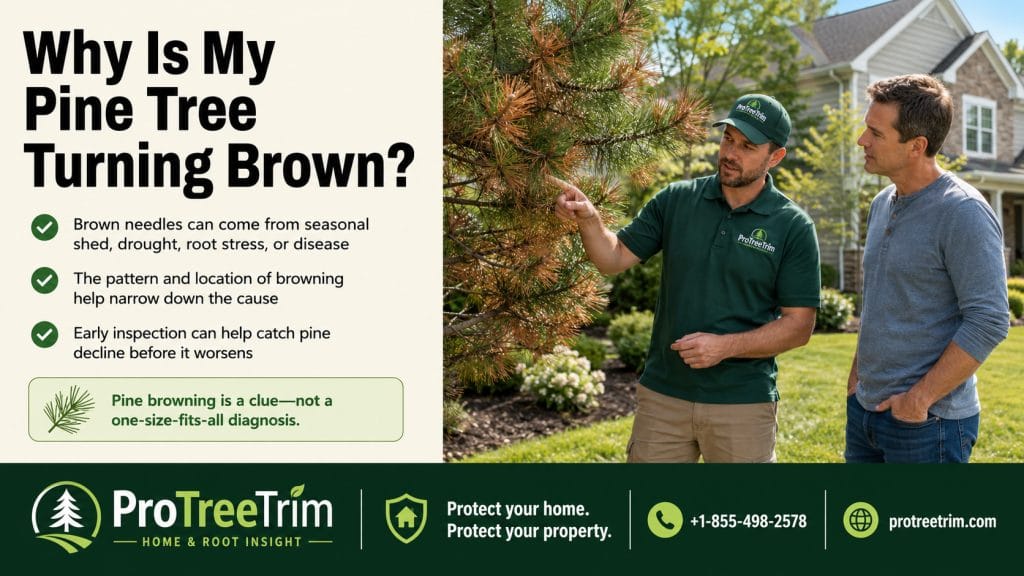
A pine tree turning brown can mean several different things. Sometimes it is normal seasonal needle drop. Sometimes it points to drought stress, too much water, poor drainage, pests, disease, root damage, construction stress, or branch decline. The important question is not only that the needles are brown. It is where the browning appears, how quickly it spread, and whether the branch tips are still alive.
Start With Where the Browning Is Happening
The pattern of browning matters more than the color alone.
Interior needles turning brown can be normal on many pines as older needles age out. Browning at the branch tips, top of the tree, one side of the canopy, or entire branches is more concerning.
| Browning pattern | What it may suggest |
|---|---|
| Older interior needles turning brown | Often normal seasonal shedding |
| Outer branch tips turning brown | Stress, pests, disease, or branch decline may be involved |
| One side of tree browning | Sun, wind, irrigation, roots, or construction damage may matter |
| Top of pine turning brown | More serious decline may be possible |
| Whole tree fading quickly | Root, water, pest, or severe stress concern |
| Brown needles after storm | Wind, root movement, or branch injury may be involved |
| Brown needles plus sawdust or holes | Pest activity may need attention |
A pine can look alarming during normal needle shed, but the branch tips tell a more important story.
Normal Needle Drop Usually Starts Inside
Pines are evergreens, but evergreen does not mean every needle stays forever. Older interior needles naturally turn yellow, brown, and drop while newer outer growth remains green.
Normal shedding is more likely when:
- browning is mostly inside the canopy
- branch tips stay green
- the tree still looks full from the outside
- the change is seasonal
- nearby pines show a similar pattern
- there are no large dead branches
- the trunk and root area look stable
If only the interior needles are browning and the outer growth is healthy, the pine may not be in serious trouble.
Brown Tips Are More Concerning
If the newest growth or branch tips are turning brown, look closer. Pines do not always replace lost branch-tip growth easily. Tip browning may suggest stress, pests, disease, drought, root damage, or branch injury.
Check whether the affected branch is still flexible and whether there is any green tissue left. A fully dead branch may not recover.
Tip browning deserves more attention when it affects:
- many branches
- the top of the tree
- one entire side
- branches over a driveway
- limbs near a roof
- branches over a walkway or patio
- trees used as privacy screening
- newly planted pines
A brown branch over open lawn is one issue. A brown branch over a roof or driveway is another.
Water Stress Is a Common Cause
Both too little water and too much water can make pine trees struggle.
During hot, dry periods, pines may brown at the tips or shed needles earlier than usual. But overwatering or poor drainage can also stress roots by limiting oxygen. A pine in soggy soil can look drought-stressed above ground because the root system is not functioning well.
Before changing irrigation, check the soil.
Ask:
- Is the soil dry several inches down?
- Does water sit around the tree after rain?
- Is irrigation hitting one side but missing another?
- Has a downspout or drainage pattern changed?
- Is the tree in a low area?
- Is mulch piled against the trunk?
- Has nearby hardscape changed water flow?
- Are roots exposed, cut, or buried?
Do not assume brown pine needles always mean the tree needs more water.
Root Damage Can Show Up Later
Pine browning may begin below ground. Root damage from construction, trenching, driveway work, paver installation, soil compaction, grade changes, or heavy equipment can show up in the canopy weeks or months later.
Think about what happened around the tree recently.
Root stress is more likely if browning started after:
- driveway repair
- sidewalk or patio installation
- irrigation trenching
- fence work
- grading or soil fill
- parking under the tree
- stormwater changes
- heavy mulch or soil against the trunk
- stump grinding nearby
- construction traffic
If the timing matches yard work, the brown needles may be a delayed response to root-zone disturbance.
Pests May Be Involved
Some pine problems involve insects. Homeowners may notice browning needles first, but the better clues may be holes, pitch, sawdust-like material, webbing, or dying branch tips.
Look for:
| Pest clue | Why it matters |
|---|---|
| Small holes in bark | Insect activity may be present |
| Sawdust-like material | Boring insects or decay may be involved |
| Sticky pitch or resin | Tree may be reacting to injury or pests |
| Webbing on branches | Caterpillars, webworms, or mites may be possible |
| Branch tips dying back | Localized pest or disease issue may exist |
| Needles chewed or stripped | Feeding damage may be occurring |
| Bark peeling with brown canopy | Tree condition may be more serious |
A pest issue should be identified before treatment. Random spraying may miss the real cause.
Disease and Needle Problems Can Look Similar
Pines can develop needle browning from several disease or stress-related issues. Some affect needles, some affect shoots, and some affect roots or branches. From the ground, many of these problems look similar: brown needles, thinning canopy, dead branch tips, or patchy decline.
That is why the pattern matters.
A disease or broader health concern is more likely when:
- browning spreads from branch to branch
- new growth dies back
- the top thins or dies
- several pines nearby show symptoms
- needles have spots, bands, or unusual discoloration
- branches die in clusters
- the tree has repeated problems year after year
Do not remove the whole tree based on needle color alone, but do not ignore spreading decline.
Newly Planted Pines Need Extra Attention
A newly planted pine turning brown may be dealing with transplant stress, planting depth problems, root ball drying, poor drainage, or inconsistent watering.
New trees are less forgiving than established ones because their roots are still adjusting.
Check:
- Was the tree planted too deep?
- Is the root flare visible?
- Is the root ball drying out while surrounding soil stays damp?
- Is water running off instead of soaking in?
- Is the tree staked too tightly?
- Is mulch touching the trunk?
- Is the planting hole holding water?
- Did the tree arrive with damaged roots?
A newly planted pine with brown needles should be treated as an establishment issue first.
One Brown Branch May Be a Local Problem
If one branch turns brown but the rest of the tree looks green, the problem may be limited to that branch. It could be broken, shaded out, wounded, pest-affected, or cracked.
Look at the branch from the ground.
Check for:
- a crack near the trunk
- bark peeling on the branch
- dead tips beyond one point
- resin or pitch
- holes or sawdust-like material
- rubbing against another branch
- storm damage
- old pruning wounds
If the branch is dead and over a roof, driveway, walkway, patio, or fence, removal may be more urgent than if it is over open lawn.
Browning at the Top Is More Serious
A pine with the top turning brown deserves closer attention. Top decline can suggest root stress, severe drought stress, pest activity, disease pressure, lightning injury, or other serious problems.
A dead top may not recover. It may also become a future breakage concern depending on the tree’s size and location.
Be more cautious if the dead or brown top is above:
- a house
- driveway
- parked vehicles
- fence
- walkway
- patio
- utility area
- neighbor’s yard
A tall pine with top decline should not be ignored.
Storms Can Make Pine Problems Appear Suddenly
Wind, heavy rain, saturated soil, and lightning can all affect pines. A tree may show browning after a storm because branches were twisted, roots moved, soil stayed wet, or the tree was already stressed.
After storm events, check more than the needles.
Look for:
- new lean
- soil lifting near roots
- exposed roots
- cracks in trunk or branches
- broken hanging limbs
- bark damage
- lightning marks
- sudden top browning
- branches over structures
The browning may be the visible symptom, but stability and branch condition matter more.
Do Not Over-Prune a Brown Pine
A pine with brown needles does not automatically need heavy pruning. Cutting too much live growth can stress the tree more. Pines also do not always regrow well from bare older wood.
Pruning may make sense when branches are:
- dead
- broken
- cracked
- hanging
- rubbing a structure
- over a roof or driveway
- blocking a walkway
- storm-damaged
Avoid:
- topping the pine
- cutting back into bare wood without reason
- removing large healthy limbs for appearance
- stripping lower branches too aggressively
- pruning just because needles are shedding inside
- treating normal needle drop like branch death
A pine should be pruned for structure, safety, and clearance—not panic.
Check the Base of the Tree
The lower trunk and root area can reveal bigger issues.
Walk around the pine and look for:
| Base sign | Why it matters |
|---|---|
| Mushrooms near trunk | Possible decay or root concern |
| Soil piled against trunk | Root flare may be buried |
| Bark wounds | Mower, trimmer, or construction damage |
| Resin flow | Injury or pest response may be possible |
| Sawdust-like material | Insect or decay activity may exist |
| Soil lifting on one side | Stability concern |
| Standing water | Root stress may be involved |
| New lean | More serious than needle browning alone |
Canopy symptoms often begin at the root zone.
Brown Pines Near Structures Need Faster Decisions
A browning pine in open space can often be monitored more calmly. A browning pine near a house, driveway, fence, walkway, pool cage, utility line, or neighbor’s property deserves more caution.
Location changes the risk.
Pay closer attention when the pine is near:
- rooflines
- bedrooms
- driveways
- parked vehicles
- power lines
- fences
- patios
- walkways
- pool areas
- septic or utility access
A declining pine near important targets may need pruning, closer evaluation, or removal planning sooner than a tree in open yard.
What Homeowners Should Photograph
Photos help track whether the pine is improving, stable, or getting worse.
Take photos of:
- full tree from several angles
- brown sections close up
- branch tips
- interior vs outer needles
- trunk base and root flare
- any holes, resin, or sawdust-like material
- nearby construction, pavers, or driveway work
- branches over structures
- soil or drainage conditions
Good photos make it easier to compare the tree over time.
What to Do First
Before assuming the pine is dying, work through this simple check:
- Is browning inside the canopy or at the branch tips?
- Are the branch tips still green?
- Did hot, dry, wet, or stormy weather happen recently?
- Has nearby construction or digging occurred?
- Is soil too dry or too wet?
- Are there holes, resin, sawdust, or pests?
- Are dead branches over structures?
- Is the tree leaning or showing root movement?
This helps separate normal needle drop from a serious tree problem.
Final Homeowner Takeaway
A pine tree turning brown is not always dying. Interior needle drop can be normal. Browning at the tips, top, one side, or entire branches is more concerning.
Start by checking the pattern, soil, roots, trunk, recent yard changes, and whether branches are over important property areas. Avoid panic pruning and do not assume fertilizer, water, or sprays will fix the problem without identifying the cause.
If you are unsure whether your pine tree is shedding normally or showing signs of decline, ProTreeTrim can help connect homeowners with local tree service support. Call +1-855-498-2578 or visit protreetrim.com.
FAQs
Is it normal for pine trees to turn brown inside?
Yes, older interior needles can brown and drop naturally while outer branch tips remain green.
Why are the tips of my pine tree turning brown?
Brown tips may point to drought stress, too much water, pests, disease, root damage, or branch decline.
Can a brown pine tree recover?
Sometimes, if the browning is stress-related and branch tips remain alive. Fully dead branches usually do not recover.
Should I cut off brown pine branches?
Dead, broken, cracked, or hazardous branches may be removed. Do not heavily prune a pine just because of normal interior needle drop.
ProTreeTrim™ can help you take the next step.
If you are dealing with a damaged tree, fallen branch, stump, root issue, palm concern, or storm cleanup question in Florida, call ProTreeTrim for tree service support.