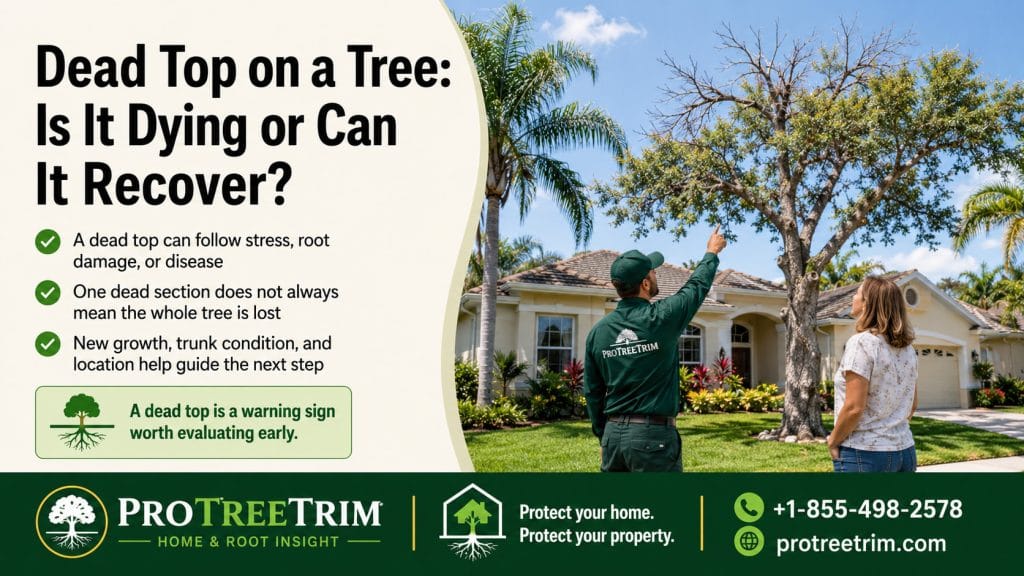
A dead top on a tree is a warning sign that should not be ignored. Sometimes the problem is limited to the upper canopy and the tree may respond with proper care or pruning. Other times, a dead top can signal root damage, drought stress, pest activity, disease, lightning injury, trunk damage, decay, or a tree that is declining from the inside out.
The key question is not simply “Is the top dead?”
It is “Why did the top die, how much of the canopy is affected, and is the tree structurally safe?”
What Does “Dead Top” Mean?
A dead top means the upper part of the canopy has stopped producing healthy leaves, needles, or new growth. This may affect the central leader, upper branches, or the highest portion of the crown.
Homeowners may describe it as:
- the top of the tree is brown
- the upper branches are bare
- the tree has a dead crown
- only the lower branches are alive
- the top snapped or dried out
- the pine top turned brown
- the oak has dead branches at the top
- the tree looks alive at the bottom but dead above
A dead top is not a diagnosis. It is a symptom.
A Dead Top Can Have Many Causes
The upper canopy is often the first place stress becomes obvious because it is farthest from the roots. If water movement, root function, trunk health, or vascular flow is disrupted, the top may show symptoms before lower branches.
Possible causes include:
| Possible cause | Why it can affect the top |
|---|---|
| Drought stress | Upper canopy may not receive enough water |
| Root damage | Reduced root function affects canopy first |
| Soil compaction | Roots lose oxygen and water access |
| Boring insects | Flow of water/nutrients may be disrupted |
| Disease or cankers | Branches or trunk tissues may die back |
| Lightning injury | Top may be damaged suddenly |
| Trunk cracks | Internal flow or structure may be affected |
| Decay | Tree may lose function or stability |
| Poor pruning | Large wounds or topping can cause decline |
| Construction damage | Roots may have been cut or compacted |
The dead top is the visible part. The cause may be below ground or inside the trunk.
Is the Tree Dead If the Top Is Dead?
Not always. A tree can have a dead top and still have living lower branches. But a dead top often means the tree is under significant stress.
A tree is more likely to be recoverable when:
- only a small upper section is dead
- the rest of the canopy is full
- the trunk is solid
- no major cracks are present
- no mushrooms are near the base
- no new lean is visible
- roots were not recently cut
- the dead area is from a known isolated injury
A tree is more concerning when:
- the entire upper crown is dead
- decline is spreading downward
- large limbs are dead
- bark is falling off
- trunk holes or sawdust are present
- mushrooms appear near the base
- the tree is leaning
- the tree is near a house, driveway, or walkway
A living lower canopy does not automatically make the tree safe.
Dead Top on a Pine
A dead top on a pine deserves prompt attention. Pines can show top dieback from drought stress, root problems, bark beetles, borers, lightning, disease, or storm damage. In some cases, pine decline can move quickly.
Be more cautious when a pine has:
- brown top
- resin or pitch flow
- small holes in the bark
- sawdust-like material
- bark flaking
- rapid needle browning
- thinning crown
- nearby declining pines
- dead branches spreading downward
- trunk damage or lightning scar
A pine with a dead top and insect signs should not be treated as a simple cosmetic issue.
Dead Top on an Oak
A dead top on an oak can come from root stress, drought, construction damage, disease, decay, lightning injury, storm damage, or long-term decline. Mature oaks are valuable, but they can also be heavy trees with serious branch-fall consequences.
With oaks, check for:
- large dead limbs
- canopy thinning
- mushrooms near the base
- trunk cavities
- bark loss
- cracks in major limbs
- old pruning wounds
- dead branches over roof or driveway
- root damage from construction
An oak with a dead top may need deadwood pruning, further evaluation, or removal depending on the cause and location.
Dead Top on a Palm
Palms are different from branching trees. If the growing point or crown of a palm is dead, the palm may not recover the way a shade tree might. A palm with crown decline, trunk softness, or leaning should be taken seriously.
Check palms for:
- brown or collapsed crown
- spear leaf pulling out
- soft trunk areas
- fungal growth near base
- leaning
- trunk wounds
- fronds declining rapidly
- signs of bud rot or crown damage
A palm that has lost its central growing point may be a removal candidate.
Dead Top After Drought or Heat Stress
Drought and heat can cause upper canopy dieback because the tree cannot move enough water to the highest branches. This is especially common when root systems are already limited, damaged, or growing in compacted soil.
Drought-related top dieback may appear with:
- leaf scorch
- early leaf drop
- smaller leaves
- thinning canopy
- dead branch tips
- dry soil
- root competition
- recent planting stress
- irrigation changes
Water stress does not always kill a tree immediately, but repeated stress can weaken it over time.
Dead Top After Root Damage
Root damage is one of the most important hidden causes of top decline. A tree can lose roots during trenching, driveway work, sidewalk repair, irrigation installation, utility work, grading, or construction. The canopy may decline weeks, months, or even longer after the damage.
Root damage may come from:
- trenching near the trunk
- driveway or patio installation
- sidewalk repair
- septic work
- irrigation repair
- soil compaction from equipment
- grade changes
- roots cut for pavers or walls
- heavy vehicles parked over roots
If the tree’s top declined after yard work, look at the root zone.
Dead Top After Lightning
Lightning can damage the top of a tree, run down the trunk, split bark, and affect internal tissues. Sometimes the damage is obvious. Other times, decline appears later.
Lightning-related signs may include:
- dead top after a storm
- bark strip down the trunk
- cracked trunk
- sudden branch dieback
- leaves browning rapidly
- hanging limbs
- splintered wood
- one side of the tree declining
- root damage near the base
A lightning-damaged tree near a home should be evaluated for both health and structure.
Dead Top After Storm Damage
Wind and storms can break upper limbs, damage branch unions, tear bark, or expose decay. A tree may appear to have a dead top because the upper canopy was physically injured.
After a storm, check for:
- broken top
- hanging branches
- split limbs
- trunk cracks
- torn bark
- exposed decay
- new lean
- soil lifting near roots
- large dead limbs still attached
A storm-damaged dead top may require pruning, but if structural damage is severe, removal may be safer.
Dead Top With Tiny Holes or Sawdust
A dead top plus tiny holes, sawdust, frass, pitch, or bark peeling may suggest insect or borer activity. Insects may attack stressed trees, especially trees weakened by drought, roots, wounds, or disease.
Look for:
| Sign | Why it matters |
|---|---|
| Small holes in trunk | Borer or beetle activity possible |
| Sawdust-like material | Wood-boring activity may be present |
| Pitch or resin | Stress response, especially in conifers |
| Bark peeling | Tissue may be dead or damaged |
| Dead top | Water movement may be disrupted |
| Rapid decline | Urgency increases |
Do not spray blindly. The tree’s overall condition and cause of stress matter.
Dead Top With Bark Falling Off
If bark is falling from the upper trunk or major limbs near the dead top, the tissue underneath may already be dead. Bark loss can also point to insects, sunscald, disease, decay, or mechanical injury.
Be more cautious if bark loss appears with:
- canopy thinning
- holes or sawdust
- dark oozing
- trunk cracks
- mushrooms
- soft wood
- dead limbs over targets
- spreading dieback
A dead top plus bark loss is more serious than a few dry twigs.
Dead Top With Mushrooms Near the Base
Mushrooms or conks near the tree base may indicate decay in roots or lower trunk wood. If the top is also dead or thinning, the tree may be losing both health and structural reliability.
This combination deserves attention:
- dead top
- mushrooms at base
- soft lower trunk
- trunk cavity
- new lean
- soil lifting
- large dead limbs
- roots damaged in the past
A tree can still have green lower branches while decay is affecting the base.
Dead Top With a Trunk Crack
A crack in the trunk plus a dead top can suggest structural stress, storm damage, decay, or disrupted flow. The crack may be old or new, but it should be checked.
More concerning signs include:
- crack is widening
- crack reaches into wood
- sap or dark ooze appears
- bark is separating
- cavity is nearby
- tree leans
- large limbs are dead
- crack is on the lower trunk
A dead top with trunk cracking should not be dismissed as normal seasonal dieback.
Dead Top and Leaning Tree
A leaning tree with a dead top deserves more caution. Dead upper branches add branch-fall risk, and the lean may indicate root or structural issues.
Act sooner when:
- the lean is new
- soil is lifting near roots
- roots appear broken
- mushrooms are near the base
- the dead top is large
- the tree leans toward a house
- large dead limbs are above a driveway
- the tree moved after storms
A dead top on a leaning tree near a target can become a safety issue.
Can You Just Cut the Dead Top Off?
Sometimes dead branches can be pruned. But cutting the top off a tree is not the same as proper pruning. Topping a tree can create large wounds, weak regrowth, decay points, and future failure risk.
Deadwood pruning may be appropriate when:
- dead branches are limited
- cuts can be made at proper branch collars
- the tree is otherwise healthy
- no major structural defects are present
- dead limbs are over targets
- the goal is risk reduction
Topping is not a good solution when:
- the main leader is dead
- the tree is severely declining
- decay is present
- the tree is already unstable
- large cuts would be required
- the species responds poorly to topping
A dead top should be managed with diagnosis, not just cutting.
Can a Tree Regrow a Dead Top?
Some trees may produce new growth below the dead top. But the original dead leader or dead upper branches will not become alive again. Whether the tree can form a safe structure afterward depends on species, age, cause of dieback, and pruning response.
Regrowth may be a problem if it is:
- weakly attached
- growing from large wounds
- clustered around topping cuts
- unbalanced
- vertical and fast-growing
- attached to decaying wood
New growth does not always mean the tree is recovering structurally.
When Pruning May Be Enough
Pruning may be enough when the dead top is limited and the rest of the tree is healthy and structurally sound.
Pruning may make sense when:
- only a few upper branches are dead
- deadwood is over a target
- no major trunk defects exist
- roots appear stable
- canopy decline is not spreading
- proper cuts can be made
- tree species can tolerate the work
- the dead area is from old storm injury
Pruning removes dead material, but it does not fix root, trunk, pest, or decay problems.
When Removal May Be the Safer Choice
Removal may need discussion when the dead top is part of larger decline or structural risk.
Removal may be more likely when:
| Situation | Why removal may be considered |
|---|---|
| Large portion of canopy is dead | Tree health may be poor |
| Dead top is spreading downward | Decline may be active |
| Trunk is cracked or hollow | Structural concern |
| Mushrooms at base | Root or trunk decay possible |
| Tree leans toward house | Consequences are high |
| Large dead limbs over targets | Branch-fall risk |
| Pine top is dead with beetle signs | Rapid decline possible |
| Palm crown is dead | Recovery may be unlikely |
| Roots were severely cut | Stability and health concern |
A tree does not need to be fully dead to become a removal candidate.
Do Not Ignore Deadwood Over Targets
Even if the whole tree is not ready for removal, dead upper limbs can fall. Deadwood over a target should be managed more quickly than deadwood over open lawn.
Targets include:
- roof
- driveway
- parked cars
- patios
- pool cages
- sidewalks
- fences
- playgrounds
- outdoor seating
- neighbor property
The same dead branch can be low priority or high priority depending on what is below it.
What Homeowners Should Photograph
Take photos of:
- full tree from several angles
- dead top close up if possible
- trunk base and root flare
- any holes, sawdust, or pitch
- bark loss or trunk cracks
- mushrooms or conks
- dead limbs over targets
- tree lean
- nearby house, driveway, patio, or walkway
- recent construction or root-zone damage
Photos help show whether the dead area is spreading.
What to Do First
A practical first response:
- Confirm whether the top is truly dead or seasonally delayed.
- Check how much of the canopy is affected.
- Look for holes, sawdust, bark loss, sap, or pitch.
- Inspect the trunk for cracks, cavities, or oozing.
- Check the base for mushrooms, soft wood, or buried root flare.
- Think about recent drought, storms, construction, or root cutting.
- Photograph the whole tree and nearby targets.
- Do not top the tree as a shortcut.
- Get help if deadwood is large, spreading, or over property.
The goal is to understand cause, condition, and risk before deciding on pruning or removal.
Final Homeowner Takeaway
A dead top on a tree can mean drought stress, root damage, insects, disease, lightning injury, storm damage, decay, or long-term decline. Sometimes the issue is limited and pruning may be enough. Other times, the dead top is the visible sign of a larger problem.
The most concerning combinations are dead top plus trunk cracks, mushrooms, bark loss, holes with sawdust, heavy sap or pitch, new lean, root damage, or large dead limbs over targets.
If you are unsure whether a tree with a dead top can recover, needs pruning, or should be removed, ProTreeTrim can help connect homeowners with local tree service support. Call +1-855-498-2578 or visit protreetrim.com.
FAQs
Does a dead top mean the whole tree is dying?
Not always. A tree can have a dead top and living lower branches, but the cause should be checked.
Can I cut the dead top off a tree?
Dead branches may sometimes be pruned, but topping the tree is not the same as proper pruning and can create future problems.
Why is the top of my pine tree dead?
Possible causes include drought stress, insects, root damage, lightning, disease, or storm injury. Pine top dieback should be checked promptly.
When should a tree with a dead top be removed?
Removal may be needed if much of the canopy is dead, decline is spreading, the trunk is cracked or decayed, or large dead limbs threaten property.
ProTreeTrim™ can help you take the next step.
If you are dealing with a damaged tree, fallen branch, stump, root issue, palm concern, or storm cleanup question in Florida, call ProTreeTrim for tree service support.