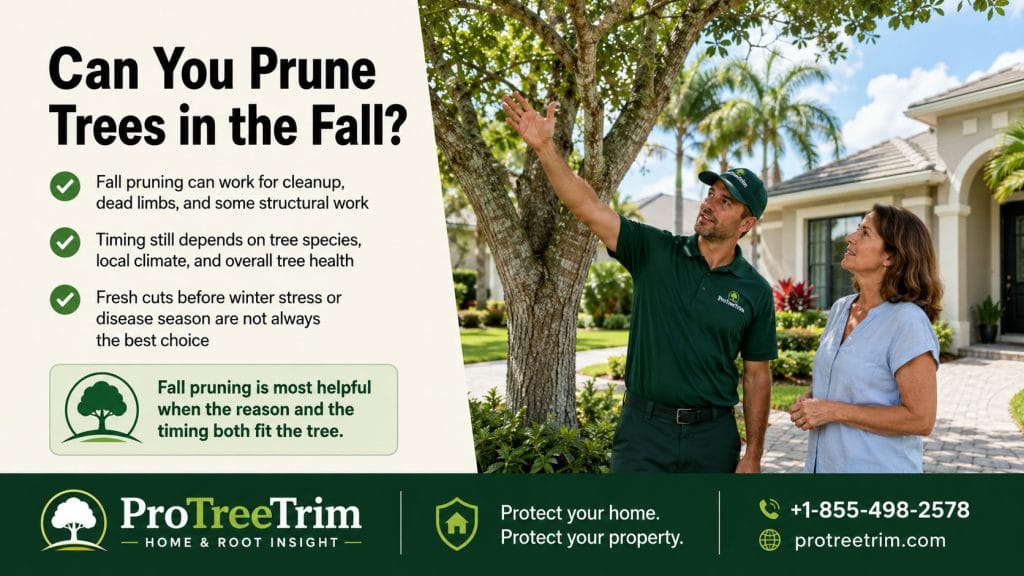
You can prune some trees in the fall, but fall is not automatically the best time for every tree. Light pruning, deadwood removal, storm cleanup, and clearance work may be appropriate when there is a clear reason. Heavy pruning, topping, or cutting a stressed tree just before colder weather or seasonal change can create problems.
The better question is not “Is fall pruning allowed?”
It is “What needs to be removed, and can the tree handle that cut right now?”
Fall Is a Transition Season
Fall is a season of change. Many trees are slowing growth, moving resources, dropping leaves, or preparing for dormancy. That makes timing important. Some pruning can be fine. Some cuts are better delayed until the tree is fully dormant or until a safer window.
Fall pruning decisions should consider:
| Factor | Why it matters |
|---|---|
| Tree species | Different trees respond differently |
| Tree health | Stressed trees may not handle heavy cuts well |
| Branch condition | Dead or broken branches may need removal |
| Weather pattern | Heat, drought, storms, or early freezes affect timing |
| Disease concerns | Some pruning wounds may be more vulnerable at certain times |
| Location | Roofs, driveways, walkways, and pool cages change urgency |
| Pruning size | Small cuts are different from large live-limb removal |
A few dead branches are not the same as a major canopy reduction.
Dead Branches Can Be Removed in Fall
Dead, broken, cracked, or hanging branches do not need to wait for a perfect season if they create a safety or property concern. A dead limb over open lawn may be monitored. A dead limb over a driveway, roof, patio, walkway, pool cage, or parked vehicle should be taken more seriously.
Fall deadwood removal may make sense when branches are:
- hanging after storms
- cracked or broken
- over driveways
- touching rooflines
- blocking walkways
- resting on fences
- over pool cages
- above outdoor seating areas
- near neighbor property
Deadwood removal is usually a risk-management decision, not a cosmetic pruning habit.
Avoid Heavy Fall Pruning Without a Clear Reason
Heavy pruning in fall can remove too much live canopy at the wrong time. It may create large wounds, trigger stress, or reduce the tree’s energy reserves as it heads into a slower season.
Be cautious with fall pruning when the goal is only to:
- make the tree smaller
- thin the canopy heavily
- cut back large healthy limbs
- reshape the tree dramatically
- top the tree
- remove branches because leaves are messy
- reduce future leaf cleanup
A tree should not be heavily cut just because fall yard cleanup is already happening.
Leaf Drop Can Make Inspection Easier
One advantage of fall is visibility. As leaves thin or drop, branch structure becomes easier to see. Homeowners may notice dead branches, crossing limbs, storm cracks, roof contact, or weak unions that were hidden in summer.
Fall can be a good time to identify:
- deadwood
- broken branches
- rubbing limbs
- weak branch unions
- trunk splits
- roofline conflicts
- branches over driveways
- branches touching fences
- storm damage
- poor structure in young trees
Inspection does not mean everything must be cut immediately. It means you can plan smarter pruning.
Trees Already Under Stress May Need to Wait
If a tree had a difficult summer, fall may not be the best time for aggressive pruning. Trees stressed by heat, drought, flooding, pests, root damage, construction, or over-pruning may need recovery time.
Wait or prune very lightly when the tree has:
| Stress sign | Why caution matters |
|---|---|
| Brown leaf edges | Heat or water stress may be present |
| Early leaf drop | Tree may already be reducing demand |
| Thin canopy | Less energy-producing leaf area remains |
| Recent root damage | Tree may be recovering below ground |
| Recent transplanting | Establishment is still in progress |
| Pest pressure | Tree may already be weakened |
| Poor drainage | Roots may be stressed |
| Large wounds from past pruning | More cuts may add stress |
If there is no urgent safety issue, waiting until dormancy or a better season may be wiser.
Fall Storm Cleanup Is Different From Routine Pruning
Fall storms, heavy rain, and wind can leave branches broken or hanging. That work should be handled based on safety, not seasonal pruning preference.
After a storm, the priority is to:
- keep people away from hanging limbs
- avoid branches near power lines
- photograph damage before cleanup
- remove broken or hazardous branches
- check for trunk splits
- look for root movement or new lean
- avoid over-pruning the remaining canopy
- decide later whether more corrective pruning is needed
Storm cleanup should stabilize the tree and property. It should not turn into unnecessary heavy pruning.
Young Trees May Benefit From Light Structural Work
Fall can be a useful time to evaluate young trees because their structure becomes easier to see. Light corrective pruning may help guide future form if the tree is healthy and the cuts are modest.
Young-tree pruning may address:
- crossing branches
- competing leaders
- broken branches
- low limbs that will become future clearance problems
- weak branch angles
- small rubbing branches
- early storm damage
The work should be light. Young trees should not be stripped or shaped aggressively.
Mature Trees Need Purposeful Pruning
Mature trees should be pruned less casually. Large cuts create large wounds. Removing too much live canopy can reduce energy reserves and change weight distribution.
Fall pruning on mature trees should focus on clear needs:
- dead limbs
- cracked branches
- storm damage
- roof contact
- driveway clearance
- walkway clearance
- branches rubbing structures
- hazardous hanging limbs
- weak or damaged limbs over targets
A mature tree should not be cut hard in fall just because it looks large.
Oaks Need Special Care
Oak pruning should be careful in any season. Fall may be acceptable for certain pruning goals in many situations, but large, unnecessary cuts should still be avoided. The tree’s condition, local disease concerns, weather, and pruning purpose all matter.
For oaks, fall pruning may be reasonable when there is:
- deadwood over a driveway
- storm damage
- roofline contact
- cracked branches
- broken hanging limbs
- rubbing branches
- clearance problems
- a specific structural concern
Avoid topping, excessive thinning, and large live-limb removal without a clear reason.
Palms Are Not Pruned Like Shade Trees
Palm pruning in fall should still follow palm rules. Remove fully dead fronds, broken fronds, hazardous hanging material, and seed pods when they create cleanup or safety issues. Do not strip healthy green fronds just because a seasonal cleanup visit is happening.
Fall palm pruning may make sense when:
- dead fronds hang over driveways
- seed pods drop on patios or pool decks
- fronds touch rooflines
- fronds rest on pool cages
- storm-damaged fronds are hanging
- palm debris affects walkways or entries
A palm should look maintained, not scalped.
Fruit and Flowering Trees May Have Different Timing
Some flowering and fruiting trees have pruning needs tied to bloom timing, fruiting cycles, and local disease concerns. Fall may not be the best time for every ornamental or fruit tree.
Before pruning a flowering tree in fall, ask:
- Does it bloom on old wood or new growth?
- Am I removing next season’s flower buds?
- Is the tree healthy?
- Is pruning needed for structure or only appearance?
- Are there dead or broken branches?
- Would dormant-season pruning be better?
For many homeowners, the safest fall pruning is limited to dead, damaged, or clearly problematic branches.
Do Not Prune Just Because Leaves Are Falling
Fall leaf drop often makes yard cleanup feel like tree-care time. But leaf mess is not usually a reason to prune. Cutting branches will not eliminate seasonal leaf cleanup in a meaningful way, and unnecessary pruning can create long-term problems.
Do not prune only because:
- leaves are falling on the driveway
- gutters need cleaning
- the patio is messy
- the tree looks bare
- branches look more visible without leaves
- you want less cleanup next year
Prune because branches are dead, broken, poorly attached, or interfering with property use.
Roof and Gutter Clearance May Be Worth Addressing
Fall is when many homeowners notice leaves in gutters and branches near rooflines. If limbs are touching shingles, rubbing gutters, or hanging over roof valleys with deadwood, selective pruning may be useful.
Roof-related fall pruning should focus on:
- branches physically touching the roof
- deadwood over the roof
- limbs rubbing gutters
- broken branches above the roofline
- branches creating access problems
- small clearance corrections
Avoid cutting the whole side of a tree flat. That can harm structure and appearance.
Driveway and Walkway Clearance Can Be Practical
Fall pruning may also be useful when branches block access. Lower limbs can interfere with vehicles, walkways, gates, sidewalks, outdoor lighting, or service paths.
Clearance pruning may be reasonable when branches:
- hit vehicles
- block a walkway
- interfere with driveway visibility
- touch a fence or gate
- obstruct service access
- hang over outdoor seating
- create repeated contact with people or property
Clearance work should be gradual and balanced.
Do Not Top Trees in Fall
Topping is not seasonal pruning. It is harmful pruning. Cutting off the top or major limbs of a tree creates large wounds, weak regrowth, and long-term structural problems.
Avoid requests like:
- “Cut it in half.”
- “Take the top off.”
- “Make it much smaller.”
- “Remove most of the canopy.”
- “Cut everything back hard before winter.”
- “Thin it way out.”
A tree that is too large for the space may need a long-term plan, not topping.
When Fall Pruning Should Wait
Waiting may be better when:
- the tree is healthy and the pruning is cosmetic
- the cuts would be large
- the tree is drought-stressed
- leaf drop is the only concern
- the tree was recently transplanted
- roots were recently disturbed
- pests or disease are active
- pruning would remove too much live canopy
- the tree is already thin or declining
If no safety or property issue exists, delayed pruning may be more tree-friendly.
When Fall Pruning Should Not Wait
Fall pruning should not wait when a branch creates a clear risk.
Handle it sooner when:
| Situation | Why action may be needed |
|---|---|
| Broken limb hanging | Could fall unpredictably |
| Dead limb over driveway | Vehicles and people are exposed |
| Branch touching roof | Can damage shingles or gutters |
| Cracked limb after storm | Failure concern may increase |
| Limb blocking walkway | Access and safety issue |
| Palm frond over pool cage | Screen damage possible |
| Branch near service lines | Requires proper help |
Urgent pruning should solve the urgent problem and stop there.
What Homeowners Should Ask Before Fall Pruning
Before approving fall pruning, ask:
- What branches are being removed?
- Are they dead, broken, rubbing, or hazardous?
- How much live canopy will be removed?
- Is the tree already stressed?
- Are cuts large or small?
- Can the work wait until dormancy?
- Is the goal safety, clearance, health, or appearance?
- Are branches near utility lines?
- Will the tree still have a natural structure afterward?
A good pruning plan should be specific and easy to explain.
Final Homeowner Takeaway
Fall pruning can be appropriate when the work is light, selective, and based on a clear need such as deadwood, storm damage, roof clearance, driveway clearance, or broken branches. It is less appropriate when the goal is heavy shaping, topping, or cutting a stressed tree for appearance.
Use fall as a good inspection season. Remove what is dead, broken, hazardous, or clearly conflicting with the home. Leave healthy structure alone when there is no urgent reason to cut.
If you are unsure whether fall pruning is right for your tree or whether the work should wait, ProTreeTrim can help connect homeowners with local tree service support. Call +1-855-498-2578 or visit protreetrim.com.
FAQs
Can trees be pruned in the fall?
Yes, especially for deadwood, storm damage, clearance, and safety issues. Heavy pruning should be considered carefully.
Is fall a bad time to trim trees?
Not always. It depends on the tree species, health, weather, pruning purpose, and how much live growth will be removed.
Can dead branches be removed in fall?
Yes. Dead, broken, cracked, or hanging branches can usually be removed when they create risk or access problems.
Should I prune trees in fall because leaves are dropping?
No. Leaf drop alone is not a good reason to prune. Prune only when there is a clear structural, safety, clearance, or health reason.
ProTreeTrim™ can help you take the next step.
If you are dealing with a damaged tree, fallen branch, stump, root issue, palm concern, or storm cleanup question in Florida, call ProTreeTrim for tree service support.