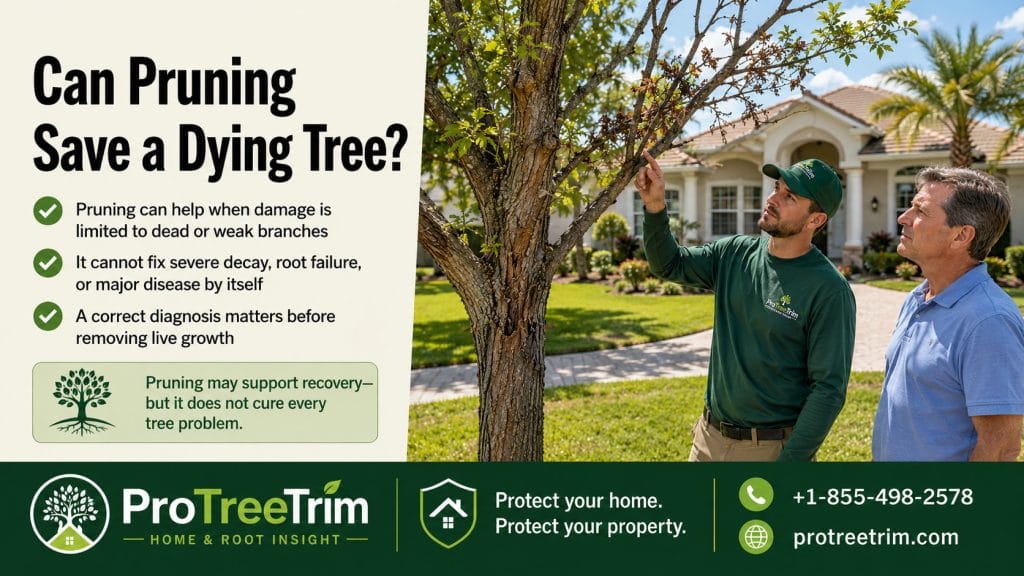
Pruning can help a struggling tree in some situations, but it cannot save every dying tree. Removing dead, broken, diseased, or hazardous branches may reduce stress and improve safety. Light structural pruning may help a young tree recover from damage. But pruning cannot fix severe root damage, trunk decay, major lean, advanced disease, poor planting depth, or a tree that is already mostly dead.
The real question is not “Can we cut it and save it?”
It is “What is causing the decline, and is there enough healthy tree left to recover?”
Pruning Helps Only When the Problem Is Prunable
Some tree problems are branch-level problems. Others are root, trunk, soil, water, or structural problems. Pruning can help with the first group. It may not help with the second.
| Problem | Can pruning help? |
|---|---|
| Dead branches | Yes, removal may help safety and appearance |
| Broken storm limbs | Yes, corrective pruning may help |
| Crossing or rubbing branches | Yes, especially on young trees |
| Minor branch dieback | Sometimes |
| Root damage | Pruning alone will not fix it |
| Trunk decay | Pruning may not solve the main risk |
| Severe lean | Pruning is usually not enough |
| Buried root flare | Site correction matters more |
| Whole canopy decline | Pruning may be limited or not useful |
A tree can look better after pruning and still be declining if the real problem is below ground or inside the trunk.
Deadwood Pruning Can Help, but It Is Not a Cure
Removing dead branches can make a tree safer and cleaner. It can also make it easier to see what healthy canopy remains. But deadwood pruning does not reverse the reason the branches died.
Deadwood pruning is useful when:
- dead limbs hang over driveways
- branches are broken after storms
- dead branches are over roofs or patios
- dead palm fronds hang over pool cages
- deadwood blocks walkways
- dead limbs make inspection harder
But if the tree keeps producing new dead branches every season, the tree needs more than deadwood cleanup. It needs a closer look at roots, trunk, soil, water, pests, disease, and structure.
Pruning Can Help After Storm Damage
After storm damage, pruning may help a tree recover if the trunk, roots, and main structure are still sound. Broken branches can be removed. Torn limbs can be cut properly. Hanging branches can be cleared. The remaining canopy can sometimes be preserved.
Storm pruning may help when:
- only some branches broke
- the trunk is not split deeply
- roots did not lift
- the tree is not newly leaning
- enough healthy canopy remains
- damage is limited to branches
- the tree was healthy before the storm
Storm pruning is less likely to save the tree when the trunk is split, roots are moving, the tree is leaning, or most of the canopy is gone.
Pruning Cannot Fix a Bad Root System
Many tree declines begin in the roots. A tree may show brown leaves, thinning canopy, dead branches, or slow growth because roots are damaged or stressed.
Root problems may come from:
- construction
- trenching
- driveway or paver work
- compacted soil
- poor drainage
- standing water
- drought
- buried root flare
- too much mulch
- root cutting
- planting too deep
Pruning may remove dead branches, but it does not rebuild damaged roots. If the root system is failing, the tree may continue to decline even after careful pruning.
Pruning Cannot Repair Serious Trunk Decay
A tree with trunk decay, cavities, mushrooms near the base, soft wood, deep cracks, or a vertical split may have a structural problem. Pruning some branches may reduce weight in limited cases, but it does not restore decayed wood.
Be cautious if the tree has:
| Trunk sign | Why pruning may not be enough |
|---|---|
| Large cavity | Structural strength may be reduced |
| Mushrooms near base | Decay may be present |
| Soft or wet wood | Internal damage may exist |
| Deep vertical split | Trunk stability may be compromised |
| Bark peeling with dead canopy | Serious decline possible |
| Oozing plus cracks | More than branch stress |
| Hollow sound | Internal strength may be questionable |
A tree can have green leaves and still be structurally unsafe.
Pruning a Mostly Dead Tree Usually Does Not Help
If most of the canopy is dead, pruning may leave very little living tree behind. A tree needs enough healthy foliage, buds, branches, trunk tissue, and roots to recover.
Pruning is less promising when:
- most branches are brittle
- no new growth appears
- the top is dead
- bark is falling off large areas
- the trunk is cracked or hollow
- roots are damaged or lifting
- the tree has a new lean
- only a few small live branches remain
At that point, removal may be more realistic than repeated pruning.
Do Not Over-Prune a Stressed Tree
A struggling tree does not need a hard cut unless there is a clear safety reason. Removing too much live canopy can reduce the tree’s ability to produce energy and recover.
Avoid heavy pruning when the tree has:
- drought stress
- transplant shock
- root damage
- recent construction stress
- widespread leaf browning
- early leaf drop
- pest pressure
- thin canopy
- poor drainage
- storm damage
A stressed tree may need dead or broken branches removed. It usually does not need aggressive thinning, topping, or major live-limb removal.
Topping Will Not Save a Dying Tree
Topping is often suggested when a tree looks too large, too weak, or too damaged. It is not a rescue method. Topping creates large wounds, weak regrowth, decay points, and poor structure.
Topping a struggling tree can make decline worse.
Avoid:
- cutting the top off
- cutting major limbs to stubs
- removing most of the canopy
- making the tree much shorter without a structural plan
- assuming fast sprouts mean recovery
- using topping as storm preparation
If a tree is too risky to keep at full height, topping is usually not the answer. A proper risk decision is needed.
Pruning May Help a Young Tree More Than an Old Declining Tree
Young trees often have more recovery potential because cuts are smaller and structure is still developing. If a young tree has broken branches, crossing limbs, or competing leaders, pruning can help guide it back into better form.
Pruning may help young trees when:
- damage is limited
- roots are still healthy
- the trunk is sound
- the tree is not planted too deep
- enough canopy remains
- cuts can be small
- aftercare is good
A mature tree with severe trunk decay, large dead limbs, or major root damage is a different situation.
Pruning Can Improve Airflow, but That Is Not a Cure-All
Sometimes pruning is recommended to improve airflow through a dense canopy. Light, selective pruning may help in certain cases. But heavy thinning can remove too much live growth and create stress.
Airflow pruning is not a cure for:
- root rot
- trunk decay
- severe pest infestation
- major deadwood
- drought stress
- poor planting location
- tree planted too close to a house
- advanced canopy decline
If the tree is dying, the cause must be understood before thinning is recommended.
Pruning Diseased Branches May Help in Limited Cases
If disease is limited to certain small branches, pruning may help remove affected material. This is more realistic when the problem is localized and the tree is otherwise healthy.
Pruning diseased branches may help when:
- symptoms are on a few branches
- cuts can be made below affected areas
- the tree has a strong remaining canopy
- the trunk and roots look stable
- the disease is not already widespread
- pruning can be done cleanly
It is less useful when the entire canopy is declining or the disease is systemic, root-based, or trunk-based.
Pruning Cannot Fix Poor Placement
Sometimes a tree is not dying because it needs pruning. It is struggling because it was planted in the wrong place.
Pruning will not fully fix a tree that is:
- too close to the house
- crowded by a pool cage
- growing into utility lines
- squeezed between driveway and sidewalk
- planted in a narrow strip
- rooted in compacted soil
- too close to septic components
- repeatedly cut back because it outgrew the space
A poorly placed tree may need a long-term decision, not endless pruning.
Palms: Pruning Helps Only in Specific Ways
Palm pruning can remove dead fronds, broken fronds, seed pods, or fronds touching structures. But pruning cannot fix a palm with a soft crown, severe trunk decay, major root problems, or serious leaning.
Palm pruning may help when:
- dead fronds hang over a walkway
- broken fronds are storm-damaged
- seed pods drop over a pool deck
- fronds touch a roof or screen enclosure
- cleanup improves inspection
Pruning will not save a palm if the center spear is failing, the crown is soft, the trunk is compromised, or the palm is unstable.
Pines and Evergreens Need Extra Caution
Pines, arborvitae, spruce, fir, and other evergreens may not regrow from old bare wood. Cutting too deeply can leave permanent gaps. If an evergreen is already browning, pruning may not restore it.
Pruning may help evergreens when:
- only dead branches need removal
- broken limbs are present
- branches touch structures
- limited correction is needed
- the tree still has healthy green growth
Pruning is less likely to help when the whole tree is brown, the top is dead, or branches are bare and brittle.
When Pruning Can Make Things Worse
Pruning can make a declining tree worse when it removes too much live canopy, creates large wounds, exposes bark, or cuts branches the tree still needs.
Pruning may harm the tree if:
| Situation | Why it is risky |
|---|---|
| Tree is drought-stressed | Fewer leaves means less energy |
| Roots are damaged | Canopy loss adds stress |
| Large healthy limbs are removed | Big wounds and imbalance |
| Tree is topped | Weak regrowth and decay risk |
| Evergreen is cut into bare wood | Bare spots may not refill |
| Palm green fronds are removed | Palm loses energy-producing fronds |
| Tree has trunk decay | Branch cuts do not fix structure |
The wrong pruning can turn a weak tree into a weaker one.
When Removal May Be More Honest
Sometimes the best answer is not pruning. If the tree is structurally unsafe, mostly dead, severely decayed, or in the wrong location, removal may be safer and more practical.
Removal may need discussion when:
- the tree is mostly dead
- large limbs are dead over targets
- the trunk is split or hollow
- mushrooms grow near the base
- the tree has a new lean
- roots are lifting or broken
- the top is dead
- the tree repeatedly drops large limbs
- the tree is too close to structures and declining
Pruning should not be used to delay a necessary removal decision when risk is high.
What Homeowners Should Check Before Asking for Pruning
Before deciding pruning can save the tree, check the whole tree.
Look at:
- how much canopy is still alive
- whether dead branches are scattered or widespread
- whether the trunk has cracks or decay
- whether the root flare is visible
- whether mushrooms are near the base
- whether the tree leans more than before
- whether roots were recently damaged
- whether soil is too wet or too dry
- whether pests or holes are visible
- what the tree could hit if it fails
A tree is more than its branches.
What a Good “Save the Tree” Scope Sounds Like
A good scope:
- “Remove deadwood over the driveway.”
- “Clean broken storm limbs without over-thinning.”
- “Preserve healthy live canopy.”
- “Check trunk and root flare before pruning.”
- “Correct small structural defects on the young tree.”
- “Avoid topping or large unnecessary cuts.”
- “Monitor recovery after pruning.”
A poor scope:
- “Cut it way back and see what happens.”
- “Top it so it survives.”
- “Remove most branches because it looks sick.”
- “Thin it heavily to let air in.”
- “Cut the dead top and leave the rest without checking structure.”
- “Strip the palm to help it recover.”
Good tree-saving work starts with diagnosis, not cutting.
Final Homeowner Takeaway
Pruning can help some struggling trees, especially when the problem involves dead, broken, damaged, rubbing, or poorly structured branches. It can improve safety, remove deadwood, and help a young tree develop better form.
But pruning cannot save every dying tree. It cannot repair severe root damage, trunk decay, major lean, deep splits, advanced decline, or poor placement. Heavy pruning can even make a stressed tree worse.
If you are unsure whether pruning can help your tree—or whether removal, root-zone correction, storm cleanup, or closer inspection is the better path—ProTreeTrim can help connect homeowners with local tree service support. Call +1-855-498-2578 or visit protreetrim.com.
FAQs
Can pruning bring a dying tree back to life?
Only sometimes. Pruning may help if the problem is limited to dead, damaged, or poorly structured branches. It will not fix severe root, trunk, or decay problems.
Should I cut dead branches off a dying tree?
Dead branches over driveways, roofs, walkways, patios, or pool cages may need removal, but widespread deadwood may mean the tree needs deeper evaluation.
Can heavy pruning save a sick tree?
Usually no. Heavy pruning can remove energy-producing canopy and make a stressed tree weaker.
How do I know if a tree should be removed instead of pruned?
Removal may be more realistic if the tree is mostly dead, leaning, split, decayed, hollow, root-damaged, or dropping large limbs near important property areas.
ProTreeTrim™ can help you take the next step.
If you are dealing with a damaged tree, fallen branch, stump, root issue, palm concern, or storm cleanup question in Florida, call ProTreeTrim for tree service support.