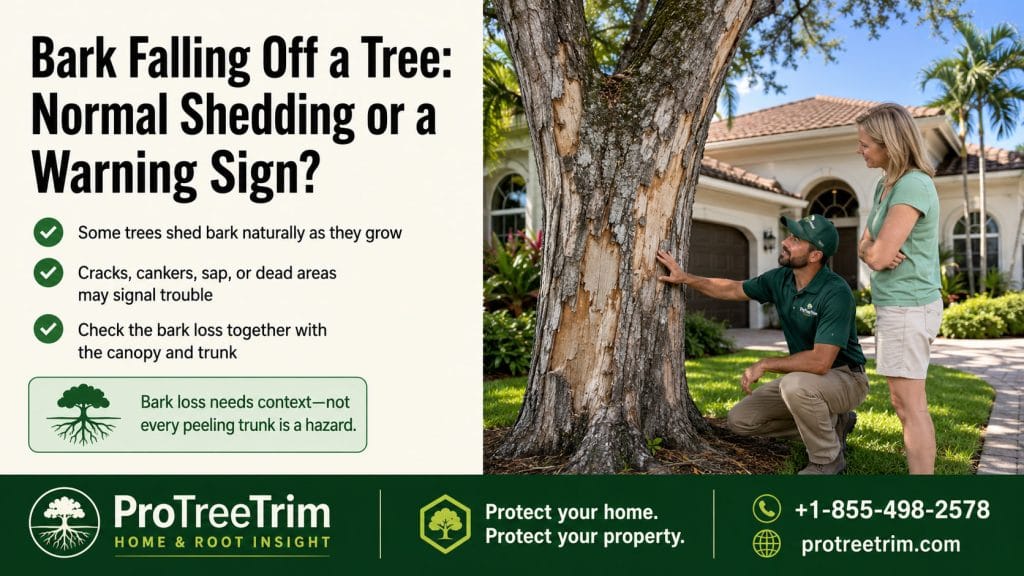
Bark falling off a tree can be normal, serious, or somewhere in between. Some trees naturally shed bark as they grow. Others lose bark because of drought stress, sunscald, insects, disease, mechanical injury, storm damage, trunk decay, or a dying section of wood.
The key question is not simply “Is bark falling off bad?”
It is “What does the wood underneath look like, and how does the rest of the tree look?”
Some Trees Naturally Shed Bark
Not all bark loss is a warning sign. Certain trees naturally shed, peel, flake, or exfoliate bark as part of normal growth. This can create a patchy, peeling, or mottled appearance.
Normal bark shedding is more likely when:
- the canopy looks healthy
- leaves are normal size and color
- bark loss is even or species-typical
- the exposed layer underneath looks firm
- there is no dark oozing
- there are no soft or hollow areas
- branches are not dying back
- the tree has a known peeling-bark habit
Trees such as sycamore, crape myrtle, river birch, some eucalyptus, and certain maples can show natural bark exfoliation. But even on these trees, bark loss paired with decline deserves attention.
Bark Falling Off in Large Sheets Is More Concerning
Large pieces of bark falling off suddenly can be more serious than light flaking. Bark protects living tissue underneath. When bark separates from the trunk or major limbs, it may mean the tissue beneath is dead, damaged, or under stress.
Be more cautious when bark falls off:
| Bark loss pattern | Why it matters |
|---|---|
| Large sheets from one side | Possible dead trunk tissue or sunscald |
| Bark falling near base | Root flare or trunk decay concern |
| Bark peeling around holes | Insect or borer activity possible |
| Bark loose near cracks | Structural concern may exist |
| Bark falling from dead limbs | Branch may already be dead |
| Bark loss with dark staining | Disease, decay, or oozing concern |
| Bark loss with mushrooms | Decay may be involved |
The size, location, and pattern matter.
Look at the Wood Under the Bark
The exposed wood tells part of the story. Firm, dry, normal-looking wood is less concerning than soft, wet, dark, crumbly, or insect-filled wood.
Check whether the exposed area is:
- firm or soft
- dry or wet
- light-colored or dark-stained
- smooth or cracked
- solid or hollow
- covered in insect galleries
- oozing sap or liquid
- surrounded by dead bark
- spreading over time
Do not peel more bark off to investigate aggressively. That can enlarge the wound.
Bark Loss Plus Canopy Decline Is a Warning
A tree can lose some bark and remain healthy. But bark falling off becomes more concerning when the canopy is also declining.
Watch for:
- thinning canopy
- smaller leaves
- early leaf drop
- dead branch tips
- large dead limbs
- dead top
- one-sided dieback
- reduced spring leaf-out
- branch drop
- sprouts near the base
If bark loss and canopy decline appear together, the tree may have a broader health or structural issue.
Bark Falling Off Near the Base
Bark loss near the base of the tree deserves extra attention because the lower trunk and root flare are critical to stability and tree health.
Check for:
- mushrooms near the base
- soft or wet wood
- trunk cracks
- cavities
- buried root flare
- mulch piled against bark
- girdling roots
- ants or insects entering soft areas
- soil staying wet
- new lean
A small bark scrape near the base may be minor. Bark falling off around decay, mushrooms, or soft wood is more serious.
Mulch Piled Against the Trunk Can Cause Problems
Mulch is helpful when used correctly, but mulch piled against the trunk can hold moisture against bark, hide decay, encourage pests, and bury the root flare.
Bad mulch signs include:
- mulch touching the trunk
- mulch piled like a volcano
- root flare hidden
- wet bark at the base
- mushrooms near the trunk
- soft bark under mulch
- insects using the moist area
Good mulch should be wide and shallow, with the trunk base and root flare visible.
Sunscald Can Cause Bark Damage
Sunscald happens when bark is injured by sudden temperature changes or intense sun exposure. It is often seen on younger trees, thin-barked trees, recently planted trees, or trees suddenly exposed after heavy pruning or nearby tree removal.
Sunscald may appear as:
- bark splitting on one side
- dead bark patches
- sunken areas
- peeling bark
- vertical cracks
- exposed wood
- one-sided trunk injury
Heavy pruning that suddenly exposes shaded bark can increase sun stress.
Mechanical Injury Can Make Bark Fall Off
Many bark problems begin with physical damage. Mowers, string trimmers, vehicles, construction equipment, stakes, ties, animals, and yard tools can wound bark.
Common causes include:
- mower impact at the base
- string-trimmer cuts
- vehicle scrape near driveway
- fence or stake rubbing
- construction equipment damage
- roots damaged during digging
- bark torn by storm debris
- animals chewing or rubbing
Bark wounds near the base can be more harmful than small wounds on outer branches.
Insects May Be a Symptom, Not the Original Cause
When bark falls off, homeowners often notice ants, beetles, termites, borers, or other insects. Sometimes insects attack healthy tissue. Other times, they move into wood that was already dead or stressed.
Check for:
- tiny holes
- sawdust-like material
- galleries under loose bark
- sap or resin flow
- dead branches above the area
- bark peeling around holes
- soft or decaying wood
- canopy thinning
Killing visible insects does not restore dead bark or decayed wood. The underlying tree condition still matters.
Borers Can Be Serious on Stressed Trees
Boring insects can enter trunks or branches and leave holes, frass, sawdust, bark cracking, or dieback. They often target trees already stressed by drought, root damage, storm wounds, poor planting, or disease.
Borer concern increases when bark loss appears with:
- fresh holes
- sawdust or frass
- sap or resin
- branch dieback
- thinning canopy
- bark galleries
- dead top
- rapid decline
A few old holes may not be urgent. Fresh holes with bark loss and decline deserve attention.
Bark Falling Off Dead Branches
If bark is falling off a branch, that branch may already be dead. Dead branches often lose bark as they dry and decay.
Dead branches matter most when they are over:
- roofs
- driveways
- patios
- pool cages
- walkways
- fences
- parked vehicles
- outdoor seating areas
- neighbor property
Dead bark on a small branch over open lawn may be low priority. Dead bark on a large limb over a driveway or roof is different.
Bark Loss After Storm Damage
Storms can tear bark, break limbs, twist branches, and crack trunks. Bark loss after a storm should be checked carefully because the wound may be larger than it first appears.
After storm damage, look for:
- hanging branches
- torn bark strips
- trunk cracks
- split branch unions
- broken limbs
- exposed wood
- canopy imbalance
- new lean
- roots lifting or soil movement
Do not just cut loose bark and move on. The structure of the tree may also need review.
Bark Loss on Oaks
Oaks can develop bark problems from wounds, decay, borers, drought stress, construction damage, and natural aging. Mature oaks near homes deserve caution when bark loss appears with deadwood or trunk defects.
With oaks, check for:
- large dead limbs
- canopy thinning
- mushrooms near base
- trunk cracks
- bark falling near old wounds
- cavities
- root damage
- branches over roof or driveway
A mature oak can be valuable, but large defects near targets should not be ignored.
Bark Loss on Pines
Pines can show bark loss with stress, beetles, borers, pitch flow, lightning injury, storm damage, or decline. Pine problems can sometimes move quickly.
Be more cautious when pine bark loss appears with:
- browning top
- pitch tubes or resin masses
- sawdust-like material
- many small holes
- bark plates falling off
- rapid needle color change
- dead branches
- trunk staining
- nearby declining pines
A pine with bark loss and crown decline deserves prompt attention.
Bark Loss on Palms
Palms are different from branching shade trees. Some old frond bases may fall away naturally, but trunk wounds, soft areas, holes, fungal growth, or leaning can be more concerning.
For palms, check:
- soft trunk tissue
- crown decline
- leaning
- fungal growth near base
- holes or oozing
- loose trunk sections
- trunk damage from tools
- fronds declining abnormally
Do not shave or “clean” palm trunks aggressively to improve appearance. That can create wounds.
Bark Loss With Mushrooms or Conks
Mushrooms or shelf-like fungal growth near bark loss can indicate decay. This is especially important when growth appears on the trunk, root flare, or major roots.
Be cautious when you see:
| Sign | Why it matters |
|---|---|
| Mushroom at trunk base | Root or lower trunk decay possible |
| Shelf fungus on trunk | Internal decay concern |
| Bark loss around fungus | Dead tissue may be expanding |
| Soft wood near fungus | Strength may be reduced |
| Lean plus fungus | Stability concern |
| Canopy thinning plus fungus | Tree health may be declining |
A fungus in mulch is different from fungus attached to the tree.
Bark Loss With Oozing or Dark Staining
Oozing, dark liquid, or foul-smelling wet areas can indicate stress, decay, disease, injury, or bacterial activity depending on the tree and location.
More concerning signs include:
- dark staining down the trunk
- wet bark near a crack
- foul odor
- soft wood
- insects gathering
- bark falling around the stain
- dead branches above the area
- repeated oozing from the same spot
Do not seal or paint the area. The cause needs to be understood.
Should You Peel Off Loose Bark?
Do not pull bark off aggressively. If bark is fully dead and already detached, it may fall naturally. But peeling semi-attached bark can damage living tissue and enlarge the wound.
Avoid:
- ripping loose bark
- cutting into live bark
- pressure washing bark wounds
- scraping the trunk hard
- sealing the exposed wood
- filling cavities
- covering the area with mulch or soil
If the wound is large or near the base, get it evaluated before trying to “clean it up.”
Should You Seal the Exposed Area?
Usually no. Tree wounds are generally not helped by paint, tar, glue, caulk, cement, foam, or random sealers. These can trap moisture and hide decay.
A better response is to:
- keep the area visible
- avoid further damage
- correct mulch problems
- reduce mower injury
- monitor the canopy
- photograph changes
- get help if decay or structural signs appear
The tree’s response depends on wound size, location, health, and cause.
When Bark Loss Is Less Urgent
Bark loss may be less urgent when:
- it is normal for the species
- the canopy is healthy
- exposed wood is firm
- no sap, oozing, or odor is present
- no mushrooms are attached
- no large dead limbs are present
- the tree is not leaning
- bark shedding is even and not expanding rapidly
Even then, take photos and monitor changes.
When Bark Loss Is Serious
Act sooner when bark falling off appears with:
- canopy thinning
- large dead limbs
- trunk cracks
- soft or hollow wood
- mushrooms or conks
- sawdust or holes
- heavy sap or dark oozing
- new lean
- bark loss near the base
- branch dieback above the wound
- recent root cutting or construction
The more symptoms present, the more important professional evaluation becomes.
What Homeowners Should Photograph
Take photos of:
- bark loss close up
- full trunk
- full tree canopy
- base of the tree and root flare
- any mushrooms or holes
- sap or staining
- dead limbs
- trunk cracks
- nearby roof, driveway, or walkway
- changes over time
Photos help show whether the problem is stable or spreading.
What to Do First
A practical first response:
- Identify whether the tree species naturally sheds bark.
- Check the canopy for decline.
- Look at the exposed wood.
- Check for holes, sawdust, sap, or staining.
- Inspect the base for mushrooms, soft wood, or buried root flare.
- Pull mulch away from the trunk if needed.
- Do not peel more bark aggressively.
- Do not seal or paint the wound.
- Get help if bark loss appears with structural or health warning signs.
The goal is to understand the cause before deciding what to do.
Final Homeowner Takeaway
Bark falling off a tree can be normal on some species, especially when the canopy is healthy and the shedding pattern is typical. But bark loss can also signal stress, insects, sunscald, storm damage, decay, root problems, disease, or a dying section of the tree.
Bark loss near the base, with mushrooms, soft wood, trunk cracks, sawdust, oozing, dead limbs, canopy thinning, or lean should be taken seriously. Do not seal the wound or peel bark aggressively. Look at the whole tree.
If you are unsure whether bark falling off your tree is normal shedding or a warning sign, ProTreeTrim can help connect homeowners with local tree service support. Call +1-855-498-2578 or visit protreetrim.com.
FAQs
Is bark falling off a tree always bad?
No. Some trees naturally shed bark. It becomes more concerning when paired with canopy decline, soft wood, holes, sap, mushrooms, or trunk cracks.
Can a tree survive after losing bark?
Sometimes, depending on how much bark is lost, where the damage is, and whether living tissue remains healthy.
Should I seal a tree where bark fell off?
Usually no. Sealers can trap moisture and hide decay. It is better to identify the cause and keep the area visible.
What does bark falling off near the base mean?
It may indicate mechanical damage, decay, moisture problems, buried root flare, insects, or trunk stress. Bark loss near the base deserves closer attention.
ProTreeTrim™ can help you take the next step.
If you are dealing with a damaged tree, fallen branch, stump, root issue, palm concern, or storm cleanup question in Florida, call ProTreeTrim for tree service support.