
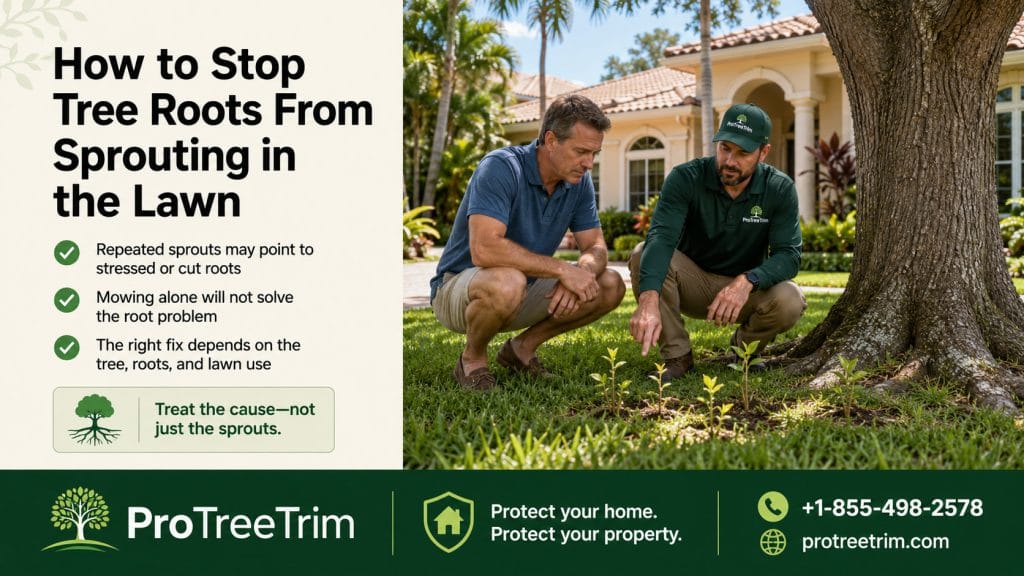
Tree roots sprouting in the lawn can be frustrating. Small shoots may appear around an old stump, along surface roots, near a recently removed tree, or even several feet away from the trunk. You cut them down, mow over them, and they come right back.
These sprouts are often called root suckers, stump sprouts, or basal shoots, depending on where they grow. The right solution depends on one important question: is the original tree still alive, recently removed, or already gone?
First, Identify Where the Sprouts Are Coming From
Before trying to stop the sprouts, look at the pattern.
| Where sprouts appear | What it may suggest |
|---|---|
| Around the base of a living tree | Tree stress, species habit, or trunk/root response |
| From an old stump | Stump is still producing shoots |
| Along visible surface roots | Living roots may be sending up suckers |
| In a line across the lawn | Root system may still be active underground |
| Near a recently removed tree | Roots or stump may still have stored energy |
| Far from the original trunk | Some species sucker aggressively from roots |
Mowing the sprouts without understanding the source usually turns into a repeated chore.
Root Sprouts Are Not Random Weeds
Root sprouts may look like weeds, but they are often connected to the tree’s root system. That means pulling or mowing the visible shoot may not stop the underground source.
Sprouts may appear because:
- the tree species naturally suckers
- the tree was recently cut down
- the stump was not ground out
- roots still contain stored energy
- the living tree is stressed
- roots were cut or disturbed
- the tree is reacting to damage
- sunlight reached exposed roots after pruning or removal
The shoot is only the visible part. The real issue may be below ground.
Mowing Alone Usually Does Not Stop Them
Mowing root sprouts may keep the lawn looking cleaner temporarily, but it rarely solves the problem. In some cases, repeated mowing can make sprouts come back denser because the root system keeps trying to push new growth.
Mowing may be acceptable for short-term control when:
- sprouts are small
- the tree has already been removed
- you are waiting for root energy to fade
- the area is not a trip hazard
- you are not damaging exposed roots of a living tree
But if sprouts keep returning quickly, mowing is only maintenance, not a solution.
If the Tree Is Still Alive, Be Careful
If sprouts are coming from the roots or base of a living tree, do not attack them aggressively without understanding why they are appearing. Root suckers can sometimes be a sign of stress.
A living tree may produce sprouts after:
- root damage
- trunk injury
- drought stress
- poor drainage
- heavy pruning
- construction nearby
- mower or string-trimmer wounds
- soil compaction
- old storm damage
If the parent tree is valuable and healthy, the goal is usually to remove the sprouts carefully while protecting the tree.
Remove Sprouts Cleanly, Not Roughly
For a living tree, sprouts near the base or along roots should usually be removed cleanly when small. Tearing them off can damage bark or root tissue.
Better habits:
- cut sprouts close to the source
- use clean, sharp tools
- avoid gouging the root or trunk
- do not cut large roots
- do not damage the root flare
- keep mowers and trimmers away from the trunk
- monitor whether sprouts return heavily
If sprouts are coming from exposed roots, avoid cutting the root itself.
Check the Root Flare
The root flare is where the trunk widens into the main roots. It should be visible. If the tree is buried under mulch, soil, or a raised bed, stress can build at the base and root system.
Sprouts near the trunk may appear with root flare problems.
Check for:
| Root flare issue | Why it matters |
|---|---|
| Trunk goes straight into soil | Tree may be planted too deep |
| Mulch piled against bark | Moisture and decay concerns can hide |
| Soil added over roots | Root oxygen may be reduced |
| Raised bed around trunk | Trunk base may stay too wet |
| Surface roots cut by mowing | Tree may respond with stress growth |
| Bark wounds at base | Sprouts may be stress response |
Do not bury the problem to hide the sprouts.
If the Tree Was Recently Removed, Sprouts May Keep Appearing
After a tree is cut down, roots may still contain stored energy. Some species can keep sending up shoots from the stump or roots for a while.
This is common when:
- the stump was left in place
- stump grinding was shallow
- large roots remain active
- the tree species suckers easily
- the tree was cut during an active growth period
- sprouts are repeatedly cut but the stump remains alive
In this situation, sprouts may continue until the remaining living tissue is exhausted or properly addressed.
Stump Grinding Can Reduce Sprouting
If sprouts are coming from an old stump, stump grinding may help by removing the main stump tissue below grade. This reduces the visible source of regrowth and makes the area easier to restore.
Stump grinding may help when:
- shoots grow directly from the stump
- the stump is in the lawn
- mowing around it is difficult
- the stump is attracting insects or fungi
- the area needs replanting or sod
- the stump is a curb appeal problem
- roots are not the only remaining issue
Grinding the stump does not instantly remove every underground root, but it can reduce the main regrowth point.
Sprouts From Remaining Roots May Still Happen
Even after stump grinding, some roots may remain underground. In many cases, those roots decay over time. But some trees can still produce shoots from remaining roots if enough living tissue remains.
This is more likely when:
- the tree species is prone to suckering
- large roots remain near the surface
- sprouts were already appearing before removal
- the stump was not fully ground
- roots are still connected to living tissue
- nearby related trees share root activity
If sprouts continue after grinding, the area may need repeated monitoring and control.
Do Not Cut Large Roots to Stop Sprouts
A sprout from a root does not mean the root should be cut. If the parent tree is still alive, cutting large roots can harm tree health and stability. If the tree has been removed, large root removal may still disturb the lawn, irrigation, pavers, or nearby hardscape.
Avoid cutting roots when:
- the parent tree is alive
- roots are large
- roots are close to the trunk
- the tree leans
- the tree is near a house or driveway
- roots run under sidewalks, patios, or pavers
- you do not know what utilities are nearby
Root cutting can create more problems than the sprouts themselves.
Be Cautious With Herbicides
Some homeowners try to spray sprouts to stop them. This can be risky, especially when sprouts are connected to a living tree you want to keep. A product applied to suckers may move into connected root tissue and harm the parent tree.
Use extra caution when:
- the parent tree is still alive
- sprouts are near desirable shrubs or grass
- roots may connect to nearby trees
- the label is unclear
- the area is near water, pets, or children
- you are treating sprouts around a stump near other plants
Never apply chemicals casually around trees. If the tree is alive and valuable, get proper guidance before using any product.
Pulling Sprouts May Not Work
Pulling small sprouts may remove the top growth, but if they are connected to a root, they may break off and return. Pulling can also disturb soil and expose roots.
Pulling may be less useful when:
- sprouts are woody
- sprouts grow in clusters
- sprouts return after mowing
- sprouts are connected to a large root
- sprouts come from an old stump
- the lawn has many small shoots in a line
Cutting cleanly and addressing the source is usually better.
Improve Lawn Maintenance Around the Root Zone
Sometimes root sprouts keep appearing in stressed lawn areas where roots are exposed, mower damage is frequent, or soil is compacted. Improving the root zone may reduce stress-related sprouting from living trees.
Helpful steps include:
- expand the mulch bed around the tree
- stop mowing over exposed roots
- keep mulch away from the trunk
- avoid deep soil over roots
- reduce foot traffic under the canopy
- avoid string-trimmer damage
- correct drainage problems
- keep the root flare visible
A stressed tree base often creates recurring maintenance problems.
Root Sprouts After Pruning
Heavy pruning can sometimes trigger sprouts from the trunk, base, or roots. This is a stress response. If too much canopy was removed, the tree may try to replace lost leaf area.
Sprouting is more likely after:
- topping
- heavy crown reduction
- over-thinning
- major storm damage
- large limb removal
- root damage plus pruning
- repeated harsh cuts
If sprouts appeared after pruning, the tree may need recovery time and better future pruning, not more aggressive cutting.
Root Sprouts After Construction
Construction can damage roots and trigger stress growth. Sprouts may appear after:
- trenching
- fence installation
- driveway work
- paver installation
- irrigation repair
- grading
- stump grinding nearby
- heavy equipment traffic
- soil compaction
If root sprouts appear after construction, also watch for canopy symptoms such as leaf browning, early leaf drop, or branch dieback.
When Sprouts Are a Sign the Tree Is Declining
Sprouts are not always harmless. A tree that produces many suckers while the upper canopy declines may be under serious stress. The tree may be trying to survive from the base or roots while the main canopy weakens.
Be more concerned if sprouts appear with:
| Warning sign | Why it matters |
|---|---|
| Top dieback | Tree may be declining from above |
| Large dead limbs | Safety concern may increase |
| Thinning canopy | Root or trunk stress may be present |
| Mushrooms near base | Decay or moisture concern |
| Trunk cracks | Structural issue may exist |
| Bark peeling | Severe stress or decline possible |
| New lean | Stability concern |
| Recent root cutting | Root system may be compromised |
In that case, removing sprouts is not enough. The parent tree needs evaluation.
When Sprouts Are Mostly a Lawn Nuisance
If the original tree was removed, the stump was ground, and the sprouts are small, the issue may mostly be persistence. Some root systems take time to exhaust stored energy.
You may need:
- repeated cutting of sprouts
- deeper stump grinding if the stump remains
- careful spot treatment only where appropriate
- lawn repair after roots decay
- patience while underground wood breaks down
- monitoring for soil settling
The area may not return to normal immediately after tree removal.
What About Sprouts From Neighbor Trees?
Sometimes shoots appear near a fence or property line from roots belonging to a nearby tree. This can complicate the decision because the parent tree may not be yours.
Before cutting or treating sprouts near a boundary:
- identify the likely parent tree
- avoid damaging a neighbor’s tree roots
- check local property rules
- avoid applying chemicals that could affect a shared tree
- document the issue with photos
- discuss the problem before major action
Root systems do not always respect property lines.
How to Reduce Sprouts Long Term
Long-term control depends on the source.
| Source | Better response |
|---|---|
| Living tree base | Cut sprouts cleanly and reduce tree stress |
| Exposed roots | Protect roots with shallow mulch, avoid mower damage |
| Old stump | Consider stump grinding |
| Recently removed tree | Monitor and remove sprouts repeatedly |
| Root suckering species | Expect persistence and plan maintenance |
| Construction stress | Protect root zone and monitor canopy |
| Declining tree | Evaluate whether pruning, care, or removal is needed |
There is no one-size solution because sprouts have different causes.
What Homeowners Should Photograph
Photos help track whether sprouts are spreading or connected to a larger issue.
Take photos of:
- sprouts close up
- full tree if still standing
- old stump location
- exposed roots
- trunk base and root flare
- lawn pattern where sprouts appear
- nearby driveway, sidewalk, or patio
- canopy condition
- dead limbs or trunk cracks
- recent construction or repair areas
Photos are useful before stump grinding, lawn repair, or tree evaluation.
What to Do First
A practical first response:
- Identify whether the parent tree is alive or removed.
- Look at where the sprouts appear.
- Do not cut large roots.
- Cut small sprouts cleanly and monitor regrowth.
- Check for stump tissue if the tree was removed.
- Consider stump grinding if sprouts come from the stump.
- Avoid herbicides around living trees unless properly guided.
- Improve mulch and root-zone conditions.
- Get help if sprouts appear with canopy decline or tree-risk signs.
The right fix starts with the source.
Final Homeowner Takeaway
Tree roots sprouting in the lawn can come from living roots, old stumps, stressed trees, or recently removed trees. Mowing the sprouts may keep them short, but it usually does not stop the underground source.
Do not cut large roots to stop sprouts. Do not spray chemicals around a living tree without understanding the risk. If sprouts come from an old stump, stump grinding may help. If they come from a living tree, reduce stress, protect the root zone, and remove sprouts carefully.
If you are unsure whether lawn sprouts are from a living tree, old stump, root damage, or a declining tree, ProTreeTrim can help connect homeowners with local tree service support. Call +1-855-498-2578 or visit protreetrim.com.
FAQs
Why are tree roots sprouting in my lawn?
They may be root suckers from a living tree, sprouts from an old stump, or regrowth from roots after tree removal.
Will mowing stop tree root sprouts?
Usually no. Mowing may keep them short, but the root or stump may keep producing new shoots.
Can stump grinding stop root sprouts?
It can reduce sprouting from the stump, but some roots may still produce shoots depending on species and remaining living tissue.
Should I spray root sprouts with herbicide?
Be careful. If sprouts are connected to a living tree you want to keep, chemicals may harm the parent tree or nearby plants.
ProTreeTrim™ can help you take the next step.
If you are dealing with a damaged tree, fallen branch, stump, root issue, palm concern, or storm cleanup question in Florida, call ProTreeTrim for tree service support.